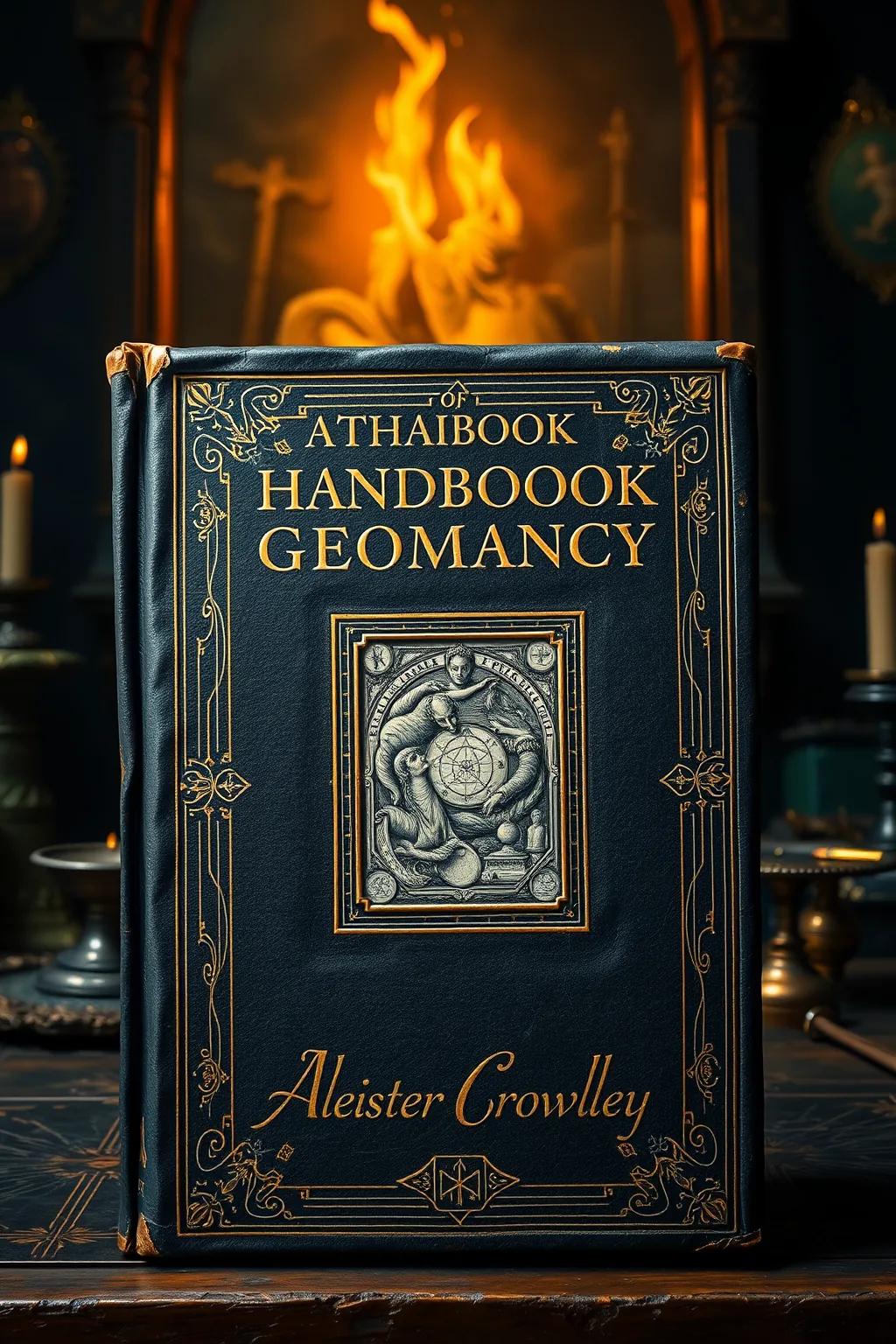
Handbook of Geomancy
 82
82

Handbook of Geomancy
Aleister Crowley's "Handbook of Geomancy" emerges not as a gentle introduction but as a direct engagement with a potent divinatory system. Its strength lies in its systematic presentation, mirroring the structured nature of geomancy itself. The text forces the reader to confront the mechanics of figure generation and interpretation without undue embellishment. A notable limitation is the potential for the work to feel dense for those unfamiliar with Crowley's broader esoteric context or the intricacies of foundational magical theory. The specific method for deriving the "Pugnus" figure, for instance, requires careful attention and repeated study. Despite its demanding nature, the book offers a valuable, unvarnished look at a historically significant divinatory art.
📝 Description
82
Aleister Crowley's Handbook of Geomancy, published in 1989, details the ancient art of divination.
This book provides a thorough explanation of geomancy, an old method of fortune-telling. It outlines how to cast the sixteen geomantic figures, which are derived from random processes like throwing pebbles. The text serves as both a guide to understanding the theory behind geomancy and a practical manual for performing readings. It details the systematic approach to generating these figures and interpreting their meanings.
The handbook is suited for those seriously interested in esoteric practices and divination. It is particularly for students of Western esotericism who want a structured system for seeking answers about past, present, or future events. The book requires dedication, aiming for the committed student rather than the casual observer of magical arts.
Geomancy originated in the Arab world around the 8th century and later spread into Europe. It was adopted by both popular diviners and learned practitioners of magic. Its logical structure, built upon sixteen binary figures, allowed for widespread use and adaptation across various traditions. The 1989 publication date situates this work within a late 20th-century revival of occult studies, where historical magical systems were often reexamined and applied to contemporary concerns.
💡 Why Read This Book?
• Learn the precise method for generating the 16 geomantic figures, a core practice dating back to medieval Arab scholars, offering a tangible skill for divination. • Understand the astrological and symbolic correspondences assigned to each figure, providing a framework for interpreting outcomes beyond simple chance. • Gain insight into Aleister Crowley's approach to a specific divinatory art, contextualizing his broader work within historical occult traditions.
⭐ Reader Reviews
Honest opinions from readers who have explored this book.
❓ Frequently Asked Questions
When was Aleister Crowley's "Handbook of Geomancy" first published?
The "Handbook of Geomancy" by Aleister Crowley was first published in 1989, long after his death, bringing his specific interpretations of this ancient art to a wider audience.
What is geomancy and how does it work according to this book?
Geomancy is a divinatory art involving the casting of 16 figures derived from random points or lines. The "Handbook of Geomancy" explains how to generate these figures and interpret their meanings to answer questions.
Is this book suitable for beginners in divination?
While it explains the system, the "Handbook of Geomancy" is dense. Beginners might find other introductions more accessible, but dedicated students of occultism will appreciate its rigor.
Does the book discuss the historical origins of geomancy?
The book's focus is on the practical application and Crowley's interpretation. While it acknowledges geomancy's ancient roots, detailed historical origins are typically found in specialized historical texts.
What are the '16 figures' in geomancy?
The 16 figures are specific patterns generated through the geomantic process, each with unique names (e.g., Fortuna, Populus, Via) and symbolic meanings tied to astrological influences.
Can I use this book for practical geomantic readings?
Yes, the "Handbook of Geomancy" is designed as a practical manual. It provides the necessary instructions and interpretive keys for performing geomantic divinations.
🔮 Key Themes & Symbolism
The Sixteen Figures
The foundational element of geomancy as presented in this handbook revolves around the generation and interpretation of the sixteen distinct geomantic figures. These figures, such as Via, Populus, Fortuna, and Acquisitio, are not arbitrary but are systematically derived through a process of random casting. Each figure carries specific astrological dignities and symbolic meanings, representing archetypal forces and potential outcomes relevant to the question posed. Understanding these figures is paramount to mastering the art.
Divinatory Process
The "Handbook of Geomancy" details the practical application of the art for divinatory purposes. This involves formulating clear questions, performing the casting ritual (whether with pebbles, dice, or other implements), generating the four mothers, deriving the 12 daughters, and finally constructing the witnesses and the judge. The book guides the reader through each step, emphasizing the systematic nature required for accurate readings and insights.
Astrological Correspondences
A critical aspect of geomancy is its deep integration with astrological principles. Each of the 16 figures is assigned specific planetary and zodiacal associations. These correspondences are not merely decorative but inform the interpretation of the figures, influencing their perceived strength, weakness, and overall meaning within a reading. The handbook likely elucidates these connections, linking the terrestrial patterns to celestial influences.
Crowley's Interpretive Lens
As attributed to Aleister Crowley, the "Handbook of Geomancy" offers a specific perspective on this ancient practice. While adhering to the core mechanics of geomancy, Crowley's approach may infuse it with his unique magical philosophy and terminology. The interpretation of the figures and their application might reflect his broader views on destiny, will, and the nature of divine communication.
💬 Memorable Quotes
Direct passages from the work, attributed to the author.
“The figures are generated by a simple process of casting points.”
— This highlights the mechanical and accessible nature of geomancy's core operation, suggesting that its power lies not in complex ritual but in a repeatable, observable procedure.
“Each figure possesses its own unique character and meaning.”
— This emphasizes the distinct symbolic language of geomancy, where individual patterns represent specific influences or outcomes that must be understood in isolation before combination.
“Geomancy provides answers regarding the past, present, and future.”
— This points to the comprehensive scope of geomantic divination, framing it as a tool for understanding the full spectrum of temporal concerns and seeking guidance across all phases of life.
“The interpretation depends on the houses and their relationships.”
— This signifies that the meaning derived from a geomantic reading is not solely based on individual figures but on their spatial arrangement and interconnections within the 'houses' or positions of the chart.
“A thorough understanding of the 16 figures is essential for proficiency.”
— This underscores the prerequisite knowledge required for effective practice, indicating that mastery comes from deep familiarity with the core symbolic components of the system.
🌙 Esoteric Significance
Tradition
This work fits within the Western Hermetic and magical tradition, which often seeks to systematize and rationalize occult practices. Geomancy, with its structured approach and astrological underpinnings, aligns with the Hermetic goal of understanding the macrocosm through the microcosm. Crowley's contribution likely frames geomancy within his broader Thelemic system, potentially reinterpreting its figures and applications through that lens.
Symbolism
The primary symbolism lies in the 16 geomantic figures themselves, such as 'Populus' (the People) or 'Fortuna Major' (Greater Fortune). These figures are understood as manifestations of astrological forces and archetypal energies. For example, 'Via' (the Way) might symbolize journeys or clear paths, while 'Laetitia' (Joy) signifies happiness and good outcomes, all interpreted through their inherent nature and planetary associations.
Modern Relevance
Contemporary practitioners of Western esotericism, particularly those interested in divination and magical systems, continue to draw upon geomancy. Modern occultists and students of Crowley's work may use this handbook to perform readings, study the art's mechanics, or integrate its principles into their personal magical practices. Its systematic nature also appeals to those seeking structured, analytical approaches to divination.
👥 Who Should Read This Book
• Students of Aleister Crowley's occult philosophy seeking to understand his specific contributions to divinatory arts. • Practitioners of Western esotericism interested in mastering a systematic, historically significant form of divination beyond Tarot or I Ching. • Researchers of magical traditions looking for detailed textual analysis of geomancy and its application within a specific occult framework.
📜 Historical Context
Geomancy, a form of divination originating in the Arab world by the 8th century, achieved significant penetration into European intellectual and occult circles during the Middle Ages and Renaissance. Its systematic, easily reproducible method, relying on the generation of 16 figures from random points, made it a popular tool. This work, published in 1989, falls within a period of renewed interest in Western esotericism, where figures like Aleister Crowley, despite his death in 1947, continued to exert considerable influence. The late 20th century saw a proliferation of occult texts, often reinterpreting or compiling earlier traditions. While Crowley himself engaged with various divinatory systems, the first full publication of his "Handbook of Geomancy" in 1989 allowed a contemporary audience to engage with his specific framework for this ancient art, distinct from the more widespread Tarot or astrological systems.
📔 Journal Prompts
The process of generating the 16 geomantic figures: what initial challenges arise?
Interpreting the 'witnesses' in a geomantic reading: how do they qualify the 'judge'?
Compare the astrological associations of 'Populus' with those of 'Fortuna Minor'.
Reflect on the symbolic meaning of the figure 'Acquisitio' in relation to personal goals.
How does the systematic nature of geomancy differ from intuitive divination methods?
🗂️ Glossary
Geomancy
An ancient method of divination involving the casting of figures derived from random points or lines, interpreted through astrological and symbolic correspondences.
The 16 Figures
The core symbolic patterns (e.g., Via, Populus, Fortuna) generated in geomancy, each possessing unique meanings and astrological associations.
Mothers
The first four figures generated in a geomantic reading, forming the basis for the subsequent derivations.
Daughters
The twelve figures derived from the Mothers, representing specific aspects or influences within the reading.
Witnesses
Two figures derived from the Daughters, which serve to qualify or modify the meaning of the Judge.
Judge
The final figure in a geomantic reading, formed by combining the Witnesses, which provides the primary answer or conclusion.
Pugnus
A specific geomantic figure, often associated with aggression or forceful action.
🔮 Readers Also Liked
Browse all →









More by Aleister Crowley
All books →

More Free Occult Philosophy Books
View all →