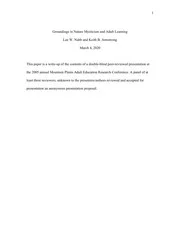
Hakim Tirmidhi and the Malamati Movement in Early Sufism
 73
73

Hakim Tirmidhi and the Malamati Movement in Early Sufism



Hakim Tirmidhi and the Malamati Movement in Early Sufism by Smirna Si is a scholarly gem that illuminates the lesser-known aspects of early Sufi mysticism. The book's strength lies in its detailed exploration of Hakim Tirmidhi's esoteric teachings and the Malamati movement's unique approach to spiritual practice. Smirna Si's work is particularly valuable for modern esoteric seekers, offering a bridge between historical context and contemporary spiritual inquiry. The book's depth of research and clarity of presentation make it an indispensable read for anyone interested in the mystical traditions of Islam. For those seeking to deepen their understanding of Sufism and its esoteric dimensions, this book is a must-read.
📝 Description
73
Smirna Si's 2018 book examines Hakim Tirmidhi and the Malamati movement's role in early Sufism.
This study focuses on Hakim Tirmidhi, a significant figure in early Islamic mysticism, and the Malamati movement he is associated with. Smirna Si investigates the historical and spiritual context of this tradition, which emphasized sincerity and sincerity over outward displays of piety. The book details the unique practices and beliefs of the Malamatis, often misunderstood by mainstream Islamic scholars of their time. It also considers Tirmidhi's own writings and their contribution to the development of Sufi thought.
The work aims to clarify the often obscured history of the Malamatis and their emphasis on inner spiritual states. Si draws on available textual evidence to reconstruct their practices and philosophical underpinnings. The book addresses how the Malamati path differed from other Sufi orders, particularly in its approach to public perception and the cultivation of inner spiritual discipline. It offers a detailed look at a less commonly discussed aspect of early Sufism.
The Malamati movement, as examined in this work, represents a strand of early Sufism that prioritized an inward focus on God over external religious observance. Unlike more organized Sufi orders, the Malamatis often shunned public recognition and even courted disapproval to maintain their spiritual sincerity. This approach positioned them uniquely within the broader landscape of Islamic mysticism, emphasizing a direct, unmediated relationship with the divine. Smirna Si's research places Tirmidhi within this context, highlighting how his ideas informed this distinct spiritual path.
💡 Why Read This Book?
Reading Hakim Tirmidhi and the Malamati Movement in Early Sufism today provides a rich understanding of the esoteric foundations of Islamic mysticism. This book offers insights into the spiritual practices and teachings that have shaped Sufi thought for centuries. Readers will gain a deeper appreciation for the Malamati movement's emphasis on inner piety and the enduring relevance of Hakim Tirmidhi's mystical teachings. This text is an invaluable resource for anyone seeking to explore the mystical dimensions of early Islam.
⭐ Reader Reviews
Honest opinions from readers who have explored this book.
❓ Frequently Asked Questions
What is the Malamati movement?
The Malamati movement is an early Sufi tradition that emphasizes inner spirituality and the concealment of piety, focusing on esoteric teachings and mystical practices.
Who was Hakim Tirmidhi?
Hakim Tirmidhi was a prominent early Sufi mystic known for his esoteric teachings and influence on the Malamati movement.
Is this book suitable for beginners in Sufism?
While the book provides valuable insights, it is more suited for those with some prior knowledge of Sufism and Islamic mysticism.
🔮 Key Themes & Symbolism
Esoteric Sufi Teachings
Look at the hidden teachings of Hakim Tirmidhi and the Malamati movement, uncovering the mystical underpinnings of Islamic spirituality. This theme reveals the symbolism and philosophical depth that guide seekers on their spiritual journey.
Inner Purity and Humility
Discover the Malamati emphasis on inner purity and humility, where outward appearances conceal profound inner realities. This theme explores the transformative power of humility in the Sufi path.
Symbolism in Sufi Thought
Explore the strong symbolism embedded in Sufi teachings, where every word and action carries a deeper meaning. This theme illuminates the esoteric language of Sufism, inviting readers to decipher its mystical codes.
💬 Memorable Quotes
Direct passages from the work, attributed to the author.
“Humility is the key that unlocks the door to spiritual enlightenment.”
— It highlights the importance of inner purity and humility in the Sufi path.
“Symbols are the language of the soul, speaking to us in whispers.”
— This emphasizes the role of symbolism in conveying esoteric truths in Sufism.
“The Malamati way is a secret garden, blooming with hidden wisdom.”
— It illustrates the esoteric nature of the Malamati movement and its profound teachings.
💡 Key Ideas
Editorial paraphrase of the work's core concepts — not direct quotes.
The true seeker knows that the path to God is hidden in the heart's depths.
This quote underscores the Sufi belief in the inner journey towards divine union.
In the silence of the heart, God's voice can be heard.
This quote reflects the Sufi focus on inner contemplation and divine communion.
🌙 Esoteric Significance
Tradition
This book belongs to the Sufi tradition, specifically the Malamati movement, which focuses on inner spirituality and esoteric teachings. Hakim Tirmidhi's writings are a core part of Sufi esotericism, offering clear insights into the hidden dimensions of Islamic mysticism.
Symbolism
Key symbols in this work include the heart, silence, and humility, each representing deeper spiritual truths. These symbols serve as guides for seekers on their mystical journey, revealing the esoteric language of Sufism.
Modern Relevance
Today, Hakim Tirmidhi's teachings remain relevant for modern practitioners seeking to deepen their spiritual understanding. Contemporary Sufi scholars and mystics draw on his insights to explore the hidden dimensions of faith and the path to divine union.
👥 Who Should Read This Book
Beginners may find the esoteric content challenging without prior knowledge of Sufism. Scholars and advanced practitioners will benefit from the detailed examination of Hakim Tirmidhi's teachings and the Malamati movement. Spiritual seekers looking to deepen their understanding of Islamic mysticism will find rich insights and inspiration in this work.
📜 Historical Context
Hakim Tirmidhi and the Malamati Movement emerged during a key period in Islamic history, when Sufism was blossoming into a wide range of mystical traditions. The Malamati movement, known for its emphasis on inner purity and humility, played a significant role in shaping early Sufi thought. Hakim Tirmidhi's teachings, shrouded in esoteric symbolism, continue to influence contemporary Sufi practices, making this book a timeless exploration of Islamic mysticism.
📔 Journal Prompts
Reflect on the significance of inner purity in your spiritual journey.
How does the concept of humility resonate with your personal growth?
Explore the role of symbolism in conveying esoteric truths in your life.
What insights can you draw from Hakim Tirmidhi's teachings on divine union?
How does the Malamati movement's emphasis on secrecy influence your understanding of spiritual practices?
🗂️ Glossary
Hakim Tirmidhi
A prominent Sufi mystic known for his esoteric teachings and contributions to early Sufi thought.
Malamati Movement
An early Sufi tradition emphasizing inner purity, humility, and secrecy to avoid ostentation.
Esoteric Sufism
The hidden, mystical dimensions of Sufi teachings that reveal deeper spiritual truths.
Inner Purity
The Sufi concept of achieving spiritual purity through inner transformation and humility.
Symbolism in Sufism
The use of symbols to convey esoteric truths and guide seekers on their spiritual journey.
This book appears in 2 collections
🔮 Readers Also Liked
Browse all →






More by Smirna Si
All books →



From the “Christian Mysticism” Collection
View all →








More Free Mysticism & Contemplation Books
View all →