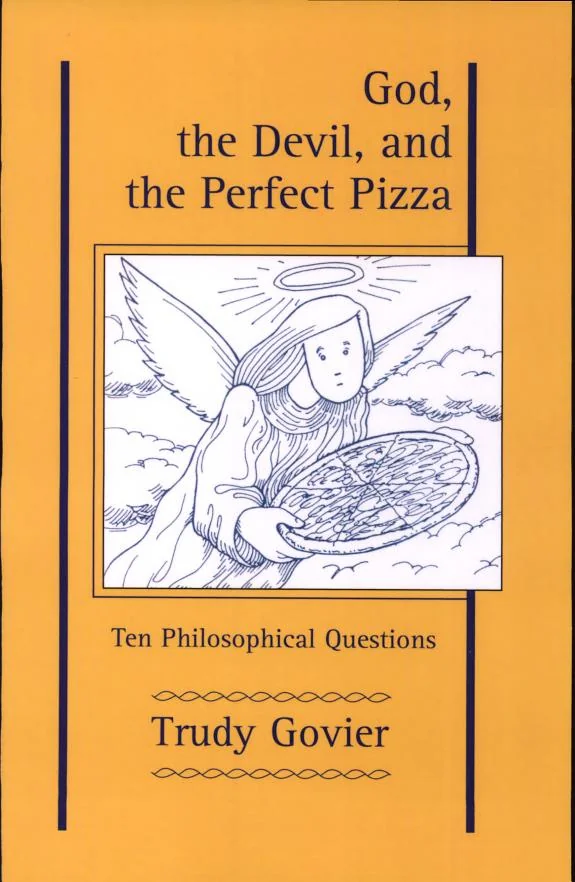
God, the Devil and the Perfect Pizza
 84
84

God, the Devil and the Perfect Pizza
Trudy Govier’s "God, the Devil and the Perfect Pizza" presents a refreshing approach to perennial philosophical questions. Rather than relying on dense academic prose, Govier employs narrative and dialogue to illuminate complex ideas. Her exploration of whether computers can truly 'cheat' offers a particularly sharp illustration of the distinction between rule-following and genuine agency, a point often muddled in contemporary discussions of AI. The book's primary limitation, however, lies in its brevity; some dialogues feel like starting points rather than fully developed arguments, leaving the reader wanting more. The discussion on the solidity of tables versus their subatomic composition, for instance, is fascinating but brief. Despite this, the collection serves as an accessible gateway to profound philosophical considerations.
📝 Description
84
Trudy Govier's 1995 collection examines logic, faith, and everyday phenomena through stories and dialogues.
Trudy Govier's "God, the Devil and the Perfect Pizza" presents philosophical questions through narrative and conversation. The book confronts common assumptions about existence, consciousness, and ethics, bridging the material and the metaphysical. It asks readers to consider the basis of their beliefs and what they claim to know.
This work appeals to those interested in applied philosophy and the nature of reality. It suits readers who enjoy intellectual puzzles, challenging scientific explanations, and questioning established ideas. Those curious about the philosophical roots of conscience, artificial intelligence, and subjective experience will find much to ponder.
Published in 1995, this collection emerged during a period where discussions around artificial intelligence and the philosophy of mind were growing, paralleling ongoing arguments in the philosophy of religion. The mid-1990s saw notable progress in computing and a rising interest in consciousness studies. Govier's writings engage with these developments, situating them within a long philosophical tradition that has debated proof, existence, and subjective experience for centuries. The book connects contemporary scientific and technological discourse with perennial philosophical concerns about belief and knowledge.
💡 Why Read This Book?
• Gain a fresh perspective on the logical basis for belief, informed by the specific philosophical dialogues presented in the book, which challenge conventional proofs for God's existence. • Understand the philosophical implications of artificial intelligence by examining Govier's 1995-era discussions on rule-following and consciousness. • Explore the nature of conscience through Govier's specific inquiries into its origins—divine, social, or rational—as presented in the text.
⭐ Reader Reviews
Honest opinions from readers who have explored this book.
❓ Frequently Asked Questions
What philosophical questions does Trudy Govier address in 'God, the Devil and the Perfect Pizza'?
Govier addresses questions about the logical proof for God's existence, the nature of consciousness and artificial intelligence, the philosophical implications of quantum physics on perceived reality, and the origins of conscience.
When was 'God, the Devil and the Perfect Pizza' first published?
The book was first published on May 31, 1995, placing its philosophical inquiries within the intellectual landscape of the mid-1990s.
Are the concepts in the book related to modern AI development?
Yes, the book's discussions on whether computers can follow rules or cheat are highly relevant to modern AI development, touching on themes of agency and intelligence.
What is the format of the book?
The book is structured as a collection of stories and dialogues, designed to explore philosophical concepts in an accessible and engaging manner.
Does the book offer definitive answers to philosophical dilemmas?
No, the book primarily serves to raise questions and stimulate thought rather than providing definitive answers, encouraging readers to engage with the presented dilemmas themselves.
Who is the author of 'God, the Devil and the Perfect Pizza'?
The author is Trudy Govier, a philosopher whose work often engages with ethical and existential themes.
🔮 Key Themes & Symbolism
Logic and Faith
The collection interrogates the boundaries between rational proof and faith. Govier examines whether logical systems can adequately support or refute abstract concepts like the existence of God. This theme challenges readers to consider the foundational assumptions of belief and the limitations of empirical evidence when confronting metaphysical questions, particularly relevant in the context of mid-1990s philosophical discourse.
Consciousness and Artificiality
Central to the work is the exploration of consciousness, particularly in relation to artificial intelligence. Govier probes the criteria for genuine intelligence and agency, questioning if machines can truly 'understand' or 'cheat' in a manner analogous to human behavior. This looks at the nature of subjective experience and the philosophical distinctions between programmed responses and authentic awareness.
Perception vs. Reality
The book highlights the discrepancies between our everyday sensory experience and scientific models of reality. Govier uses examples, such as the solidity of tables versus the probabilistic nature of subatomic particles, to illustrate epistemological challenges. This theme questions the reliability of perception and the philosophical implications of scientific discoveries on our understanding of the world.
Ethics and Self-Interest
Govier considers the rationality and consequences of pursuing self-interest. Through dialogues, the work explores whether individualistic drives can coexist with collective survival, touching upon fundamental ethical dilemmas. This theme prompts reflection on the societal implications of personal choices and the philosophical underpinnings of moral behavior.
💬 Memorable Quotes
Direct passages from the work, attributed to the author.
“Can God’s existence be proven by logic?”
— This question frames the core tension between faith and reason, inviting an examination of the limits of logical argumentation when applied to metaphysical claims.
“Are computers smart enough to follow rules—or to cheat?”
— This probes the nature of intelligence and agency, distinguishing between programmed behavior and genuine understanding, a key consideration in philosophy of mind and AI ethics.
“What is an out-of-body experience?”
— This highlights the book's engagement with subjective phenomena that challenge conventional materialist explanations, pointing towards the complexities of consciousness.
“How can tables be solid when physicists say they’re made of subatomic particles that are only probability functions?”
— This illustrates the conflict between common sense perception and scientific models, raising epistemological questions about how we know what we know.
“What is conscience? Does it come from God? From religious teaching? Social training?”
— This inquiry looks at the origins and authority of morality, exploring whether conscience is an innate faculty, a learned behavior, or a divine spark.
🌙 Esoteric Significance
Tradition
While not strictly aligned with a single esoteric lineage, Govier's work touches upon themes common in Gnostic and Hermetic traditions, particularly concerning the nature of reality and the limitations of materialist understanding. It shares a spirit of questioning established doctrines and exploring the subjective experience of consciousness, echoing the Gnostic emphasis on inner knowledge and the Hermetic pursuit of understanding the cosmos through analogy.
Symbolism
The 'Perfect Pizza' itself serves as a mundane yet potent symbol for the unattainable ideal or the subjective nature of perfection. The 'Devil' represents the principle of negation, doubt, or the adversary to logical proof and divine order. The juxtaposition of these elements highlights the book's engagement with everyday concepts to explore profound metaphysical and ethical quandaries.
Modern Relevance
Govier's 1995 inquiries into artificial intelligence and the nature of consciousness remain highly relevant. Contemporary discussions on machine learning, sentient AI, and the simulation hypothesis echo the questions she posed about rule-following, agency, and the very definition of intelligence. Thinkers exploring transhumanism and the philosophy of computation often revisit these foundational ethical and epistemological debates.
👥 Who Should Read This Book
• Students of philosophy of religion seeking accessible introductions to arguments for and against the existence of God. • Individuals interested in the philosophy of mind and artificial intelligence who want to explore early explorations of AI consciousness and agency. • Skeptics and seekers questioning the nature of reality and the reliability of perception, looking for a dialogue-driven approach to complex epistemological issues.
📜 Historical Context
Published in 1995, "God, the Devil and the Perfect Pizza" emerged during a significant period of philosophical ferment. The mid-1990s saw robust debates in the philosophy of mind, fueled by advancements in artificial intelligence and cognitive science. Thinkers like Daniel Dennett were actively exploring consciousness and computation, presenting a contrasting mechanistic view to some of the more subjective explorations Govier engages with. The book's questions about logical proof for God’s existence also situated it within ongoing discussions in the philosophy of religion, where analytic philosophy of religion was prominent. While not a direct engagement, Govier's work indirectly responded to a climate where empirical verification and logical positivism, though waning, still cast a long shadow, prompting a re-examination of faith and subjective experience.
📔 Journal Prompts
The logical proof for God's existence: what are its philosophical limits?
Computer rule-following versus genuine cheating: implications for AI.
The solidity of tables: reconciling sensory experience with quantum physics.
Conscience's origins: divine decree versus social conditioning.
Rational self-interest: its role in societal survival.
🗂️ Glossary
Probability Functions
In quantum mechanics, these mathematical descriptions represent the likelihood of finding a particle in a particular state or location, challenging classical notions of deterministic physical objects.
Conscience
An inner feeling or voice that acts as a guide to the rightness or wrongness of one's behavior, often debated in terms of its origin (divine, social, evolutionary).
Logic
The systematic study of valid reasoning and inference, used in philosophy to construct arguments and analyze the structure of thought.
Subatomic Particles
Particles smaller than an atom, such as electrons, protons, and neutrons, which exhibit quantum mechanical properties.
Esoteric
Intended for or likely to be understood by only a small number of people with a specialized knowledge or interest.
Metaphysical
Concerning the fundamental nature of reality, existence, and the world, often beyond the scope of empirical science.
Epistemological
Relating to the theory of knowledge, especially with regard to its methods, validity, and scope, and the distinction between justified belief and opinion.
This book appears in 1 collection
🔮 Readers Also Liked
Browse all →









From the “Out-of-Body Experience” Collection
View all →







More Free Occult Philosophy Books
View all →