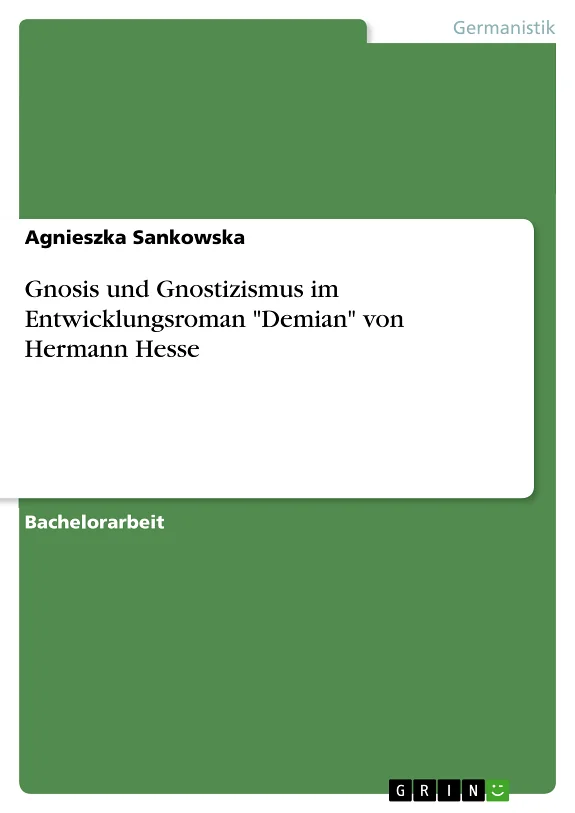
Gnosis und Gnostizismus im Entwicklungsroman "Demian" von Hermann Hesse
 74
74

Gnosis und Gnostizismus im Entwicklungsroman "Demian" von Hermann Hesse
Agnieszka Sankowska's examination of Gnostic elements in Hermann Hesse's "Demian" offers a focused and academically rigorous approach. The strength of this work lies in its precise demarcation of Gnosis and Gnosticism, a crucial step often overlooked in broader literary analyses. By grounding her arguments in the specific context of the novel, Sankowska highlights how Hesse's narrative can be read as an allegory for the Gnostic quest for inner liberation. However, the book's academic origin as a Bachelor's thesis means it might be less accessible to the general reader seeking a more narrative exploration. A notable passage involves the interpretation of the character Abraxas, which Sankowska links directly to Gnostic cosmogony. The study serves as a valuable, albeit specialized, contribution to Hesse scholarship.
📝 Description
74
Agnieszka Sankowska's 2022 study analyzes Gnostic motifs in Hermann Hesse's 1919 novel, 'Demian.'
Published in 2022, Agnieszka Sankowska's book, "Gnosis und Gnostizismus im Entwicklungsroman 'Demian' von Hermann Hesse," examines the presence of Gnostic ideas within Hermann Hesse's 1919 novel, 'Demian.' The study began as a 2021 Bachelor's thesis at Uniwersitet Gdański. Its first chapter establishes definitions for Gnosis and Gnosticism, distinguishing them from common misunderstandings.
Sankowska's analysis focuses on specific Gnostic elements within 'Demian.' These include dualistic worldviews, the idea of hidden knowledge (gnosis) as a means of salvation, and the figure of a guide who leads the seeker. The author contrasts these Gnostic interpretations with purely psychological readings of the novel, asserting that a distinct Gnostic layer is present.
The book situates Hesse's 'Demian' within Germany's post-World War I intellectual environment. This was a time of questioning traditional values and seeking new spiritual paths. Gnosticism, with its focus on inner knowledge and escaping a flawed material existence, offered a relevant framework for understanding this period.
This work places itself within the study of Gnosticism's enduring influence on Western thought and literature. Gnosticism, a diverse set of religious and philosophical ideas that flourished in the first centuries CE, emphasizes spiritual knowledge (gnosis) as the key to liberation from a material world seen as flawed or illusory. Sankowska's research investigates how these ancient concepts resonate within a modern literary context, specifically Hesse's 'Demian,' suggesting a continued spiritual or philosophical undercurrent in 20th-century European culture.
💡 Why Read This Book?
• Understand the specific distinction between Gnosis and Gnosticism as applied to literature, a concept central to the initial chapter and crucial for nuanced analysis. • Gain insight into the Gnostic archetypes present in Hermann Hesse's "Demian," particularly how the dualistic worldview and the search for inner knowledge are portrayed. • Appreciate the historical context of "Demian" (published 1919) within post-WWI German intellectual currents, showing how Gnostic ideas offered an alternative spiritual framework.
⭐ Reader Reviews
Honest opinions from readers who have explored this book.
❓ Frequently Asked Questions
What is the primary goal of Agnieszka Sankowska's "Gnosis und Gnostizismus im Entwicklungsroman 'Demian' von Hermann Hesse"?
The primary goal is to identify and explain the Gnostic motifs present in Hermann Hesse's novel "Demian." The work also aims to clearly define and differentiate between the terms Gnosis and Gnosticism, which are frequently conflated.
When was Hermann Hesse's novel "Demian" originally published?
Hermann Hesse's novel "Demian" was first published in 1919, a period of significant intellectual and social upheaval in Germany following World War I.
What academic institution is associated with this study on "Demian"?
This study originated as a Bachelor's thesis from Uniwersitet Gdański, where it received a top academic grade of 1.0.
What is the significance of the term 'Abraxas' in the context of Gnosticism and Hesse's "Demian"?
Abraxas is a significant figure in Gnosticism, often interpreted as a supreme deity or a mystical name. Sankowska's work likely explores its symbolic relevance within "Demian" as a representation of a higher, perhaps paradoxical, spiritual reality.
Does this book focus on the psychological aspects of "Demian" or its philosophical underpinnings?
While acknowledging psychological interpretations, the book's focus is specifically on the philosophical and spiritual underpinnings, particularly the presence and influence of Gnostic thought within the novel.
What is the date of the first publication of Agnieszka Sankowska's work?
Agnieszka Sankowska's work, "Gnosis und Gnostizismus im Entwicklungsroman 'Demian' von Hermann Hesse," was first published on January 26, 2022.
🔮 Key Themes & Symbolism
Gnosis vs. Gnosticism
Sankowska's work begins by meticulously distinguishing between 'Gnosis,' the direct, intuitive, and often esoteric knowledge sought in Gnostic traditions, and 'Gnosticism,' the broader religious and philosophical system that encompasses this pursuit. This foundational clarity is essential for understanding how specific Gnostic concepts manifest within "Demian," moving beyond superficial similarities to identify genuine thematic resonance. The study argues that Hesse's narrative reflects the Gnostic emphasis on achieving salvation through this inner knowledge, distinct from conventional dogma.
The Gnostic Quest for Liberation
A central theme is the Gnostic concept of liberation from a flawed material existence or a restrictive spiritual order. In "Demian," this translates to Emil Sinclair's journey of self-discovery, breaking free from societal expectations and the 'world of light' represented by his conventional upbringing. Sankowska examines how Sinclair's path mirrors the Gnostic seeker's struggle against the Demiurge or the constraints of ignorance, seeking true spiritual awakening through forbidden or hidden truths.
Dualism and the Shadow Self
The study investigates the Gnostic dualistic worldview – the inherent opposition between spirit and matter, good and evil, light and darkness. "Demian" famously explores this through the dichotomy between Emil Sinclair's perceived 'good' world and the darker, more authentic realm associated with Max Demian and the symbol of Abraxas. Sankowska connects this to the Gnostic idea that true spiritual understanding often involves embracing the perceived 'negative' or the shadow, recognizing it as integral to the totality of existence.
The Revealer Figure
The role of a spiritual guide or revealer is crucial in Gnosticism, someone who imparts the saving knowledge. Max Demian himself serves as this figure for Emil Sinclair. Sankowska analyzes Demian's function not merely as a friend but as an initiator, presenting esoteric insights that challenge Sinclair's worldview, much like a Gnostic teacher (Gnostikos) guiding a disciple toward gnosis.
💬 Memorable Quotes
Direct passages from the work, attributed to the author.
“The careful distinction between Gnosis and Gnosticism.”
— This highlights the academic rigor of Sankowska's approach, emphasizing her foundational work in defining terms before applying them, ensuring a precise analysis of Hesse's novel.
“Emil Sinclair's journey as a parallel to the Gnostic seeker's path.”
— This interpretation points to the core argument that "Demian" can be read through a Gnostic lens, where personal liberation is achieved via esoteric self-knowledge rather than external doctrine.
“The symbolic importance of Abraxas in relation to Gnostic cosmology.”
— This suggests the book explores specific Gnostic symbols found within "Demian," linking them to broader Gnostic traditions and their complex interpretations of divinity and reality.
“The novel's exploration of dualistic worldview.”
— This refers to the inherent tension between opposing forces within "Demian," which Sankowska connects to the fundamental Gnostic concept of a divided reality.
“Max Demian as an initiator figure.”
— This interpretation focuses on Demian's role as a spiritual guide, embodying the Gnostic teacher who imparts hidden wisdom crucial for the protagonist's awakening.
🌙 Esoteric Significance
Tradition
This work directly engages with the Gnostic tradition, a complex and diverse set of religious and philosophical movements from late antiquity that emphasized gnosis (spiritual knowledge) as the key to salvation. Sankowska's analysis positions Hermann Hesse's "Demian" not merely as a psychological novel but as a literary embodiment of Gnostic themes. It highlights how the novel reflects the Gnostic worldview, including concepts of dualism, the hidden nature of true divinity, and the path of liberation through self-knowledge, thereby bridging literary criticism with esoteric studies.
Symbolism
Key symbols explored likely include Abraxas, a potent Gnostic figure often representing a higher, paradoxical divinity transcending good and evil, and the serpent, a recurring symbol in Gnosticism representing wisdom or the primal creative force. The novel's exploration of light versus dark, or the 'called' versus the 'uncalled,' also mirrors Gnostic cosmology's division between the spiritual realm and the material world governed by lesser powers, with the protagonist seeking to bridge this divide.
Modern Relevance
Contemporary thinkers in fields ranging from depth psychology (building on Jung's early interest in Gnosticism) to postmodern philosophy, which questions grand narratives and emphasizes subjective truth, find resonance in Gnostic ideas. Sankowska's work demonstrates how literary texts from the early 20th century, like "Demian," continue to serve as conduits for exploring these enduring Gnostic themes of alienation, the search for authentic selfhood, and the critique of restrictive societal or religious structures.
👥 Who Should Read This Book
• Students of comparative literature and Germanistik focusing on Hermann Hesse and the Modernist period, seeking a deeper understanding of the philosophical influences on "Demian." • Scholars and practitioners of esoteric traditions, particularly Gnosticism, interested in how its core concepts are represented and interpreted within a significant literary work. • Readers of philosophical novels who appreciate analyses that connect literary narratives to historical intellectual movements and spiritual quests.
📜 Historical Context
Agnieszka Sankowska's analysis of "Gnosis und Gnostizismus im Entwicklungsroman 'Demian' von Hermann Hesse" arrives in 2022, engaging with a novel first published in 1919. Hesse's "Demian" emerged from the fertile, yet turbulent, intellectual soil of post-World War I Germany, a period marked by profound disillusionment with traditional values and a fervent search for meaning. This era saw a resurgence of interest in esoteric philosophies, including Gnosticism, Theosophy, and Jungian psychology, as individuals sought alternative frameworks for understanding the self and the cosmos. Gnosticism, with its emphasis on inner knowledge and liberation from a perceived flawed reality, offered a potent counter-narrative to the prevailing materialism and societal collapse. Sankowska’s work situates itself within this historical milieu, contributing to the ongoing scholarly conversation about Hesse’s engagement with spiritual and philosophical currents, potentially drawing on or diverging from earlier interpretations by scholars like Martin Buber or contemporary psychological analyses that might favor purely Jungian readings.
📔 Journal Prompts
Emil Sinclair's internal conflict between the 'world of light' and the 'world of darkness'.
Max Demian's role as a spiritual guide and revealer of hidden knowledge.
The symbolic meaning of Abraxas within the narrative of "Demian."
The concept of 'gnosis' as presented through Sinclair's journey.
Hesse's portrayal of dualism and its connection to Gnostic thought.
🗂️ Glossary
Gnosis
In Gnosticism, refers to direct, intuitive, and experiential spiritual knowledge, often considered the key to salvation and liberation from the material world.
Gnosticism
A diverse set of religious and philosophical movements in antiquity emphasizing gnosis, often featuring dualistic cosmologies, a critique of the material world, and a belief in a transcendent, true God.
Demiurge
In Gnostic cosmology, a lesser divine being, often equated with the God of the Old Testament, who created the flawed material universe and is seen as ignorant or malevolent.
Abraxas
A mystical word and deity figure found in Gnosticism, often interpreted as a supreme being transcending conventional dualities of good and evil, or as a symbol of the totality of existence.
Entwicklungsroman
A genre of novel focusing on the psychological and moral growth of the protagonist from youth to adulthood; a 'coming-of-age' novel.
Dualism
A philosophical or religious concept that posits two fundamental, often opposing, principles (e.g., spirit vs. matter, good vs. evil) as the basis of reality.
Esoteric
Intended for or likely to be understood by only a small number of people with a specialized knowledge or interest; inner teachings.
This book appears in 1 collection
🔮 Readers Also Liked
Browse all →









From the “Western Esotericism” Collection
View all →







More Free Occult Philosophy Books
View all →