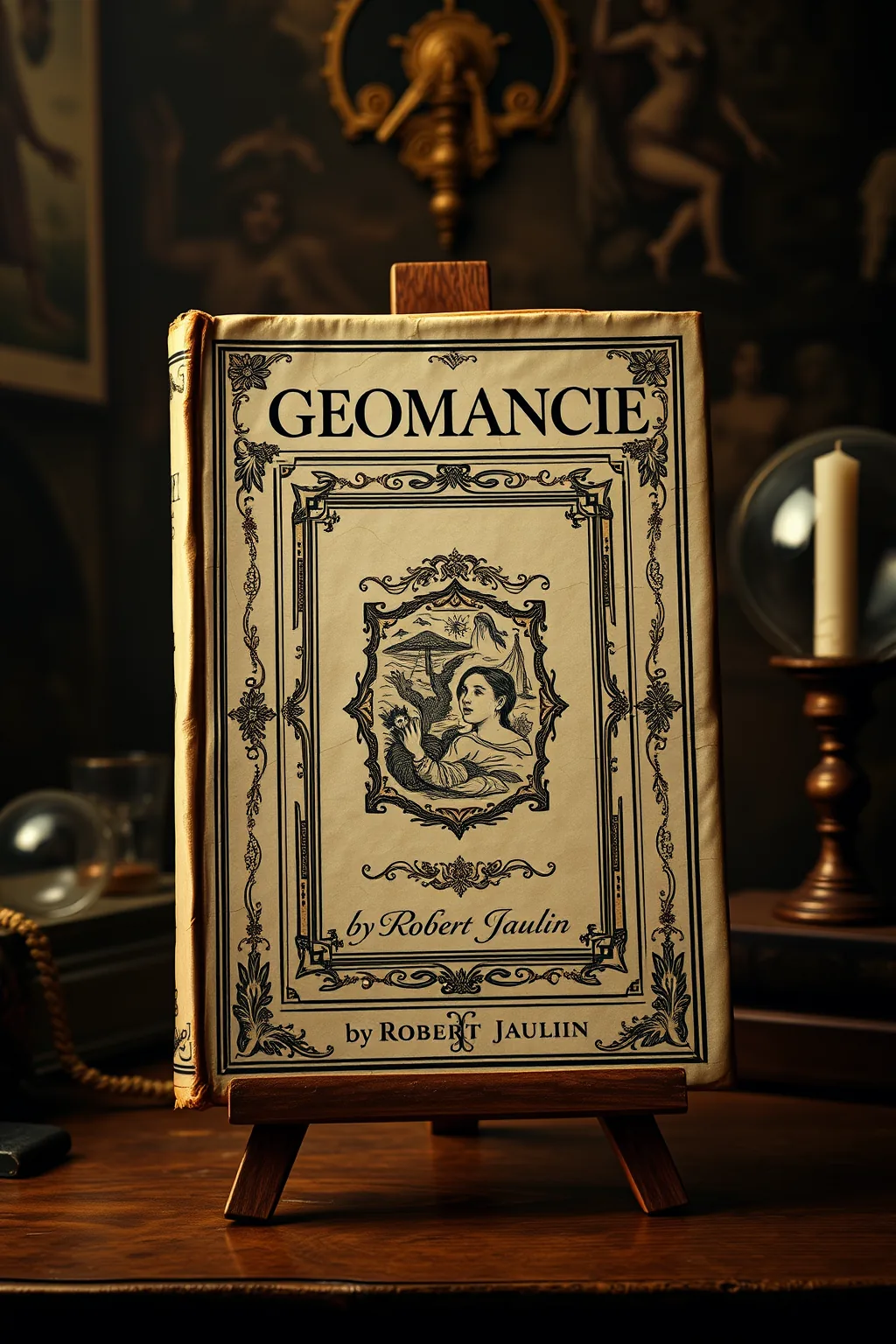
Geomancie
 82
82

Geomancie
Robert Jaulin’s "Geomancie" offers a precise, almost crystalline, exposition of a complex divinatory art. Rather than a romanticized account, Jaulin presents geomancy as a logical system, meticulously detailing the derivation of figures and their astrological attributions. The strength lies in its systematic clarity, a welcome antidote to more mystical vagaries. One particular passage, detailing the calculation of the 'Via Combustae' within the geomantic chart, showcases the intricate, almost algebraic, nature of the practice. However, the book’s rigor can also be its limitation; it demands significant focus from the reader, offering little in the way of anecdotal examples or historical color that might ease the learning curve for novices. "Geomancie" serves as an essential, if demanding, manual for the dedicated student.
📝 Description
82
Robert Jaulin's Geomancie, first published in 1966, examines geomancy as symbolic logic.
Robert Jaulin's Geomancie analyzes geomancy as a system of symbolic logic and cosmic correspondence, not just a method for fortune-telling. The book details how to construct the 16 basic geomantic figures from four elemental lines, and how these figures then generate mothers and daughters. Jaulin explains the assignment of planetary, zodiacal, and elemental dignities to these figures. He also covers their placement within the 16 houses of a geomantic chart and the rules for interpreting the resulting combinations. This work is intended for serious practitioners and scholars of esoteric traditions, especially those interested in Western magical and divinatory systems. It will benefit readers seeking to understand geomancy's historical development and theoretical basis beyond contemporary interpretations. Students of comparative divination, magical history, and symbolic systems will find it a valuable resource due to its scholarly approach and thorough coverage.
Published in 1966, Geomancie appeared during a resurgence of interest in occultism and esoteric studies. Unlike earlier revival movements that sometimes offered less structured approaches, Jaulin's book provided a more analytical and detailed examination of a specific divinatory art. It served as a scholarly counterpoint to more impressionistic accounts of magic and contributed to a more academic consideration of divinatory practices within Western esoteric traditions.
💡 Why Read This Book?
• Learn the precise method for generating the 16 geomantic figures and their derived matrices, as detailed in Jaulin’s systematic approach, offering a unique computational framework for divination. • Understand the specific astrological and elemental attributions assigned to each geomantic figure, providing a concrete basis for interpretation beyond generalized symbolism. • Gain insight into the historical evolution of geomancy as a divinatory art, appreciating its development and structural integrity as presented in this 1966 scholarly analysis.
⭐ Reader Reviews
Honest opinions from readers who have explored this book.
❓ Frequently Asked Questions
What is the historical origin of geomancy as discussed by Robert Jaulin?
Robert Jaulin's "Geomancie" places the origins of geomancy in the medieval period, likely developing in North Africa or the Middle East. It posits the art evolved from simple methods of marking sand or earth to a sophisticated system of 16 figures by the 11th century.
How does Jaulin explain the generation of geomantic figures?
Jaulin details a method involving throwing dice or drawing lines of points, which are then converted into pairs of 'solid' (yao) and 'broken' (yao) lines based on parity. These lines combine to form 16 unique figures, the foundation of the entire art.
What is the significance of the 'mothers' and 'daughters' in geomancy according to Jaulin?
The 'mothers' are the first four figures generated, from which all subsequent figures are derived. The 'daughters' are figures formed by combining the mothers in specific ways, creating a complex interrelationship within the geomantic chart.
Does Jaulin discuss the astrological connections in geomancy?
Yes, Jaulin extensively covers the astrological correspondences. Each of the 16 figures is linked to specific planets, signs of the zodiac, and elements, which are crucial for interpreting their meaning within a divinatory reading.
What kind of questions can geomancy answer, according to the book?
Jaulin presents geomancy as capable of answering a wide range of questions, from practical matters like the success of a venture to more abstract concerns about relationships, health, or spiritual direction, based on the generated figures.
Is Robert Jaulin's "Geomancie" suitable for absolute beginners?
While comprehensive, "Geomancie" is best suited for those with some prior exposure to esoteric concepts or a strong academic interest. Its detailed, systematic approach requires dedicated study and is less of an introductory guide than a thorough manual.
🔮 Key Themes & Symbolism
The 16 Geomantic Figures
The core of geomancy lies in its 16 fundamental figures, each a unique combination of four lines (solid/broken). Jaulin's work systematically breaks down the generation of these figures, often starting with a method akin to drawing lines of points. These figures, such as 'Puer' (Boy), 'Puella' (Girl), 'Fortuna Major', and 'Fortuna Minor', are not arbitrary but possess intrinsic qualities derived from their construction and subsequent astrological and elemental assignments. Understanding their creation is paramount to grasping the logic of the entire system.
Astrological and Elemental Correspondences
Jaulin meticulously details how each of the 16 geomantic figures aligns with specific planets, zodiacal signs, and the four elements. This cross-referencing provides a rich interpretive layer, allowing practitioners to understand a figure's nature through the lens of established astrological symbolism. For instance, a figure might be ruled by Mars, indicating conflict or action, or by Jupiter, suggesting expansion and good fortune. These attributions form a bridge between terrestrial divination and celestial influences.
The Geomantic Chart and Interpretation
The book guides readers through the construction of the geomantic chart, a matrix of 16 houses where the generated figures are placed according to specific rules. Jaulin explains how the relationships between figures in different houses, their dignities, and the overall patterns that emerge are interpreted to answer specific questions. This process involves complex calculations and a deep understanding of the interplay between the figures, the querent's question, and the cosmic forces represented.
Geomancy as a System of Logic
Beyond mere fortune-telling, Jaulin presents geomancy as a coherent system of symbolic logic and cosmic resonance. The derivation of figures from one another, the assignment of significations, and the structured interpretation process highlight its intellectual rigor. The work suggests that geomancy reflects underlying universal patterns, making it a tool not just for prediction but for understanding the order of the cosmos and humanity's place within it.
💬 Memorable Quotes
Direct passages from the work, attributed to the author.
“The 16 figures are born from four lines, themselves born from a simple game of chance.”
— This highlights the elegant simplicity at the root of geomancy. Despite the complex interpretations and applications, the entire system originates from a basic act of randomization, mirroring how profound order can emerge from apparent chaos in nature.
“Each figure carries its own planetary and elemental nature.”
— This emphasizes the astrological and elemental framework that underpins geomantic interpretation. The inherent qualities of a figure, derived from its celestial and elemental associations, are key to understanding its meaning in a divinatory context.
“The position of the figures within the 16 houses determines their role as judge, significator, or witness.”
— This points to the structural aspect of the geomantic chart. The 'house' a figure occupies dictates its function and influence within the reading, transforming abstract symbols into specific actors within the context of the question asked.
“Geomancy provides a mirror to the terrestrial world, reflecting celestial influences.”
— This interpretation frames geomancy as a mediating art, connecting the earthly realm with the cosmic order. It suggests the figures are not random but symbolic representations of universal energies impacting human affairs.
“The 'Via Combustae' presents a point of tension or difficulty within the geomantic reading.”
— This specific concept within geomancy, the 'Burning Way,' is identified as a critical area of focus. Its presence in a chart signals potential challenges or significant turning points, requiring careful analysis of the figures it contains.
🌙 Esoteric Significance
Tradition
Jaulin's "Geomancie" primarily engages with the Western Hermetic and divinatory traditions. It aligns with the corpus of knowledge that views divination not as mere chance but as a structured system reflecting cosmic order. While not strictly Kabbalistic or Gnostic, it shares with these traditions a belief in symbolic correspondences and the interconnectedness of all things. The work seeks to systematize a practice often treated with less academic rigor, placing it within a lineage of Western esoteric arts that includes astrology and the Tarot.
Symbolism
The 16 geomantic figures are the central symbols, each representing archetypal forces and energies. Figures like 'Fortuna Major' (Greater Fortune), with its upward-pointing structure, often signify positive outcomes and stability, while 'Laetitia' (Joy) brings associations of happiness and success. Conversely, figures like 'Via' (Road), indicating journeys or changes, or 'Piger' (Sluggard), signifying delay, carry different interpretive weight. Their planetary and elemental attributions further enrich their symbolic language.
Modern Relevance
Contemporary practitioners of Western esotericism, particularly those focused on traditional divination and magical systems, continue to draw upon Jaulin's systematic approach. His work provides a solid foundation for understanding geomancy's structure, which is essential for modern magical workings, astrological integrations, and comparative studies of divination. Thinkers and practitioners interested in the mechanics of symbolic systems and the historical practice of magic often refer to "Geomancie" for its clarity and historical grounding.
👥 Who Should Read This Book
• Students of Western Esotericism seeking a structured understanding of geomancy, moving beyond anecdotal accounts to its technical underpinnings. • Divination practitioners interested in adding a historically grounded, systematic method to their repertoire, complementing astrology or tarot studies. • Researchers of comparative religion and magical history looking for detailed analyses of medieval and Renaissance divinatory practices.
📜 Historical Context
Robert Jaulin’s "Geomancie," first published in 1966, arrived during a period of significant resurgence in occult and esoteric studies in the West. Following the more spiritual and philosophical inclinations of earlier movements like Theosophy, Jaulin's work offered a rigorous, analytical approach to a specific divinatory art. It contrasted with the more syncretic or impressionistic occult texts prevalent at the time, focusing instead on the systematic structure and historical roots of geomancy. While figures like Agrippa had documented geomancy in the 16th century, Jaulin provided a 20th-century scholarly perspective. The book contributed to a growing body of literature that sought to reconstruct and practice traditional magical arts with greater precision, appealing to a readership interested in the mechanics and historical development of these disciplines.
📔 Journal Prompts
The generation of the 16 geomantic figures from four lines.
The specific planetary ruler assigned to the figure 'Acquisitio'.
Interpretation of a specific figure's placement in the 'House of Judgement'.
The 'Via Combustae' and its role in a geomantic reading.
Comparing the elemental nature of 'Populus' with 'Tristitia'.
🗂️ Glossary
Geomantic Figure
One of the 16 basic symbolic patterns generated in geomancy, formed by combinations of solid and broken lines, each carrying specific meanings and correspondences.
Solid Line (Punctum)
A single point or line representing a 'yang' or masculine principle in geomancy, typically depicted as a single solid line.
Broken Line (Punctum)
A line with two points or a broken line representing a 'yin' or feminine principle, typically depicted as two dots or a broken line.
Mother Figures
The first four geomantic figures generated, from which all subsequent figures (daughters) are derived through specific combinations.
Daughter Figures
Geomantic figures derived from the mother figures through specific additive or subtractive processes, forming the bulk of the geomantic chart.
House
One of the 16 positions within a geomantic chart, each corresponding to a specific area of life or type of question being asked.
Via Combustae
A specific section of the geomantic chart, often considered an area of difficulty or significant influence, comprising certain houses and figures.
🔮 Readers Also Liked
Browse all →








More by Robert Jaulin
All books →

More Free Occult Philosophy Books
View all →