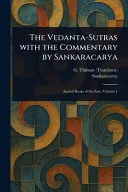
The Vedanta-Sutras With the Commentary by Sankaracarya
 79
79

The Vedanta-Sutras With the Commentary by Sankaracarya
The Thibaut translation of the Vedanta-Sutras, with Sankaracarya's commentary, remains a cornerstone for anyone seriously engaging with Advaita Vedanta. Its strength lies in presenting Sankaracarya's rigorous dialectic directly, allowing the reader to follow his intricate arguments for the non-dual nature of reality. The translation, though dated, captures the systematic, almost legalistic, structure of the Sutras and the sharp logic of the commentary. A point of contention, however, is the occasional density of the prose, which can make Sankaracarya's refutations of opposing schools feel particularly abstract without extensive prior knowledge. A passage that exemplifies this is the detailed examination of the Avidya (ignorance) as the root cause of phenomenal existence, where Sankaracarya's refutation of alternative explanations is both profound and demanding. This edition is essential, albeit challenging, for understanding the bedrock of a major Indian philosophical system.
📝 Description
79
George Thibaut's 1890 translation made the Vedanta-Sutras and Sankaracarya's commentary available to Western scholars.
This volume presents the Vedanta-Sutras, aphorisms on Brahman attributed to Badarayana, alongside the extensive commentary by Adi Shankara, the chief proponent of Advaita Vedanta. The translation by George Thibaut, published in 1890, aimed to make these complex philosophical texts understandable to a broader audience. It serves as a primary source for grasping the systematic exposition of Vedanta philosophy.
Scholars of comparative religion and Eastern philosophy will find this text useful for its direct engagement with primary sources. Students of Advaita Vedanta can study its core doctrines through its most influential commentator. Those interested in the history of Indian thought, particularly the development of philosophical systems stemming from the Upanishads, will find a crucial link here. It is for the serious student of metaphysical knowledge.
The Vedanta-Sutras, compiled by Badarayana around 500 BCE, organize earlier Vedic and Upanishadic ideas. Adi Shankara's 8th-century CE commentary became the standard interpretation for Advaita Vedanta, significantly shaping later Indian philosophy. Thibaut's translation brought these texts to Western attention during a period of growing global intellectual exchange.
The Vedanta-Sutras, systematized by Badarayana, represent a key text in the Vedanta tradition, a major school of Hindu philosophy. Adi Shankara's commentary is central to Advaita Vedanta, a nondualistic system that posits the ultimate identity of the individual soul (Atman) with the absolute reality (Brahman). This tradition seeks liberation through direct knowledge of this unity, often understood through meditative and philosophical practices. The translation makes these core teachings accessible to those studying the philosophical underpinnings of Indian spiritual paths.
💡 Why Read This Book?
• Grasp the foundational tenets of Advaita Vedanta, understanding Sankaracarya's interpretation of the Vedanta-Sutras, particularly his concept of Maya, which explains the illusory nature of the perceived world. • Engage with the rigorous philosophical reasoning from the 8th century CE that shaped Indian metaphysical discourse, examining Sankaracarya's method of refuting competing schools of thought. • Access a pivotal text within the 'Sacred Books of the East' series (first published 1890), providing direct insight into how these ancient Indian philosophical works were introduced to Western scholarship.
⭐ Reader Reviews
Honest opinions from readers who have explored this book.
❓ Frequently Asked Questions
What is the primary focus of the Vedanta-Sutras with Sankaracarya's commentary?
The primary focus is the systematic exposition of Brahman, the ultimate reality, and the nature of Atman (the individual soul), as interpreted through the Advaita Vedanta philosophy of Sankaracarya.
Who was Sankaracarya and why is his commentary important?
Sankaracarya, an 8th-century philosopher, is the most influential proponent of Advaita Vedanta. His commentary is crucial because it provides the definitive, non-dualistic interpretation of the Vedanta-Sutras, shaping a major school of Hindu philosophy.
What does 'Advaita Vedanta' mean?
Advaita Vedanta translates to 'non-dualism' or 'inconceivable unity'. It posits that Atman and Brahman are ultimately one and the same, and the perceived multiplicity of the world is an illusion (Maya).
Is this book suitable for beginners in philosophy?
While foundational, the text is dense and requires dedication. It's best suited for those with some background in philosophy or a strong interest in Indian metaphysical thought, as Sankaracarya's arguments can be complex.
What is the significance of the 'Sacred Books of the East' series for this text?
This volume's inclusion in the 'Sacred Books of the East' series (first published 1890) marked a significant step in introducing classical Indian philosophical and religious texts to Western academic and public discourse.
What is Maya as discussed by Sankaracarya?
Maya, as expounded by Sankaracarya, refers to the cosmic illusion or veil of ignorance that makes the non-dual reality (Brahman) appear as a diverse, phenomenal world. It is considered inexplicable but empirically real.
🔮 Key Themes & Symbolism
The Nature of Brahman
This work is a deep exploration of Brahman, understood not as a personal deity but as the attributeless, all-pervading, ultimate reality. Sankaracarya's commentary meticulously argues that Brahman is the sole existence, the ground of all being, beyond all conceptualization and duality. The Sutras themselves are presented as pointers towards this singular truth, which is beyond causation and change, serving as the foundational principle of the cosmos and individual consciousness.
The Identity of Atman and Brahman
A central theme is the non-dualistic assertion that the individual self (Atman) is identical to Brahman. Sankaracarya uses the Sutras to dismantle the illusion of separation, demonstrating through logical analysis and scriptural references that the apparent distinction between the subject and the ultimate reality is a product of ignorance (Avidya). Realizing this identity is presented as the direct path to liberation (Moksha).
Maya and the Phenomenal World
The concept of Maya is crucial for understanding Sankaracarya's Advaita. The commentary explains that the empirical world, with its multiplicity and apparent reality, is not ultimately real but an appearance superimposed on Brahman. Maya is the power that conceals the true nature of reality and projects the illusion of a separate self and a diverse universe. Understanding Maya is key to transcending suffering and illusion.
The Path to Liberation (Moksha)
The text outlines the means to achieve Moksha, or liberation from the cycle of birth and death. For Sankaracarya, this is primarily achieved through Jnana Yoga – the yoga of knowledge. This involves scriptural study, contemplation, and direct realization of the non-dual truth of Atman-Brahman, facilitated by the discrimination between the real and the unreal, and the shedding of ignorance.
💬 Memorable Quotes
Direct passages from the work, attributed to the author.
“For the purpose of the text, the meaning of the word 'knowledge' is the knowledge of the oneness of the Self.”
— This interpretation emphasizes Sankaracarya's focus on realizing the non-dual identity of Atman and Brahman as the true 'knowledge' that leads to liberation, distinguishing it from mere intellectual understanding.
“The world is like a dream or an illusion.”
— This captures the essence of Maya as explained by Sankaracarya. It suggests that the perceived reality of the universe is not fundamentally real but an appearance, akin to the vividness of a dream.
“Ignorance is the cause of bondage.”
— This statement points to Avidya (ignorance) as the root cause of suffering and the cycle of rebirth. Overcoming this ignorance through true knowledge is the central aim of the philosophy.
💡 Key Ideas
Editorial paraphrase of the work's core concepts — not direct quotes.
Brahman is that from which the origin, subsistence, and dissolution of this world proceed.
This paraphrased concept highlights the Sutras' definition of Brahman as the efficient and material cause of the universe, establishing its role as the ultimate source and sustainer of all existence.
The Self is not born and does not die.
This paraphrased concept refers to the eternal and unchanging nature of the Atman, which is beyond the cycles of creation and destruction that characterize the phenomenal world.
🌙 Esoteric Significance
Tradition
While rooted in the Vedic and Upanishadic traditions, Sankaracarya's Advaita Vedanta functions as a highly sophisticated philosophical system that informs many esoteric practices within Hinduism. Its emphasis on the non-dual nature of reality and the illusory character of the material world aligns with certain Gnostic and Hermetic concepts of overcoming material illusion to attain gnosis or true knowledge.
Symbolism
Key symbols include the Om mantra, representing the primordial sound and the essence of Brahman, and the concept of the 'substratum' (Adhishthana), which is Brahman as the underlying reality upon which all phenomena are projected, much like a screen upon which a movie plays. The analogy of the rope and the snake, where the snake is a mistaken perception of the rope due to darkness, is a classic symbol for Maya.
Modern Relevance
Advaita Vedanta continues to influence contemporary spiritual thinkers and practitioners globally. Its core tenets are explored in modern mindfulness practices, non-dual awareness teachings, and by contemporary philosophers and authors who engage with consciousness studies and the nature of reality. Thinkers like Alan Watts and Ram Dass drew heavily on Advaita principles in their popularizations of Eastern philosophy for Western audiences.
👥 Who Should Read This Book
• Advanced students of Indian philosophy seeking to engage directly with the primary source texts of Advaita Vedanta and Sankaracarya's foundational commentary. • Comparative religion scholars interested in the historical development and intellectual lineage of major world philosophies, particularly the Vedantic tradition. • Dedicated practitioners of meditation and spiritual inquiry who wish to deepen their understanding of non-dual concepts and the nature of consciousness.
📜 Historical Context
The Vedanta-Sutras, compiled by Badarayana likely in the early centuries CE, sought to harmonize the diverse teachings of the Upanishads into a coherent philosophical system. Adi Shankara's commentary, written in the 8th century CE, revitalized and systematized the Advaita Vedanta school, positioning it as a dominant force in Indian philosophy. His exegesis became the standard against which later Vedanta thinkers, such as Ramanuja (Vishishtadvaita) and Madhva (Dvaita), would define their own contrasting schools of thought. The translation by George Thibaut, published in 1890 as part of F. Max Müller's monumental 'Sacred Books of the East' series, was a landmark event. It made these complex Sanskrit texts accessible to a burgeoning Western academic audience interested in Orientalism and comparative religion, during a period when figures like Swami Vivekananda were also introducing Hindu philosophy to the West, albeit through a more devotional lens.
📔 Journal Prompts
The nature of Brahman as the cause of the universe.
Sankaracarya's explanation of Maya and its implications for perceived reality.
The concept of Atman and its ultimate identity with Brahman.
The role of Avidya (ignorance) in the philosophical system.
The ultimate goal of Moksha and the path of Jnana Yoga.
🗂️ Glossary
Brahman
The ultimate, unchanging, all-pervading reality in Hindu philosophy; the Absolute, the ground of all being.
Atman
The individual soul or self; in Advaita Vedanta, it is ultimately identical with Brahman.
Advaita Vedanta
A school of Hindu philosophy emphasizing the non-duality (Advaita) of Atman and Brahman, meaning 'not two'.
Sutras
Concise aphorisms or threads of discourse, often requiring commentary for full explanation, used in ancient Indian philosophical texts.
Maya
Cosmic illusion or divine play; the power that conceals the true nature of reality (Brahman) and projects the phenomenal world.
Moksha
Liberation or release from the cycle of birth, death, and rebirth (samsara); the ultimate spiritual goal.
Avidya
Ignorance; spiritual ignorance that obscures the true nature of reality and leads to suffering and bondage.