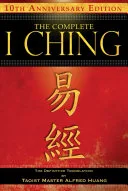
The Complete I Ching — 10th Anniversary Edition
 72
72

The Complete I Ching — 10th Anniversary Edition
Alfred Huang's "The Complete I Ching" offers a translation that feels deeply rooted in its source tradition, a notable achievement given the text's complex interpretive history. The inclusion of the "Ten Wings" is a significant strength, providing essential Confucian-era context often omitted in more abridged versions. Huang’s background as a Taoist Master lends a distinct voice, particularly in his rendering of the hexagram commentaries. However, the prose, while faithful, can sometimes be dense for readers unfamiliar with classical Chinese philosophical language, demanding careful study. A passage like the explanation for Hexagram 1, "Qian" (The Creative), exemplifies this, offering layers of meaning that require sustained attention but reward the diligent reader with profound symbolic depth. This edition is a valuable resource for those committed to a thorough engagement with the I Ching.
📝 Description
72
Alfred Huang's 2010 translation of the I Ching includes the crucial "Ten Wings" commentaries.
Alfred Huang's "The Complete I Ching - 10th Anniversary Edition" offers an English version of the ancient Chinese oracle, translated by a Taoist Master. Published in 2010, this edition emphasizes the inclusion of the "Ten Wings," commentaries traditionally attributed to Confucius. These writings clarify the hexagrams' deeper meanings and philosophical structures. The work is suited for serious students of divination, Chinese philosophy, and comparative religion who desire an authoritative translation that honors the I Ching's original context. It serves as both a divinatory tool and a philosophical text.
The I Ching, or Book of Changes, has a history of thousands of years within Chinese civilization, impacting philosophy, governance, and personal development. The "Ten Wings," compiled later around the Han Dynasty (206 BCE – 220 CE), are vital for understanding the systematic interpretation of the I Ching. Huang's translation, stemming from a Taoist lineage, presents a viewpoint distinct from earlier Sinological translations that may have favored Confucian or Western academic perspectives. The core of the I Ching comprises 64 hexagrams, each formed by six lines, representing archetypes of situations and transformations. The "Ten Wings" elaborate on these, providing philosophical commentary and explaining the principles of cosmic change central to the concept of "yi."
The I Ching is a foundational text within Chinese cosmology and esoteric traditions. Its system of 64 hexagrams, derived from yin and yang lines, maps fundamental states of transformation. The "Ten Wings" are a later layer of interpretation, systematizing the oracle's philosophical and ethical dimensions, often within a Confucian framework. Huang's translation, however, is rooted in his Taoist lineage, offering a perspective that may highlight different resonances or applications of the text compared to purely Confucian or Western academic approaches. This edition thus bridges classical Chinese thought and its esoteric applications.
💡 Why Read This Book?
• Gain an insider's perspective on the I Ching through Alfred Huang's direct lineage as a Taoist Master, offering interpretations that transcend typical academic translations. • Understand the crucial philosophical framework of the "Ten Wings," the commentaries attributed to Confucius, which are essential for grasping the I Ching's deeper meanings beyond simple divination, as presented in this 2010 edition. • Explore the 64 hexagrams and their dynamic interplay with a translator's deep familiarity with the text's use within traditional Chinese practices, providing a nuanced view of change and harmony.
⭐ Reader Reviews
Honest opinions from readers who have explored this book.
❓ Frequently Asked Questions
When was the first edition of Alfred Huang's I Ching translation published?
The first edition of Alfred Huang's "The Complete I Ching" was published on November 17, 2010, marking a significant contribution to English-language I Ching scholarship and practice.
What are the "Ten Wings" mentioned in the book?
The "Ten Wings" are a collection of commentaries, traditionally attributed to Confucius, that provide philosophical and interpretive depth to the 64 hexagrams of the I Ching, essential for understanding its wisdom.
Who is Alfred Huang?
Alfred Huang is an eminent Taoist Master and the translator of "The Complete I Ching," bringing an authentic, tradition-based perspective to this rendition.
Is this translation suitable for beginners?
While comprehensive, the translation's depth, particularly the inclusion of the "Ten Wings," makes it most rewarding for serious students rather than absolute beginners, though it can serve as a foundational text with dedication.
What makes this I Ching translation unique?
Its uniqueness lies in being the first English translation from within the tradition by a Chinese Taoist Master, incorporating the essential "Ten Wings" commentaries.
What is the significance of the 10th Anniversary Edition?
The 10th Anniversary Edition celebrates the enduring impact and readership of Alfred Huang's authoritative translation, reaffirming its status as a definitive English version of the I Ching.
🔮 Key Themes & Symbolism
Hexagrammatic Symbolism
The 64 hexagrams, each formed by six yin or yang lines, serve as archetypal symbols representing the dynamic states of the cosmos and human experience. Huang's translation elucidates their symbolic language, moving beyond mere fortune-telling to reveal patterns of change and transformation. Each hexagram is presented not just as a symbol but as a complex map of potential developments, deeply embedded in Taoist principles of balance and cyclical movement.
The Ten Wings
These essential commentaries, traditionally attributed to Confucius, are integral to understanding the I Ching's philosophical depth. Huang's translation foregrounds them, explaining their role in interpreting the hexagrams' ethical, cosmological, and practical dimensions. They transform the text from a divinatory manual into a profound guide for self-cultivation and understanding the Mandate of Heaven, offering insights crucial for navigating life's complexities.
Taoist Principles of Change
Central to the I Ching is the concept of 'yi' or change. Huang, as a Taoist Master, emphasizes the continuous, cyclical nature of transformation as described in the text. This edition explores how the hexagrams illustrate the constant interplay of yin and yang, the processes of growth, decay, and renewal, and how aligning oneself with these natural rhythms leads to harmony and effective action.
Divination as Self-Reflection
Beyond predicting the future, the I Ching, as presented by Huang, functions as a tool for introspection and wise decision-making. The hexagrams offer perspectives on current situations, encouraging the user to reflect on their circumstances and potential actions. This approach aligns with Taoist philosophy, where understanding the flow of events allows for more skillful and less forceful engagement with the world.
💬 Memorable Quotes
Direct passages from the work, attributed to the author.
“The superior man, in his orderliness, makes the clouds gather and the rain fall.”
— This statement, often associated with Hexagram 1 (Qian), suggests the power of cultivated virtue and inner order to influence external reality, a core concept in the I Ching's philosophical interpretations.
“When the sun has set, one must not try to use its rays.”
— An interpretation pointing to the importance of timing and acting in accordance with the natural progression of events, rather than clinging to past conditions or methods.
“To understand the Book of Changes is to understand Heaven and Earth.”
— This highlights the I Ching's cosmological scope, positioning it as a key text for comprehending the fundamental principles governing the universe and one's place within it.
“He who knows the changes is like a god.”
— This implies that mastery of the principles of change, as revealed by the I Ching, grants a profound understanding and almost prescient ability to navigate life's circumstances.
“The superior man makes himself strong and untiring.”
— Reflecting the energetic nature of the hexagrams, this encourages continuous self-improvement and resilience in the face of challenges, mirroring the dynamic forces the I Ching describes.
🌙 Esoteric Significance
Tradition
This work is deeply embedded in the Taoist tradition, a major lineage within Chinese esotericism that emphasizes living in harmony with the Tao, the fundamental principle of the universe. Huang’s translation positions the I Ching not merely as a divinatory tool but as a guide to understanding cosmic patterns and achieving balance, aligning with Taoist practices of wu wei (non-action) and self-cultivation.
Symbolism
Key symbols include the 64 hexagrams, each a binary code of six lines (yin/yang) representing archetypal situations and transformations. The trigrams (three-line figures) like Qian (Heaven/Creative) and Kun (Earth/Receptive) are fundamental building blocks. The concept of the 'Dragon' within Qian symbolizes potent, dynamic energy, while the 'Field' within Kun represents receptivity and nurturing potential.
Modern Relevance
Contemporary practitioners of mindfulness, systems thinking, and even chaos theory find resonance in the I Ching's depiction of dynamic change and interconnectedness. Philosophers exploring comparative ethics and scholars of ancient wisdom traditions continue to draw on texts like Huang's for their insights into cyclical processes and the nature of reality, bridging ancient Chinese thought with modern inquiry.
👥 Who Should Read This Book
• Students of Taoism and Chinese philosophy seeking an authentic translation from a recognized master. • Divination practitioners looking for a comprehensive text that explains the deeper philosophical underpinnings of the I Ching beyond simple fortune-telling. • Comparative religion scholars interested in understanding the I Ching's place within the broader range of world spiritual and philosophical traditions.
📜 Historical Context
The I Ching, or Book of Changes, represents one of the oldest and most influential texts in Chinese civilization, with roots stretching back over three millennia. Its philosophical development was significantly shaped during the Spring and Autumn (771–476 BCE) and Warring States (475–221 BCE) periods, and further systematized during the Han Dynasty (206 BCE – 220 CE) with the compilation of the "Ten Wings." Alfred Huang's translation, published in 2010, emerges in an era of global interest in Eastern philosophies, following a long tradition of Western Sinological scholarship that began with translations by figures like James Legge in the 19th century. Huang's approach distinguishes itself by offering a translation from within the Taoist tradition, providing a perspective potentially different from the more Confucian-centric interpretations prevalent in earlier scholarship or contemporary Western Neo-Confucian studies.
📔 Journal Prompts
The concept of 'yi' (change) as illustrated by Hexagram 51, 'Zhen' (The Arousing).
Reflecting on the 'Ten Wings' and their role in interpreting the hexagrams.
The dynamic interplay of yin and yang lines across various hexagrams.
The symbolic representation of the 'Dragon' in Hexagram 1, 'Qian'.
How the principles of 'wu wei' are reflected in the I Ching's guidance.
🗂️ Glossary
I Ching
Literally 'Book of Changes,' an ancient Chinese text used for divination and as a foundational philosophical work, comprising 64 hexagrams and extensive commentaries.
Hexagram
A figure composed of six stacked horizontal lines, each either solid (yang) or broken (yin). There are 64 unique hexagrams in the I Ching, representing fundamental archetypes of situations and transformations.
Trigram
A figure composed of three horizontal lines, either solid (yang) or broken (yin). The eight trigrams are building blocks for the 64 hexagrams and have their own symbolic meanings.
Yang
In I Ching symbolism, the solid line representing active, strong, masculine, or creative principles. It is often associated with light, heaven, and movement.
Yin
In I Ching symbolism, the broken line representing passive, receptive, feminine, or yielding principles. It is often associated with darkness, earth, and stillness.
Ten Wings
A collection of commentaries traditionally attributed to Confucius, which systematically interpret the I Ching's hexagrams and provide philosophical depth, considered essential for understanding the text.
Tao (Dao)
The fundamental, ineffable principle of the universe in Taoism, often translated as 'The Way.' It represents the natural order and the source of all existence.