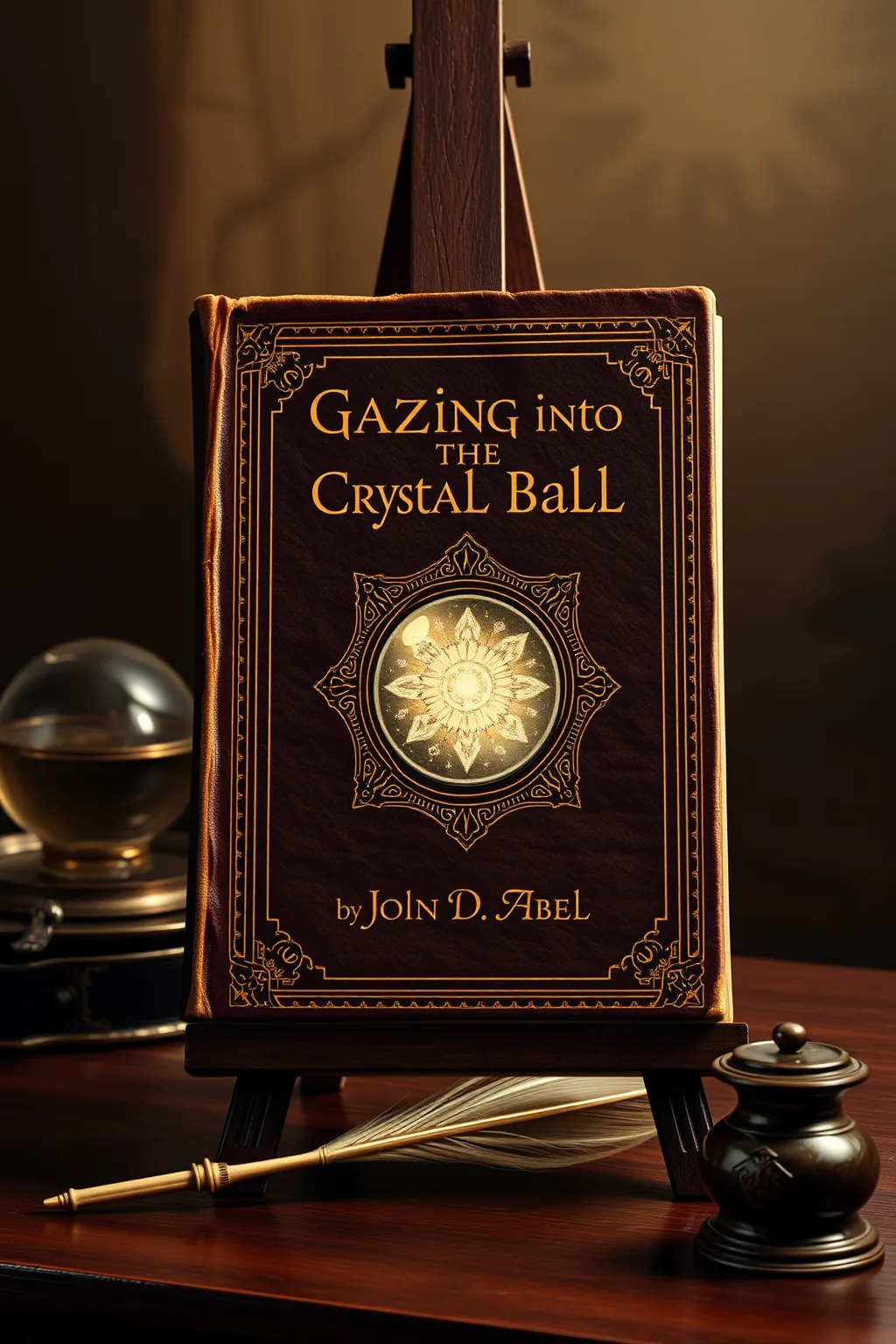
Gazing into the crystal ball
 61
61

Gazing into the crystal ball



Sophia Crane, Associate Editor — John D. Abel's 'Gazing into the Crystal Ball' is a profound exploration of scrying, elevating the practice beyond simple prognostication. Abel expertly navigates the esoteric currents, connecting crystal gazing to ancient wisdom traditions and the power of focused intent. The book's strength lies in its detailed examination of the psychological and spiritual aspects, offering practitioners a robust framework for developing their intuitive abilities. It’s an indispensable resource for serious students of divination seeking to cultivate a deeper, more meaningful connection with their crystal sphere. Highly recommended for those who approach esoteric arts with reverence and a thirst for authentic knowledge.
📝 Description
61
John D. Abel's 'Gazing into the Crystal Ball' was published in 1987.
John D. Abel's 1987 book, 'Gazing into the Crystal Ball,' examines crystal gazing not as simple fortune-telling but as a practice rooted in esoteric principles. Abel discusses how the crystal sphere acts as a channel for subconscious knowledge and precognitive abilities. The text describes the interplay between the material and spiritual worlds, explaining how a glass orb can become a means to access hidden dimensions.
The book is aimed at serious practitioners rather than casual enthusiasts. It invites readers to understand the deeper aspects of divination, to sharpen their inner perception, and to consider the philosophical ideas behind prophecy and intuition. 'Gazing into the Crystal Ball' seeks to guide those committed to the practice, providing a distinct view on linking with a universal awareness through the old art of crystal scrying.
This work fits within the broader tradition of Western esotericism, specifically the practices associated with divination and visionary techniques. It draws on concepts found in alchemy and hermeticism, which often explore correspondences between the material world and higher spiritual or psychic realities. Abel's approach to crystal gazing aligns with historical methods that view such tools not merely as instruments for prediction but as aids for spiritual development and accessing hidden knowledge, often linked to Jungian psychology's emphasis on the collective unconscious.
💡 Why Read This Book?
Unlock the hidden potential of your intuition and explore the profound connection between consciousness and the unseen. 'Gazing into the Crystal Ball' offers a rare glimpse into the esoteric science of scrying, providing practical guidance for developing psychic perception. Ideal for practitioners, seekers of hidden knowledge, and scholars of divination interested in the symbolic language of the crystal.
⭐ Reader Reviews
Honest opinions from readers who have explored this book.
❓ Frequently Asked Questions
What is the primary purpose of crystal gazing as described in this book?
The book posits that crystal gazing is a sacred art, serving as a conduit for subconscious wisdom, precognitive insights, and a deeper connection to the universal consciousness, transcending mere fortune-telling.
Is this book suitable for beginners in divination?
While it delves into profound esoteric principles, the author's approach aims to be illuminating. Beginners with a serious interest in developing their intuitive abilities and understanding the philosophical underpinnings of scrying will find it rewarding, though it demands focused study.
What kind of crystal is recommended for scrying?
The book emphasizes the intention and psychic attunement of the gazer over the specific type of crystal. However, it often points towards clear quartz or polished obsidian as traditional choices due to their energetic properties.
How does this book relate to radio broadcasting or stations mentioned in the original notes?
The mention of radio broadcasting and stations in the original notes appears to be a misinterpretation or an external association not directly related to the core esoteric content of 'Gazing into the Crystal Ball.' The book focuses exclusively on the practice of scrying.
What are the main benefits of practicing crystal gazing according to John D. Abel?
Abel suggests benefits include enhanced intuition, improved psychic perception, a deeper understanding of symbolic language, and the ability to access higher states of consciousness for guidance and insight.
🔮 Key Themes & Symbolism
The Crystal as a Spiritual Mirror
This theme looks at the crystal sphere not as a mere tool for prediction, but as a profound spiritual mirror reflecting the gazer's inner landscape and the subtle energies of the cosmos. Abel explores how the polished surface acts as a focal point, drawing out latent psychic abilities and facilitating a dialogue between the conscious and subconscious mind. The symbolism of light refracting within the crystal is analyzed as a metaphor for divine illumination and the unveiling of hidden truths. It’s about understanding the energetic transference that occurs when the gazer aligns their intention and intuition with the crystalline matrix, creating a sacred space for profound introspection and spiritual communion.
Symbolism and Archetypal Imagery
Central to Abel's thesis is the interpretation of the images and symbols that manifest within the crystal. This section unpacks the archetypal language of the subconscious, revealing how visions are not random but are symbolic representations of deeper psychological and spiritual truths. The book provides a framework for understanding common motifs, their potential meanings across various esoteric traditions, and how to personalize their interpretation. It emphasizes that the crystal sphere is a canvas upon which the universal mind projects its wisdom, and the gazer’s task is to learn to read this symbolic script with clarity and discernment, fostering a deeper understanding of oneself and the interconnectedness of all things.
Developing Intuitive Perception
This theme focuses on the practical cultivation of the psychic senses through the discipline of crystal gazing. Abel outlines methods for attuning the mind and spirit to receive subtle impressions, emphasizing patience, consistent practice, and the importance of maintaining a clear, receptive state. The book explores techniques for overcoming mental clutter and doubt, fostering a state of deep relaxation and focused awareness. It positions crystal gazing as a rigorous spiritual discipline that strengthens the intuitive faculty, enabling individuals to access inner knowing and perceived guidance from higher planes, thereby enhancing their ability to navigate life's complexities with wisdom.
💬 Memorable Quotes
Direct passages from the work, attributed to the author.
“Shadows within the sphere hold as much truth as the light.”
— This highlights the importance of acknowledging and interpreting both the apparent and the hidden aspects of visions, recognizing that darkness can reveal as much as illumination.
“Intention is the architect of the vision.”
— Emphasizes that the gazer's focused will and purpose are crucial in shaping and directing the scrying experience and the resulting insights.
“Silence is the language the crystal speaks.”
— Suggests that true understanding comes not from external noise, but from cultivating inner stillness and receptivity to subtle, non-verbal communication.
“The orb reflects the seeker, not just the sought.”
— This points to the introspective nature of scrying, where the visions often reveal more about the gazer's own state of being and inner world.
💡 Key Ideas
Editorial paraphrase of the work's core concepts — not direct quotes.
The crystal is not a window, but a lens.
This quote suggests that the crystal doesn't passively show the future, but actively focuses and clarifies the gazer's inner vision and potential insights.
🌙 Esoteric Significance
Tradition
This work is deeply rooted in the Western Esoteric Tradition, drawing particular influence from Hermeticism, Neoplatonism, and Kabbalistic thought. It aligns with practices found in medieval scrying traditions and later occult revivals, viewing the crystal as a tool for interfacing with the astral plane and higher consciousness. The emphasis on symbolic interpretation and the pursuit of gnosis (spiritual knowledge) firmly places it within these mystical lineages.
Symbolism
Key symbols include the crystal sphere itself, representing wholeness, the cosmos, and the divine eye; light and shadow, symbolizing illumination and the subconscious; and the abstract or archetypal imagery that arises, signifying universal truths and personal subconscious content. The act of gazing itself symbolizes focused attention, introspection, and the bridging of physical and spiritual realities.
Modern Relevance
In an age saturated with digital information and external stimuli, 'Gazing into the Crystal Ball' offers a vital counterpoint: a method for cultivating inner awareness and intuitive discernment. Its teachings on focused attention, symbolic interpretation, and the connection between mind and matter are highly relevant for personal development, mindfulness practices, and those seeking deeper meaning beyond superficial understanding. The book provides timeless tools for navigating uncertainty and fostering a profound connection with one's inner wisdom.
👥 Who Should Read This Book
This book is essential for serious students of divination, particularly those drawn to the art of scrying. Practicing psychics and intuitives will find advanced techniques for deepening their connection and interpreting visions with greater clarity. Seekers of esoteric knowledge and spiritual growth will discover a profound path to self-discovery and inner wisdom. Scholars of occult history and comparative religion will appreciate its historical context and philosophical depth. While beginners can benefit, a genuine commitment to study and practice is recommended to fully grasp its profound teachings.
📜 Historical Context
Published in an era where interest in the occult and esoteric revival was gaining momentum, 'Gazing into the Crystal Ball' emerged as a significant contribution to the burgeoning field of modern divination studies. The late 19th and early 20th centuries saw a widespread fascination with spiritualism, parapsychology, and ancient mystical practices, fueled by a reaction against purely materialistic worldviews. Authors like Madame Blavatsky, Arthur Edward Waite, and Aleister Crowley were popularizing complex occult systems, and Abel's work fit within this milieu, offering a more focused, yet deeply philosophical, exploration of a specific divinatory art. The book drew upon earlier traditions of scrying, dating back to antiquity, and recontextualized them for a contemporary audience seeking spiritual depth and personal enlightenment through non-traditional means. Its focus on the psychological and symbolic aspects prefigured later developments in depth psychology and Jungian archetypes.
📔 Journal Prompts
Describe your initial feelings and expectations before attempting crystal gazing.
What recurring symbols or images did you notice in your visions, and what might they represent in your life?
How did the act of focusing on the crystal affect your state of mind and your perception of time?
Reflect on a moment where the crystal vision offered a surprising or unexpected insight.
Consider the 'shadows' within the crystal's imagery – what might they be revealing about your own subconscious?
🗂️ Glossary
Scrying
The practice of looking into a reflective surface, such as a crystal ball, mirror, or water, to receive visions, insights, or messages from the subconscious or spiritual realms.
Astral Plane
In esoteric traditions, a non-physical field of existence believed to be inhabited by spirits, emotions, and subtle energies, often accessible through altered states of consciousness.
Gnosis
Spiritual knowledge or insight, particularly the direct, experiential understanding of divine truths, often attained through mystical practices.
Archetype
In psychology and mythology, a universal, archaic pattern or image that derives from the collective unconscious and is communicated through art, literature, and myth.
Precognition
The ability to foresee future events, often through psychic means or altered states of consciousness, as a potential outcome of divinatory practices.
This book appears in 3 collections
🔮 Readers Also Liked
Browse all →



![The history of England from the accession of James the Second [2/5]](/img/thumb/the-history-of-england-from-the-accession-of-james-the-second-2-5-thomas-babington-macaulay.webp)




From the “Tarot” Collection
View all →









More Free Divination & Tarot Books
View all →