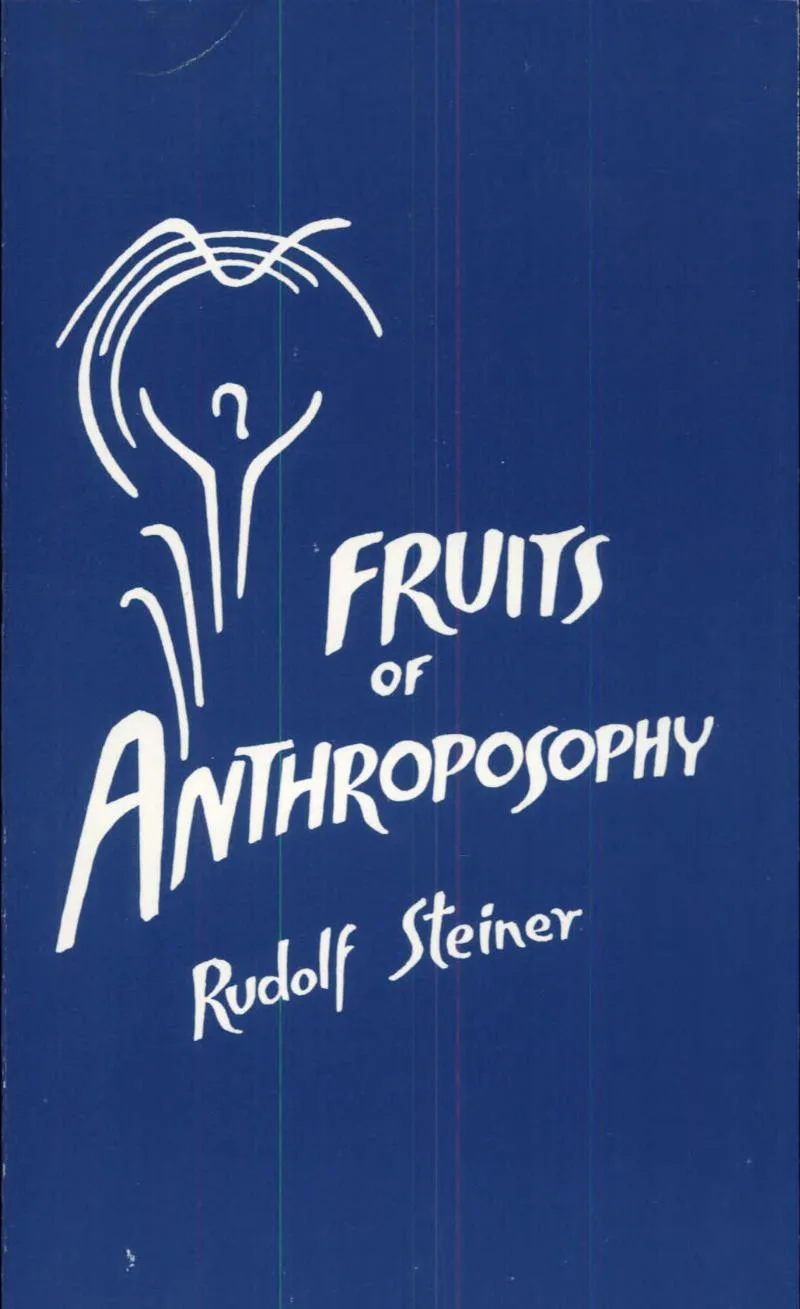
Fruits of Anthroposophy
 75
75

Fruits of Anthroposophy
Rudolf Steiner’s *Fruits of Anthroposophy* offers a dense, yet remarkably clear, exposition of the cognitive faculties necessary for engaging with the spiritual world. The strength lies in Steiner's systematic approach to defining imagination, inspiration, and intuition not as passive experiences but as active organs of perception. His description of imagination as a 'widening of our experience of memory to cosmic dimensions' is particularly striking, reframing memory from a personal archive to a universal register. However, the work's limitation is its inherent reliance on a pre-existing familiarity with Steiner's extensive conceptual framework; readers new to Anthroposophy may find the terminology and conceptual leaps challenging without supplementary material. The passage detailing intuition as the 'means by which the spiritual world bears fruit for the future of human evolution' encapsulates the forward-looking, evolutionary aspect central to Steiner's vision. It is a text for the committed student, rewarding careful study with profound conceptual clarity.
📝 Description
75
Rudolf Steiner delivered these lectures on Anthroposophy in 1923, published later in 1986.
Rudolf Steiner's *Fruits of Anthroposophy*, first published in 1986, contains lectures given in 1923. These talks focus on Anthroposophy's path of knowledge and the development of human consciousness. Steiner explains that imagination, inspiration, and intuition are distinct capacities for perceiving spiritual realities, not just mental states. He details how these faculties are central to human evolution and the future of consciousness.
The book is for those who want to go beyond basic introductions to Anthroposophy. It will interest readers concerned with consciousness, spiritual perception, and humanity's developmental path as Steiner saw it. A prior understanding of esoteric philosophy and complex spiritual concepts is helpful for engaging with this material. It is best suited for dedicated students of Steiner's work.
The first publication of *Fruits of Anthroposophy* in 1986 occurred decades after Steiner's death in 1925. Steiner founded Anthroposophy early in the 20th century, building upon Theosophy but creating his own system. This era saw a renewed interest in esoteric thought, partly as a response to materialism. Steiner's focus on developing consciousness set his work apart from other spiritual movements of the time. The 1986 publication date also aligns with a period when spiritual science was drawing more attention, though often with controversy.
Anthroposophy, founded by Rudolf Steiner, emerged from Theosophy but developed into a distinct spiritual science. Steiner's work proposes a path of inner development aimed at cultivating specific cognitive faculties like imagination, inspiration, and intuition. These are presented not as psychological phenomena but as instruments for perceiving higher spiritual realities. The tradition emphasizes that through conscious effort, individuals can develop these capacities to understand the spiritual underpinnings of the cosmos and human evolution.
💡 Why Read This Book?
• Gain a precise understanding of Anthroposophy's core cognitive faculties, learning how Rudolf Steiner defined imagination as a cosmic memory, a concept distinct from ordinary recall. • Grasp the evolutionary significance of spiritual perception as described in the lectures, understanding inspiration not as chance insight but as a deliberate extension of forgetting from the personal. • Explore intuition as a practical means for the spiritual world to manifest future evolutionary potentials, a concept central to Steiner's teachings since the early 20th century.
⭐ Reader Reviews
Honest opinions from readers who have explored this book.
❓ Frequently Asked Questions
What is the primary focus of Rudolf Steiner's 'Fruits of Anthroposophy'?
The book focuses on the Anthroposophical path of knowledge, detailing how faculties like imagination, inspiration, and intuition can be developed to perceive spiritual realities and contribute to human evolution.
When was 'Fruits of Anthroposophy' first published?
The book was first published in 1986, presenting lectures given by Rudolf Steiner, who passed away in 1925.
How does Steiner differentiate imagination, inspiration, and intuition in this work?
Steiner describes imagination as cosmic memory, inspiration as an extension of forgetting, and intuition as the faculty through which the spiritual world actively bears fruit for future evolution.
Is 'Fruits of Anthroposophy' suitable for beginners in esoteric studies?
While offering clarity, the book presumes some familiarity with Anthroposophical concepts. Beginners might benefit from introductory texts before engaging with Steiner's specific definitions of these faculties.
What is the Anthroposophical path of knowledge?
It is a spiritual-scientific approach developed by Rudolf Steiner, aiming to cultivate higher cognitive capacities to directly perceive and understand the spiritual dimensions of existence.
What is the significance of imagination as 'cosmic dimensions' of memory?
It suggests that imagination, when properly cultivated, can access a universal memory or knowledge base, extending beyond personal past experiences to grasp supra-sensible truths.
🔮 Key Themes & Symbolism
Cultivating Spiritual Faculties
The work emphasizes the active development of human consciousness, moving beyond ordinary sensory perception. Steiner details how imagination, inspiration, and intuition are not passive gifts but cultivated capacities. This involves a rigorous inner training, transforming perception from merely physical to spiritual. The lectures suggest that by consciously working with these faculties, individuals can bridge the gap between the material and spiritual worlds, making the unseen perceivable and actionable in daily life and for future development.
Imagination as Cosmic Memory
Steiner redefines imagination, positing it as an expansion of memory beyond personal experience. Instead of recalling past events, this cultivated imagination accesses a universal or cosmic memory. This allows the individual to perceive underlying spiritual realities and archetypal forms that shape the physical world. It's presented as a fundamental tool for understanding the hidden processes of nature and consciousness, offering a way to remember the spiritual origins and future possibilities of existence.
Inspiration and Intuition in Evolution
The book frames inspiration as an 'extension of forgetting,' implying a shedding of the personal ego to receive objective, universal knowledge. Intuition is presented as the vital bridge, the faculty through which the spiritual world actively injects its potential for future human evolution. This perspective highlights a dynamic, collaborative relationship between humanity and the spiritual realms, where conscious perception and reception are key drivers of progress and transformation.
Anthroposophy as a Path of Knowledge
This volume serves as an exposition of Anthroposophy's core epistemological claims: that knowledge of the spiritual world is attainable through disciplined inner work. It outlines a 'path of knowledge' distinct from religious dogma or purely intellectual speculation. By developing specific cognitive capacities—imagination, inspiration, and intuition—individuals can achieve direct experience and verifiable understanding of spiritual phenomena, contributing to both personal growth and the broader evolution of consciousness.
💬 Memorable Quotes
Direct passages from the work, attributed to the author.
“Imagination is described as a widening of our experience of memory to cosmic dimensions.”
— This statement reframes imagination not as mere fantasy, but as a profound cognitive tool capable of accessing a universal archive of knowledge, extending beyond personal history.
“Inspiration is described as an extension of forgetting.”
— This suggests that true inspiration arises when the individual transcends personal biases and memories, becoming an open channel for universal truths and insights.
“Intuition is shown to be the means by which the spiritual world bears fruit for the future of human evolution.”
— This highlights intuition's critical role in manifesting spiritual potential into tangible future realities, positioning it as a vital faculty for conscious evolutionary participation.
“The anthroposophical path of knowledge.”
— This refers to Rudolf Steiner's specific method for developing higher perception, distinguishing it from traditional science or religion by emphasizing cultivated spiritual faculties.
“The spiritual world bears fruit for the future of human evolution.”
— This concept implies an active, ongoing creative process within the spiritual realms that directly influences and shapes humanity's developmental trajectory.
🌙 Esoteric Significance
Tradition
This work is firmly rooted in the esoteric tradition founded by Rudolf Steiner: Anthroposophy. While Steiner drew inspiration from various sources, including Gnosticism, Hermeticism, and Theosophy, he synthesized these into a unique system focused on the evolution of human consciousness through spiritual science. *Fruits of Anthroposophy* specifically elaborates on the cognitive mechanisms (imagination, inspiration, intuition) that Anthroposophy posits are essential for perceiving the spiritual world, representing a departure from purely devotional or speculative esoteric practices.
Symbolism
While the book focuses more on cognitive faculties than overt symbolism, the concepts themselves function symbolically. 'Fruits' represents the tangible results or manifestations of spiritual work in the world and for future evolution. 'Memory' is symbolic of accessing ancient spiritual knowledge, while 'forgetting' symbolizes the necessary detachment from the personal ego to receive higher truths. The 'spiritual world' itself acts as a symbolic representation of the unseen realms that humanity is evolving towards understanding and interacting with.
Modern Relevance
Contemporary thinkers and practitioners in fields like consciousness studies, integral psychology, and various branches of Western esotericism continue to draw upon Steiner's conceptual framework. His detailed descriptions of inner cognitive development and the evolutionary role of spiritual perception are particularly relevant for those seeking to integrate spiritual understanding with scientific inquiry. Schools inspired by Steiner's pedagogy (Waldorf education) and biodynamic agriculture also implicitly rely on the principles discussed in works like this, demonstrating the enduring influence of his ideas.
👥 Who Should Read This Book
• Students of Rudolf Steiner's philosophy seeking a deeper understanding of the specific cognitive faculties required for spiritual perception. • Practitioners of meditation and inner development looking for systematic methods to cultivate imagination, inspiration, and intuition beyond generic practices. • Researchers in comparative spirituality and consciousness studies interested in alternative epistemologies for accessing supra-sensible realities.
📜 Historical Context
The first publication of *Fruits of Anthroposophy* in 1986 occurred decades after the passing of its author, Rudolf Steiner (died 1925). Steiner, an important figure in early 20th-century esoteric thought, developed Anthroposophy from his experiences within the Theosophical Society, establishing a distinct spiritual-scientific worldview. By the 1980s, esoteric and spiritual movements were experiencing renewed interest, often as a response to the perceived limitations of scientific materialism. Anthroposophy, with its emphasis on the cultivation of inner faculties for perceiving spiritual realities, offered an alternative framework. It stood apart from more mystical or purely philosophical traditions, proposing a rigorous, observable path of inner development. While Steiner engaged with contemporaries like Annie Besant and later figures like Carl Jung explored similar psychological territory, Steiner's specific methodology for developing faculties like imagination, inspiration, and intuition created a unique intellectual current.
📔 Journal Prompts
The role of imagination as cosmic memory: How can this concept be applied to understanding historical events or scientific discoveries?
Inspiration as an extension of forgetting: Reflect on moments where letting go of preconceived notions led to new understanding.
Intuition as the fruit of the spiritual world: Explore the practical implications of receiving spiritual impulses for future planning.
The Anthroposophical path of knowledge: How does this differ from paths you have previously explored?
The evolutionary purpose of developing spiritual faculties: Consider the long-term impact on individual and collective consciousness.
🗂️ Glossary
Anthroposophy
A spiritual philosophy founded by Rudolf Steiner, aiming to understand the spiritual dimensions of existence through a method of 'spiritual science' and the cultivation of higher human capacities.
Imagination (Anthroposophical)
In Steiner's work, a cultivated cognitive faculty that accesses supra-sensible realities and archetypal forms, functioning as a form of cosmic memory, distinct from ordinary fantasy.
Inspiration (Anthroposophical)
A higher cognitive state, described by Steiner as an 'extension of forgetting,' where universal knowledge is received by transcending the personal ego and its limitations.
Intuition (Anthroposophical)
The highest cognitive faculty in Steiner's hierarchy, enabling direct perception of spiritual realities and serving as the channel through which the spiritual world manifests for human evolution.
Spiritual World
In Anthroposophy, the areas of existence that are not accessible to the physical senses but can be perceived through developed spiritual faculties.
Path of Knowledge
The systematic process within Anthroposophy for developing spiritual perception and gaining verifiable knowledge of the spiritual world through disciplined inner work.
Human Evolution
The ongoing development of humanity, not only physically but also consciously and spiritually, guided by spiritual forces and realized through the cultivation of human capacities.