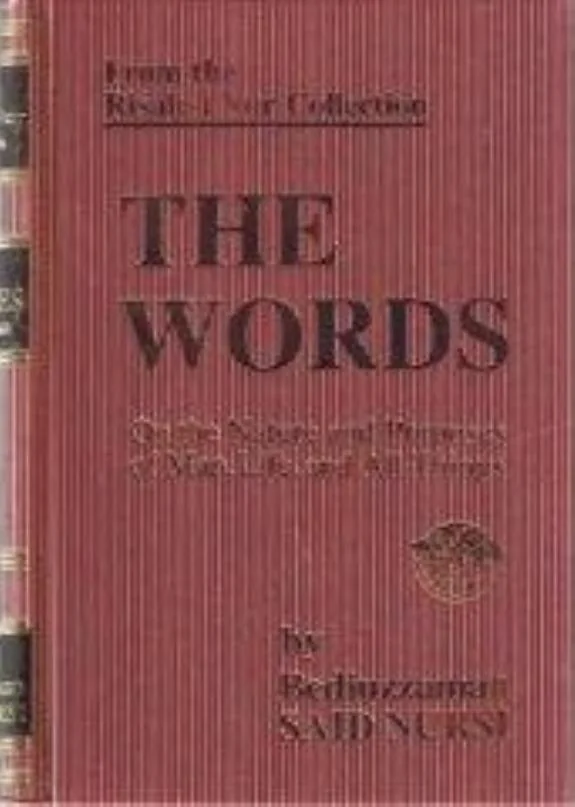
From the Risale-i Nur Collection: The words
 78
78

From the Risale-i Nur Collection: The words
Said Nursi's "The Words" offers a compelling, albeit dense, exploration of faith grounded in contemplation of the natural world. The text’s strength lies in its persistent effort to bridge the perceived chasm between scientific inquiry and spiritual belief, presenting the universe as a divine text. However, its devotional fervor can sometimes overshadow its philosophical arguments, making certain passages feel more like sermons than reasoned expositions. The extended metaphor of the universe as a 'book' is particularly potent, yet the sheer volume of interconnected ideas can be overwhelming for the uninitiated. The work's appeal to an innate human disposition towards recognizing the Divine, rather than solely relying on external proof, is its most distinctive contribution. It ultimately succeeds as a spiritual guide for those already inclined towards its particular theological framework.
📝 Description
78
Said Nursi wrote The Words while under confinement, responding to the early Turkish Republic's secularization.
The Words, part of Said Nursi's Risale-i Nur Collection, departs from typical theological studies. It is a series of spiritual reflections designed to answer modern existential questions. Nursi presents the Divine Word as the central source of guidance and understanding, aiming to link readers to core truths about existence, purpose, and God.
This collection appeals to those who seek a faith that goes beyond strict dogma, especially individuals interested in Islamic thought with an appreciation for mystical and philosophical depth. It is suitable for readers confronting the intellectual challenges of scientific materialism and secularism. Those who enjoy devotional writings that blend intellectual curiosity with spiritual experience will find significant material here. Familiarity with Sufi traditions or the intellectual legacy of Bediüzzaman Said Nursi enhances the reading experience.
Emerging in Anatolia in the early 20th century, Said Nursi's Risale-i Nur Collection, including The Words, represents a unique response within Islamic thought. Nursi developed these spiritual expositions during a period of significant political and social change, addressing a perceived spiritual void. His work, often produced under restrictive conditions, draws on Islamic intellectual heritage while emphasizing a direct, intuitive connection to divine truth, moving beyond purely legalistic or scholastic interpretations. This approach aligns with mystical traditions that seek experiential knowledge of the Divine.
💡 Why Read This Book?
• Gain an understanding of the Risale-i Nur Collection's unique approach to reconciling faith and reason, as exemplified by Nursi's prolific writing career beginning in the early 20th century. • Discover how the concept of the 'Divine Word' is presented not just as scripture, but as an active principle reflected throughout creation, offering a new lens for observing the natural world. • Explore a method of spiritual reflection that prioritizes contemplation of the cosmos as a means to apprehend the Creator, a practice central to the Risale-i Nur’s teachings.
⭐ Reader Reviews
Honest opinions from readers who have explored this book.
❓ Frequently Asked Questions
What is the primary goal of the Risale-i Nur Collection?
The primary goal is to reaffirm faith in God and the Qur'an for modern individuals, countering the skepticism and materialism prevalent in the 20th century. It seeks to illuminate spiritual truths through reason and observation of the universe.
Who was Bediüzzaman Said Nursi?
Bediüzzaman Said Nursi (1877-1960) was a Kurdish theologian, writer, and revolutionary from Eastern Anatolia. He developed the Risale-i Nur Collection over decades, often while imprisoned or exiled, as a spiritual and intellectual response to the challenges of his time.
How does 'The Words' differ from traditional Islamic theology texts?
Unlike many systematic theological works, 'The Words' emphasizes experiential faith and direct contemplation of God's signs in creation. It integrates philosophical inquiry and a mystical sensibility, often using allegorical language rather than purely scholastic discourse.
Can 'The Words' be read by non-Muslims?
Yes, while rooted in Islamic tradition, the book addresses universal existential questions about creation, purpose, and the nature of reality. Its philosophical and contemplative approach can resonate with individuals from diverse backgrounds seeking spiritual insight.
What is the significance of the year 1992 in relation to this book?
The year 1992 likely marks a specific edition or translation publication date, as Said Nursi's work primarily originated in the mid-20th century. The collection's continued relevance led to its wider dissemination and translation efforts around this period.
What does Nursi mean by the universe being a 'book'?
Nursi uses this metaphor to suggest that the universe, in its intricate design and order, functions like a text written by the Divine Creator. By observing and understanding the natural world, one can learn about God's attributes and power.
🔮 Key Themes & Symbolism
The Divine Word as Creation
The work posits that the universe itself is a manifestation of the Divine Word, a grand text revealing God's existence and attributes. Each element, from the smallest atom to the largest galaxy, is seen as a sign ('ayat') pointing towards the Creator. This perspective encourages a contemplative approach, where observing natural phenomena becomes a form of spiritual reading, fostering direct apprehension of Divine reality beyond mere intellectual assent. It reinterprets the concept of 'word' from being solely textual scripture to encompassing the active, creative force of God.
Existential Purpose and the Hereafter
A central concern is the nature of human existence, framed as a temporary sojourn and a test. The book addresses the inherent human longing for meaning and permanence, arguing that true fulfillment lies in recognizing one's servitude to the Creator and preparing for the eternal afterlife. It critiques materialistic philosophies that reduce human life to biological processes, emphasizing instead the soul's eternal destiny. This theme underscores the urgency of spiritual awareness and righteous action within the finite span of earthly life.
Reconciling Reason and Revelation
The Risale-i Nur Collection, and 'The Words' specifically, strives to bridge the gap between scientific rationalism and divine revelation. Nursi employs logical argumentation and appeals to reason, but integrates these with intuitive understanding and spiritual experience. The work suggests that true knowledge encompasses both empirical observation and faith-based insight, arguing that they are not contradictory but complementary paths to truth. This approach aims to provide a robust intellectual defense of faith in an era of increasing secularism.
The Unity of God (Tawhid)
Underpinning the entire collection is the concept of Tawhid, the absolute oneness of God. Nursi elaborates on this fundamental Islamic principle by demonstrating how the sheer diversity and order of creation paradoxically testify to a single, unifying Divine source. He argues against any form of polytheism or associationism, urging readers to perceive the singular authorship behind all existence. This focus on Tawhid serves as the ultimate foundation for all spiritual understanding and practice within the Risale-i Nur framework.
💬 Memorable Quotes
Direct passages from the work, attributed to the author.
“The universe is a book whose pages are the stars, mountains, and seas.”
— This signifies that creation is a divine text, readable through observation and contemplation, revealing the Creator's attributes and power. It encourages seeing the cosmos as a source of spiritual knowledge.
“This world is a temporary dwelling, a testing ground for the eternal life.”
— This emphasizes the transient nature of earthly existence and frames life as an opportunity to prepare for the hereafter through faith and righteous deeds, directing focus towards eternal outcomes.
“True happiness is found not in worldly pleasures, but in knowing the Creator.”
— This highlights a core tenet: ultimate contentment and peace derive from spiritual connection and recognition of the Divine, rather than ephemeral material or sensory gratifications.
“Reason and revelation are two wings of the same bird of truth.”
— This interpretation suggests that intellectual inquiry and divine guidance are not opposing forces but complementary means necessary for achieving complete spiritual and intellectual understanding.
“Every being is a mirror reflecting the beauty and power of the Maker.”
— This concept encourages the reader to see the divine imprint on all aspects of existence, viewing every created thing as a reflection that can lead one to recognize the source of its being.
🌙 Esoteric Significance
Tradition
The Risale-i Nur Collection, particularly "The Words," draws from the rich tradition of Islamic mysticism (Sufism) and philosophical theology (Kalam), while forging a unique path. It aligns with the Sufi emphasis on direct experiential knowledge of God and the contemplation of creation as a divine manifestation, echoing themes found in figures like Ibn Arabi, though Nursi’s method is less focused on ecstatic states and more on reasoned contemplation and affirmation of faith. It departs from purely scholastic approaches by integrating philosophical inquiry and a direct appeal to the reader's innate spiritual disposition, making it a distinct branch of Islamic esoteric thought.
Symbolism
A primary symbol is the 'book' or 'text' used to represent the universe, signifying that creation is divinely authored and intended for human reflection and understanding. Light ('nur') is another crucial symbol, representing divine knowledge, guidance, and the useful power of faith, often contrasted with the darkness of ignorance and materialism. The human heart is also symbolically depicted as the locus of spiritual perception, capable of recognizing divine truths when purified and attuned through contemplation and devotion.
Modern Relevance
Contemporary thinkers and spiritual seekers continue to draw upon Nursi's work for its approach to reconciling faith with modern scientific and philosophical challenges. Various study groups and organizations worldwide engage with the Risale-i Nur, particularly its emphasis on interfaith dialogue and intellectual defense of religion. Its themes of cosmic contemplation and the search for meaning resonate with those in the New Age movement and other spiritual circles interested in finding universal truths within specific religious traditions, adapting its core ideas for a globalized, pluralistic context.
👥 Who Should Read This Book
• Students of comparative religion and Islamic philosophy seeking to understand a significant 20th-century intellectual movement within Islam that bridges mysticism and rationalism. • Individuals grappling with existential questions and the perceived conflict between faith and scientific worldview, looking for a text that offers a contemplative and reasoned perspective. • Seekers interested in devotional literature that emphasizes the beauty and order of the natural world as a pathway to understanding the Divine.
📜 Historical Context
Bediüzzaman Said Nursi’s Risale-i Nur Collection, including "The Words," emerged from the tumultuous intellectual and political range of the late Ottoman Empire and the early Turkish Republic. Nursi, a contemporary of figures like Mustafa Kemal Atatürk, was a religious scholar deeply concerned with the impact of Western secularism and materialism on Islamic faith. His work, originating in the 1910s and continuing for decades, was a direct response to this perceived spiritual crisis. Developed often under conditions of surveillance and imprisonment, the collection faced significant censorship. Competing schools of thought included nascent Kemalist secularism and various Islamic reformist movements. Nursi’s intellectual output, though sometimes controversial, significantly influenced religious thought within Turkey and beyond, offering a distinct approach that prioritized reasoned faith and contemplation of creation, contrasting with more dogmatic or purely traditionalist Islamic discourse.
📔 Journal Prompts
The universe as a divine book: how does this metaphor shape your perception of nature?
Reflect on the concept of the 'Divine Word' beyond scripture.
Contemplating creation: identify one element of nature and consider its 'signs'.
The test of earthly life: how does this perspective influence your daily actions?
The balance of reason and revelation: where have you seen these two paths converge or diverge?
🗂️ Glossary
Risale-i Nur Collection
A multi-volume body of religious, philosophical, and scientific works written by Bediüzzaman Said Nursi, intended to illuminate the Qur'anic message for the modern age.
Bediüzzaman Said Nursi
The author (1877-1960) of the Risale-i Nur Collection, a prominent Islamic scholar and mystic who developed his teachings often under conditions of political persecution.
Divine Word
In Nursi's context, this refers not only to the Qur'an but also to the creative power and speech of God manifest throughout the universe and all existence.
Tawhid
The Islamic concept of the absolute oneness and uniqueness of God. Nursi elaborates on this by showing how the diversity of creation points to a single Creator.
Ayat
Literally 'signs' or 'verses'. In the Risale-i Nur, it refers to the signs of God's presence and attributes observable in the natural world and within oneself.
Hereafter
The concept of life after death, a central tenet in Islam. Nursi emphasizes preparing for this eternal existence through faith and righteous deeds in this life.
Secularism
A system of thought and governance that separates religious institutions from the state and public life. Nursi's work was a response to the strong secularizing trends in Turkey.
This book appears in 1 collection
🔮 Readers Also Liked
Browse all →







From the “Sufism” Collection
View all →





More Free Occult Philosophy Books
View all →