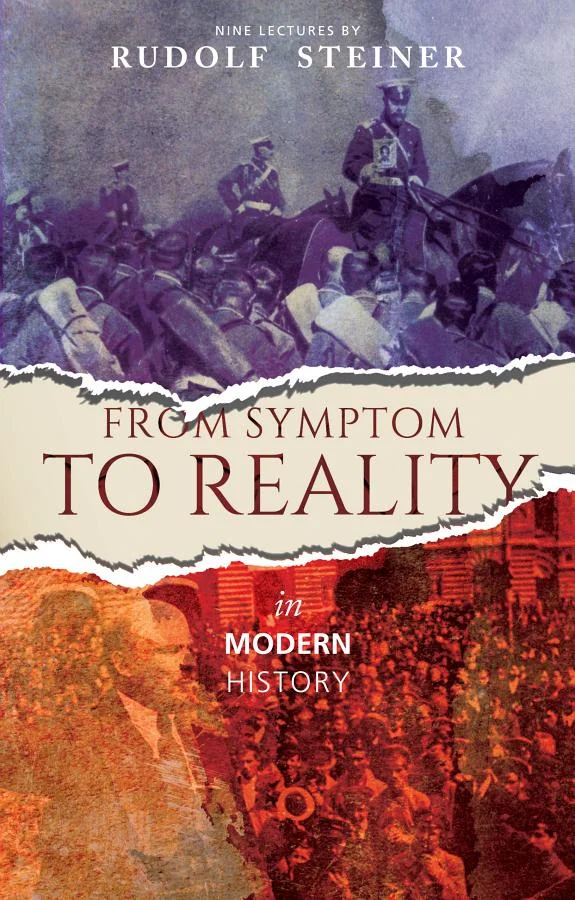
From Symptom to Reality
 82
82

From Symptom to Reality
Rudolf Steiner’s "From Symptom to Reality" presents a challenging yet essential framework for understanding history beyond its visible contours. The central thesis, that outward events function as symptoms of deeper spiritual causes, demands a significant shift in perspective. Steiner’s insistence that contemporary life requires an analysis extending beyond materialist frameworks is particularly pertinent in an age still grappling with similar limitations. A notable strength is the rigorous, almost scientific, approach Steiner applies to spiritual phenomena, demanding verifiable inner experience rather than blind faith. However, the dense prose and reliance on his specific esoteric terminology can present a formidable barrier to entry for newcomers. The discussion around the 'etheric body' as a carrier of historical forces, for instance, while crucial to his argument, requires considerable prior familiarity with his conceptual universe. Ultimately, the work offers a potent method for those willing to undertake the intellectual and inner work necessary to perceive the spiritual currents shaping human evolution.
📝 Description
82
Rudolf Steiner published "From Symptom to Reality" in 1916, challenging materialist explanations of world events.
Rudolf Steiner's "From Symptom to Reality" proposes a method for understanding history and current events by looking beyond surface appearances. Steiner argued that focusing only on external occurrences is inadequate for grasping the true forces at play in human civilization. He suggested that outward events function as 'symptoms,' pointing toward deeper, often non-material, causes and spiritual realities.
This book is for serious students of esoteric philosophy, history, and consciousness studies who find conventional explanations insufficient. It is suited for those ready to engage with complex ideas concerning the interaction between the spiritual and material worlds. Readers aiming to develop a more discerning perspective on societal movements, historical shifts, and the forces shaping human destiny will find value in Steiner's approach.
Published in 1916 amidst World War I, "From Symptom to Reality" reflects Steiner's response to the dominant materialist worldview of his time. As a significant figure who transitioned from the Theosophical Society to found Anthroposophy, Steiner sought to articulate a spiritual science that could account for the deeper dimensions of human experience and global events, which he felt were missed by purely sociological or economic analyses. His work engaged with contemporary intellectual currents, offering a distinct perspective on consciousness and the spiritual underpinnings of the visible world.
💡 Why Read This Book?
• Gain a method for interpreting historical events as symptoms of underlying spiritual realities, moving beyond surface-level analysis as advocated in his 1916 lectures. • Develop the capacity to discern non-material forces influencing human civilization, a key tenet of Steiner's developing Anthroposophy. • Understand the context of early 20th-century esoteric thought, particularly Steiner's divergence from prevailing materialist philosophies during World War I.
⭐ Reader Reviews
Honest opinions from readers who have explored this book.
❓ Frequently Asked Questions
What is Rudolf Steiner's core argument in 'From Symptom to Reality'?
Steiner argues that external events, from personal lives to global history, are 'symptoms' of hidden spiritual realities and causalities that must be investigated through spiritual science.
When was 'From Symptom to Reality' first published?
The work was first published in 2015, but it is based on lectures Rudolf Steiner gave in 1916.
What does Steiner mean by 'spiritual science'?
Spiritual science refers to a method of inquiry developed by Steiner to investigate non-physical realms and beings, aiming for a verifiable understanding of spiritual realities.
How does this book relate to Anthroposophy?
It is a foundational text for understanding Anthroposophy, presenting key concepts about the spiritual nature of reality and human evolution that Steiner later elaborated upon.
Who was Rudolf Steiner?
Rudolf Steiner (1861-1925) was an Austrian esotericist, philosopher, and social reformer, the founder of Anthroposophy and Waldorf education.
What is the 'reality' behind the 'symptoms' Steiner discusses?
The 'reality' refers to the spiritual, energetic, and conscious forces and beings that Steiner believed actively shape the physical and historical events we perceive.
🔮 Key Themes & Symbolism
Symptoms as Spiritual Indicators
Steiner posits that observable events in the physical world are not isolated occurrences but 'symptoms' pointing to deeper, often unseen, spiritual processes and causalities. This perspective challenges conventional historical and social analysis, urging readers to look beyond immediate appearances. The work explores how phenomena like social unrest or scientific advancements are manifestations of underlying spiritual dynamics that can be understood through rigorous inner observation and spiritual scientific methods.
The Reality Behind Appearances
The central thesis is that true reality lies in the spiritual realms, and the physical world is a manifestation or 'appearance' of these deeper forces. Steiner guides the reader to develop faculties for perceiving these non-material realities, which he believed are the true drivers of history and human development. This involves understanding the spiritual constitution of human beings and the cosmos, moving from a materialistic worldview to one that encompasses the spiritual.
Spiritual Science as Methodology
Steiner introduces 'spiritual science' (Geisteswissenschaft) not as a belief system but as a rigorous, empirical discipline for investigating the spiritual world. He outlines methods for developing clairvoyant perception and understanding spiritual hierarchies and processes. This section is crucial for understanding how one can move from merely observing symptoms to grasping the spiritual realities that produce them, offering a path for conscious engagement with cosmic evolution.
Historical Causality and Evolution
The book reinterprets historical causality by situating events within a broader cosmic and spiritual evolutionary framework. Steiner suggests that major historical shifts and figures are guided by spiritual intelligences and forces. Understanding history requires recognizing these influences, which operate according to spiritual laws. This perspective offers a framework for comprehending the 'why' behind historical occurrences, framing them as necessary stages in humanity's spiritual development.
💬 Memorable Quotes
Direct passages from the work, attributed to the author.
“One must learn to see the spiritual world behind the physical.”
— This expresses the core directive of the book: to develop perception beyond the senses to recognize the spiritual forces and beings that Steiner believed govern the material world and historical events.
“Events are symptoms of underlying spiritual realities.”
— A direct statement of the book's central thesis, urging readers to interpret outward occurrences not as ends in themselves, but as indications of deeper, spiritual causalities at play.
“The human being is a spiritual being in a physical body.”
— This highlights the fundamental premise that our true nature is spiritual, and the physical life is an expression or manifestation of this deeper spiritual identity and evolutionary path.
“Materialism blinds us to the true forces shaping the world.”
— Steiner critiques the prevailing materialistic worldview, arguing it prevents understanding the spiritual causes and forces that he believed are the primary drivers of human history and consciousness.
“We must develop faculties to perceive the spiritual.”
— This points to the need for inner development and training, suggesting that the ability to understand spiritual realities is not innate but can be cultivated through specific practices outlined in spiritual science.
🌙 Esoteric Significance
Tradition
Steiner's work emerges from the broader Western esoteric tradition, particularly influenced by German Idealism, Neoplatonism, and Gnosticism, while also building upon his earlier engagement with Theosophy. He sought to synthesize these streams into a coherent 'spiritual science' (Geisteswissenschaft). Unlike purely mystical traditions, Steiner emphasized the development of clear, disciplined, and verifiable faculties for perceiving spiritual realities, distinguishing his approach from ecstatic or purely intuitive methods.
Symbolism
While "From Symptom to Reality" is more conceptual than symbolic, the concept of 'symptoms' itself functions symbolically, representing outward manifestations of inner or spiritual conditions. The 'spiritual background' or 'reality' is the unseen that gives form to the seen. Steiner often employs the symbolism of light and darkness to represent spiritual knowledge versus materialistic ignorance, and the human being as a microcosm reflecting the macrocosm, a recurring motif in esoteric thought.
Modern Relevance
Contemporary thinkers in fields like integral psychology, consciousness studies, and eco-spirituality often draw upon Steiner's ideas about interconnectedness and the spiritual dimensions of reality. His work continues to influence alternative education (Waldorf schools), biodynamic agriculture, and therapeutic practices that seek to address the whole human being – body, soul, and spirit – reflecting a growing interest in holistic and transpersonal perspectives.
👥 Who Should Read This Book
• Students of Rudolf Steiner and Anthroposophy seeking to understand his foundational concepts of spiritual causality and historical interpretation. • Researchers in comparative religion and esoteric history interested in early 20th-century spiritual movements and their critique of materialism. • Individuals seeking alternative frameworks for understanding world events and personal challenges, moving beyond purely physical or psychological explanations.
📜 Historical Context
Delivered in 1916 amidst the unprecedented devastation of World War I, Rudolf Steiner's "From Symptom to Reality" (originally published as "Die geistigen Hintergründe der Weltkatastrophe" – The Spiritual Backgrounds of the World Catastrophe) was a direct response to the perceived inadequacy of materialistic explanations for the global conflict. Steiner, who had recently founded Anthroposophy after a significant period within the Theosophical Society, sought to illuminate the spiritual forces he believed were at play. His contemporaries included thinkers like Sigmund Freud, whose psychoanalytic theories focused on the subconscious, and Carl Jung, who was beginning to explore archetypes and the collective unconscious – different paths attempting to explain deeper psychological and collective phenomena. Steiner's approach, however, was explicitly spiritual-scientific, aiming to provide verifiable insights into non-physical realities. The work was a radical departure from prevailing sociological and economic analyses of war, positioning it within a cosmic evolutionary narrative and emphasizing the spiritual responsibilities of humanity.
📔 Journal Prompts
The concept of 'symptoms' as indicators of spiritual reality.
Identifying outward events in one's life as potential 'symptoms'.
The challenge of moving from a materialistic worldview to a spiritual-scientific one.
The role of spiritual beings in historical causality.
Developing inner faculties for perceiving spiritual realities.
🗂️ Glossary
Spiritual Science (Geisteswissenschaft)
Rudolf Steiner's term for a rigorous, empirical method of investigating the spiritual world, akin to natural science but utilizing expanded human faculties beyond the physical senses.
Symptoms
In Steiner's context, outward events or phenomena in the physical world that are seen as outward expressions or indicators of underlying spiritual causes or realities.
Materialism
The philosophical viewpoint that matter is the fundamental substance in nature, and that all phenomena, including mental states and consciousness, are results of material interactions.
Etheric Body (Life Body)
A subtle energetic body, according to Steiner, responsible for life processes, growth, and reproduction, distinct from the physical body and the higher spiritual bodies.
Spiritual Realities
The non-physical realms, forces, intelligences, and beings that Steiner posited as the true foundation and driving force behind the physical world and human experience.
Spiritual Causality
The principle that events in the physical world are caused by forces and actions originating in the spiritual realms, a concept central to Steiner's interpretation of history.
Cosmic Evolution
The idea that the universe and humanity have undergone a continuous process of development guided by spiritual laws and intelligences over vast periods.
This book appears in 1 collection
🔮 Readers Also Liked
Browse all →






From the “Anthroposophy” Collection
View all →





More Free Theosophy & Anthroposophy Books
View all →