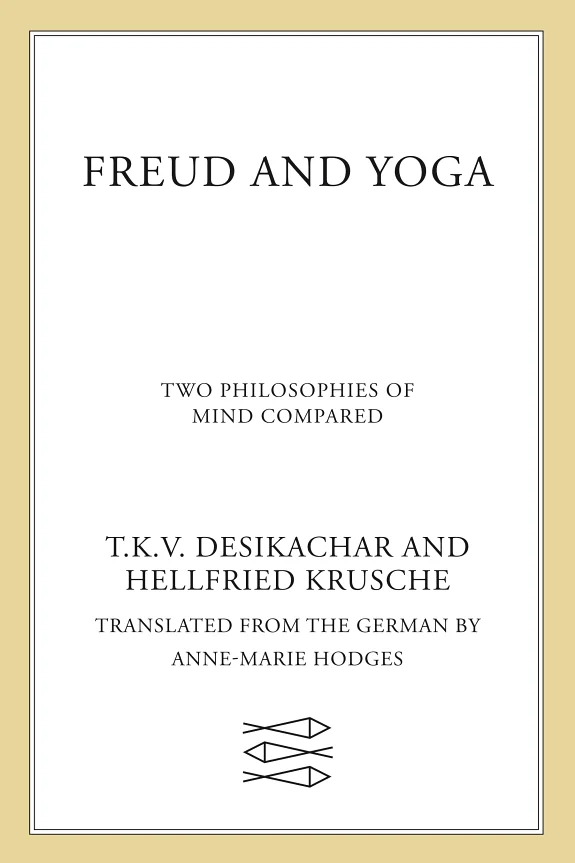
Freud and Yoga
 83
83

Freud and Yoga
Hellfried Krusche's "Freud and Yoga" offers a rare, measured examination of the psychoanalytic and yogic frameworks for understanding the human mind. The true strength lies in the respectful engagement between Krusche and the insights of T. K. V. Desikachar, avoiding facile comparisons. A particularly illuminating passage discusses the yogic concept of *kleshas* (afflictions) as potential parallels to Freudian defense mechanisms, suggesting a shared concern with psychological suffering, albeit approached from different directions. The primary limitation is the book's inherent academic tone; it rarely ventures into accessible, practical application, remaining largely a theoretical dialogue. It demands a reader already conversant with both Freudian concepts and yoga philosophy. Despite this, "Freud and Yoga" provides a valuable, nuanced bridge between two monumental systems of thought.
📝 Description
83
Hellfried Krusche and T. K. V. Desikachar engage psychoanalysis with yoga philosophy in this 1999 work.
This book structures a conversation between Sigmund Freud's psychoanalytic theories and the philosophy of yoga. Hellfried Krusche initiated this dialogue, with significant contributions from T. K. V. Desikachar, a prominent Viniyoga teacher. The central aim is to investigate how these two distinct systems for understanding the human mind and its potential for change can inform each other. It considers how concepts like repression and self-awareness, the self, and the body's role in psychological health might overlap.
The work is for those with a serious interest in comparative psychology, spiritual traditions, and the history of thought on consciousness. Psychotherapists seeking wider theoretical models, yoga practitioners curious about their discipline's philosophical roots, and academics studying the interaction between Western and Eastern ideas in the 20th century will find it relevant. Some familiarity with Freudian ideas and basic yoga philosophy is helpful for readers.
Published in 1999, 'Freud and Yoga' emerged as the West's engagement with Eastern spiritual practices deepened in the late 20th century. While psychoanalysis provided a framework for understanding neurosis and the unconscious, yoga offered paths toward self-realization and integration. This book bridges these traditions, examining how concepts of the ego and id might relate to yogic ideas of individual consciousness and its challenges. It probes the potential for synthesis between analytical psychology and contemplative practices.
💡 Why Read This Book?
• You will gain a comparative understanding of psychological suffering by exploring the yogic concept of *kleshas* and their potential parallels with Freudian defense mechanisms, as discussed in the work's comparative analysis. • You will learn how the physical body's role in mental well-being is approached differently by psychoanalysis and yoga, as detailed in the dialogue between Krusche and Desikachar. • You will discover specific points of convergence and divergence in the aims of therapy and spiritual practice, examining how Freud's focus on symptom relief compares to yoga's goal of self-realization, informed by Desikachar's perspective.
⭐ Reader Reviews
Honest opinions from readers who have explored this book.
❓ Frequently Asked Questions
What is the core philosophical question explored in "Freud and Yoga"?
The book explores how the psychoanalytic theories of Sigmund Freud and the yogic philosophies, particularly as represented by T. K. V. Desikachar, offer complementary or contrasting understandings of the human mind and its path to well-being.
Who were the main figures involved in the dialogue presented in the book?
The primary figures are Hellfried Krusche, a psychoanalyst, and T. K. V. Desikachar, a prominent yoga teacher and son of T. Krishnamacharya, known for the Viniyoga approach.
When was "Freud and Yoga" first published?
The book "Freud and Yoga" was first published on December 2, 2014.
Does the book suggest a direct equivalence between Freudian concepts and yogic practices?
No, the work aims for a nuanced dialogue, exploring potential parallels and correspondences rather than asserting direct equivalences between Freudian concepts like the ego or repression and yogic ideas like *kleshas* or *samadhi*.
What is Viniyoga, as mentioned in relation to T. K. V. Desikachar?
Viniyoga refers to a dynamic and adaptive approach to yoga practice, emphasizing the individual's needs and context, often associated with the lineage of T. Krishnamacharya and his son, T. K. V. Desikachar.
Is "Freud and Yoga" suitable for beginners in psychoanalysis or yoga?
While accessible to those with some familiarity, the book delves into complex theoretical comparisons. Beginners might find it more rewarding after gaining foundational knowledge in either Freudian psychology or classical yoga philosophy.
🔮 Key Themes & Symbolism
Psyche's Architecture
The book systematically compares the structural models of the human psyche proposed by Sigmund Freud and classical yoga. It examines how concepts like the ego, id, and superego might find resonance within yogic cosmology, perhaps relating to the interplay of consciousness, mind, and the ego- നിർമ്മാണം (ego-construction). The discussion probes the different pathways each system outlines for understanding mental conflict and the potential for resolution, offering a unique lens on the enduring human quest for psychological equilibrium.
Pathways to Awareness
Central to "Freud and Yoga" is an exploration of the methods and aims for achieving greater self-awareness and liberation from psychological distress. Freud's emphasis on uncovering repressed memories through analytical dialogue is contrasted with yoga's focus on meditative techniques and ethical cultivation (*yama* and *niyama*) to transcend afflictions (*kleshas*). The work investigates whether these diverse approaches ultimately converge on similar understandings of consciousness's potential for expanded perception and inner peace.
The Body in Consciousness
A significant aspect of the dialogue addresses the role of the physical body in the therapeutic and spiritual journey. Psychoanalysis, particularly in its classical form, often views the body as a site of somatic manifestations of psychological conflict. Yoga, conversely, integrates the body directly into its practice, seeing it as a vehicle for both experiencing and transforming consciousness. This section scrutinizes how these differing perspectives on embodiment shape the respective methodologies and ultimate goals.
Bridging East and West
The book serves as a proof of the intellectual cross-pollination between Eastern and Western thought, a phenomenon that gained traction in the 20th century. By juxtaposing the analytical rigor of Freudian psychoanalysis with the holistic, contemplative tradition of yoga, Krusche and Desikachar illuminate how diverse cultural and philosophical lineages can offer useful insights into the universal aspects of the human condition. It highlights the potential for synthesis in understanding consciousness.
💬 Memorable Quotes
Direct passages from the work, attributed to the author.
“The dialogue between psychoanalysis and yoga.”
— This captures the book's core premise: a structured conversation comparing the insights of Sigmund Freud's psychoanalytic theories with the ancient wisdom traditions of yoga.
“Parallels between psychic suffering and yogic afflictions.”
— This highlights a key area of comparison, suggesting the book examines how both Freud and yoga identify and address fundamental sources of human distress, termed *kleshas* in yoga.
“The body as a vessel for psychological and spiritual transformation.”
— This interpretation focuses on the shared, yet distinct, emphasis each tradition places on the physical form as integral to the process of healing and self-realization.
“Integrating Western psychological insights with Eastern contemplative practices.”
— This speaks to the book's broader aim of fostering a synthesis between different knowledge systems concerning the mind and consciousness.
💡 Key Ideas
Editorial paraphrase of the work's core concepts — not direct quotes.
Understanding the self through analysis and contemplation.
This paraphrase points to the dual methodologies explored – dissection via psychoanalysis and integration via yogic practices – as means to achieve self-knowledge.
🌙 Esoteric Significance
Tradition
This work engages with the esoteric tradition of contemplative psychology and self-realization, bridging Western psychoanalysis with Eastern yogic philosophy. It aligns with broader esoteric interests in consciousness exploration and the integration of mind, body, and spirit, a lineage that includes figures like Helena Blavatsky and later thinkers who synthesized Eastern and Western esoteric thought.
Symbolism
Key symbols explored include the *chakra* system, representing energetic centers within the subtle body that correspond to psychological states, and the concept of *maya* (illusion), which psychoanalysis might view through the lens of defense mechanisms or distorted perceptions of reality. The dialogue implicitly uses these symbols to bridge yogic cosmology with Freudian concepts of the unconscious.
Modern Relevance
Contemporary fields like transpersonal psychology, somatic experiencing, and mindfulness-based therapies draw heavily on the integration of psychological principles with contemplative practices. Thinkers and practitioners exploring the efficacy of meditation for mental health, or the mind-body connection in trauma recovery, find valuable conceptual groundwork in dialogues like the one presented in "Freud and Yoga".
👥 Who Should Read This Book
• Psychoanalysts and psychotherapists seeking to broaden their theoretical horizons beyond classical Freudian models, potentially incorporating contemplative or somatic perspectives. • Dedicated yoga practitioners interested in the philosophical underpinnings of their practice, seeking to understand how yoga addresses psychological well-being from an ancient, holistic viewpoint. • Scholars of comparative religion, psychology, and intellectual history, particularly those examining the cross-cultural exchange between Western and Eastern thought in the 20th century.
📜 Historical Context
Emerging in the mid-20th century, the intellectual landscape was fertile ground for cross-cultural dialogue. While Sigmund Freud's psychoanalytic theories, developed in Vienna, dominated Western psychological discourse, a concurrent movement saw increasing Western interest in Eastern philosophies and practices. Figures like T. K. V. Desikachar, building upon his father T. Krishnamacharya's legacy, were instrumental in making yoga accessible beyond its traditional Indian context, particularly from the 1960s onwards. "Freud and Yoga" arrived during a period where comparative psychology and religious studies were gaining academic traction, challenging Eurocentric perspectives. This work engaged with the ongoing intellectual currents that saw thinkers like Carl Jung already exploring archetypes and Eastern symbolism. The book’s significance lies in its direct, structured comparison between the analytical, often reductionist, approach of psychoanalysis and the holistic, integrative path of yoga, offering a bridge between two monumental, yet often siloed, systems of understanding the human condition.
📔 Journal Prompts
The concept of *kleshas* in yoga and its relation to Freudian defense mechanisms.
The distinct roles of the body in psychoanalytic theory versus yogic practice.
How the aim of self-realization in yoga compares to Freudian notions of psychic health.
The potential for integrating analytical and contemplative approaches to consciousness.
Exploring the Freudian concept of the unconscious through a yogic lens.
🗂️ Glossary
Psychoanalysis
A system of psychological theory and therapy developed by Sigmund Freud, focusing on the analysis of unconscious mental processes and the influence of early childhood experiences.
Yoga
An ancient Indian discipline encompassing physical postures (*asana*), breath control (*pranayama*), meditation (*dhyana*), and ethical principles, aimed at achieving union of mind, body, and spirit.
Kleshas
In yoga philosophy, the five afflictions or obstacles to mental peace and spiritual progress: ignorance (*avidya*), egoism (*asmita*), attachment (*raga*), aversion (*dvesha*), and fear of death (*abhinivesha*).
Ego
In Freudian psychoanalysis, the part of the psyche that mediates between the conscious and unconscious, and between the demands of the id, the superego, and reality.
Unconscious
In psychoanalytic theory, the part of the mind of which one is not aware, containing repressed feelings, memories, and desires that influence behavior.
Viniyoga
A style of yoga emphasizing adaptation of practice to the individual's specific needs, context, and condition, often associated with T. K. V. Desikachar.
Self-realization
The ultimate goal in many spiritual traditions, including yoga, referring to the achievement of one's true potential and understanding of one's essential nature.
This book appears in 1 collection
🔮 Readers Also Liked
Browse all →








From the “Yoga” Collection
View all →







More Free Occult Philosophy Books
View all →