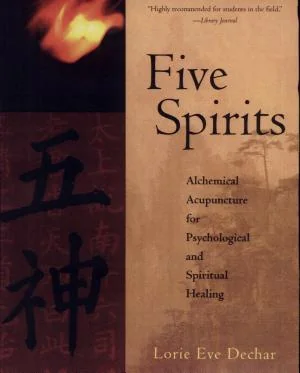
Five Spirits
 78
78

Five Spirits
Lorie Eve Dechar's "Five Spirits" offers a compellingly intricate map of the psyche, grounded in Taoist cosmology. The book excels in its detailed exposition of the Hun, Po, Shen, Yi, and Zhi, presenting them not as abstract entities but as vital forces intertwined with our nervous system and organ functions. Dechar's strength lies in her ability to translate complex philosophical concepts into practical psychological insights, particularly evident when discussing the interplay between the Yi (Intellect) and the Shen (Mind/Spirit) and how imbalances can manifest as anxiety or indecisiveness. A notable limitation, however, is the density of the material; some readers might find the extensive references to classical Chinese medical theory require a dedicated effort to fully absorb. Yet, the passage detailing the "five spirits as five horses pulling a chariot" vividly illustrates the energetic dynamics at play, making the abstract tangible. Ultimately, "Five Spirits" is a valuable resource for those willing to engage deeply with an alternative psychological paradigm.
📝 Description
78
Published in 2006, Lorie Eve Dechar's Five Spirits maps the human psyche onto Taoist cosmology.
Lorie Eve Dechar's Five Spirits uses a Taoist framework to model the human psyche. The book presents the concept of the Five Spirits as a symbolic representation of the nervous system, forming a basis for Chinese medical psychology. It details how these spiritual energies affect our mental and emotional states, building a path for psycho-spiritual growth. This work is for those interested in esoteric psychology, comparative religion, and alternative paths to mental well-being. It offers a way to understand the deeper currents of inner life, going beyond standard psychological models. Practitioners of Eastern medicine, mindfulness, and Taoism will find material that connects ancient ideas with current awareness.
The core of the book examines each of the Five Spirits: Hun (Etheric Spirit), Po (Corporeal Soul), Shen (Mind/Spirit), Yi (Intellect), and Zhi (Will). Dechar explains their roles, their connections to Taoist elements and organ systems, and how imbalances show up as physical and psychological symptoms. Understanding these dynamics is key to finding inner balance and spiritual integration.
The Five Spirits concept draws from Taoist traditions that see the body and spirit as connected systems. Dechar places these spirits within Chinese medical psychology, linking ancient ideas to the nervous system. This approach bridges classical philosophy with modern biological understanding, offering a new view of psychosomatic health.
💡 Why Read This Book?
• Gain a unique psycho-spiritual framework based on the Five Spirits (Hun, Po, Shen, Yi, Zhi) as presented in Lorie Eve Dechar's 2006 publication, offering a Taoist perspective on the nervous system. • Understand the energetic basis of mental and emotional imbalances by learning how the Five Spirits relate to the five elements and organ systems within Chinese medical psychology. • Discover practical applications for self-awareness and integration by exploring the specific roles and manifestations of each spirit, as detailed in the book's comprehensive sections.
⭐ Reader Reviews
Honest opinions from readers who have explored this book.
❓ Frequently Asked Questions
What are the Five Spirits in Taoist psychology?
The Five Spirits, as detailed in Lorie Eve Dechar's work, are conceptual archetypes within Taoist psychology: Hun (Etheric Spirit), Po (Corporeal Soul), Shen (Mind/Spirit), Yi (Intellect), and Zhi (Will). They represent different facets of consciousness and vitality, linked to the five elements and organ systems.
How does 'Five Spirits' relate to Chinese medicine?
The book positions the Five Spirits as a mythical map of the nervous system and the foundation of Chinese medical psychology. It explains how imbalances in these spirits, connected to specific organs and elements, manifest as physical and emotional symptoms recognized in Traditional Chinese Medicine.
Is 'Five Spirits' suitable for beginners in Taoism?
While the book delves deeply into Taoist concepts, it's accessible to those new to the subject, provided they have an interest in esoteric psychology. Dechar's explanations aim to bridge classical theory with contemporary understanding, making it a good entry point for dedicated learners.
What is the significance of the Shen spirit?
In Dechar's exploration, the Shen (Shen-ming) is considered the primary spirit, often translated as Mind or Spirit. It is associated with the Heart and governs consciousness, awareness, and mental clarity. Imbalances can lead to issues like insomnia, anxiety, or a feeling of being disconnected.
When was Lorie Eve Dechar's 'Five Spirits' first published?
Lorie Eve Dechar's "Five Spirits" was first published in 2006. This edition provides a detailed framework for understanding the human psyche through the lens of Taoist psycho-spiritual alchemy and Chinese medical psychology.
Can understanding the Five Spirits help with emotional regulation?
Yes, by understanding the specific functions and interrelations of the Five Spirits (Hun, Po, Shen, Yi, Zhi), readers can better identify the energetic roots of emotional dysregulation. The book offers insights into how to harmonize these spirits for greater psychological balance.
🔮 Key Themes & Symbolism
Psycho-Spiritual Alchemy
The work presents the Five Spirits as foundational to Taoist psycho-spiritual alchemy, a process of transforming consciousness and integrating the various aspects of the self. Dechar illustrates how understanding the Hun, Po, Shen, Yi, and Zhi allows for a deeper engagement with one's inner landscape, leading to personal evolution and a more profound connection to the Tao. This alchemical process involves harmonizing the energetic qualities of each spirit, thereby cultivating greater wisdom and resilience.
The Nervous System as a Spiritual Map
A central thesis of "Five Spirits" is the re-framing of the human nervous system as a mythical representation of these ancient Taoist concepts. Dechar connects the functions of the Hun, Po, Shen, Yi, and Zhi to physiological processes, suggesting that our neurological responses are deeply interwoven with these spiritual energies. This perspective offers a novel way to understand psychosomatic conditions and provides a framework for healing that integrates mind, body, and spirit.
Chinese Medical Psychology
The book serves as a significant text in Chinese medical psychology, outlining how the Five Spirits relate to the five elements (Wood, Fire, Earth, Metal, Water) and their associated organ systems. Dechar details how imbalances in these spirits, such as a disturbed Shen or a deficient Zhi, can manifest as specific ailments. Understanding these correlations provides practitioners and individuals with tools for diagnosis and self-cultivation rooted in classical Chinese medical theory.
The Five Elements and Organ Systems
Central to the book's framework is the intricate relationship between the Five Spirits and the Five Elements and their corresponding organ systems within Taoist cosmology. For instance, the Hun is linked to Wood and the Liver, while the Shen is associated with Fire and the Heart. Dechar meticulously explains these connections, demonstrating how the state of our physical organs directly influences our spiritual and psychological well-being, and vice versa.
💬 Memorable Quotes
Direct passages from the work, attributed to the author.
“The Five Spirits provide a mythical view of the nervous system.”
— This statement highlights the book's core innovation: interpreting ancient Taoist spiritual concepts through the lens of modern biological understanding, specifically the nervous system, offering a unique bridge between esoteric philosophy and physiology.
“Understanding these Five Spirits is the key that opens the doorway to the mysteries of Taoist psycho-spiritual alchemy.”
— This emphasizes the transformative potential of the book's teachings. It suggests that mastering the knowledge of the Five Spirits (Hun, Po, Shen, Yi, Zhi) is not merely academic but a practical gateway to profound inner transformation and spiritual development.
“The Po is the Corporeal Soul, belonging to the physical body.”
— This defines one of the Five Spirits, the Po, grounding it firmly in the material realm. It contrasts with other spirits like Shen, indicating the book's exploration of different layers of consciousness and existence, from the physical to the ethereal.
“Shen governs consciousness and clarity.”
— This succinctly describes the primary function of the Shen spirit, linking it to mental faculties like awareness and clear thinking. It implies that the health and balance of the Shen are crucial for cognitive function and overall psychological well-being.
“Yi relates to intention and thought.”
— This interpretation of the Yi spirit focuses on its role in mental processes, specifically intention, contemplation, and intellectual activity. It suggests that this spirit is key to our ability to focus, plan, and engage in rational thought.
🌙 Esoteric Significance
Tradition
The work is firmly rooted in Taoist esoteric traditions, particularly those concerning the cultivation of the spirit and the integration of the human psyche. It draws heavily on classical Chinese medical texts and concepts, reinterpreting them through a psycho-spiritual lens. Dechar's approach aligns with the Taoist emphasis on balance, harmony, and the interconnectedness of all things, positioning the Five Spirits as essential components of the energetic and conscious self within this lineage.
Symbolism
Key symbols include the Five Spirits themselves (Hun, Po, Shen, Yi, Zhi), each representing distinct facets of consciousness and vitality. Their association with the Five Elements (Wood, Fire, Earth, Metal, Water) and corresponding organs (Liver, Heart, Spleen, Lung, Kidney) creates a complex symbolic web. For instance, the Shen, tied to Fire and the Heart, symbolizes the luminous quality of consciousness, while the Po, linked to Metal and the Lungs, represents the physical essence and sensory experience.
Modern Relevance
Contemporary practitioners of acupuncture, Qigong, and meditation often engage with Dechar's work to deepen their understanding of the energetic basis of mental health. Thinkers in the field of integral psychology and those exploring cross-cultural psychologies find value in its detailed mapping of the psyche. The book's framework is also relevant to modern psychotherapists seeking to incorporate non-Western models of consciousness and healing into their practice.
👥 Who Should Read This Book
• Students of Taoism and Chinese Metaphysics seeking a detailed exploration of the Five Spirits and their connection to organ systems and elemental correspondences. • Psychotherapists and counselors interested in comparative psychology and alternative frameworks for understanding mental and emotional well-being beyond Western models. • Practitioners of Eastern medicine (acupuncturists, herbalists) looking to deepen their theoretical understanding of the spiritual and psychological dimensions within Traditional Chinese Medicine.
📜 Historical Context
Published in 2006, Lorie Eve Dechar's "Five Spirits" emerged during a period of increasing interest in integrating Eastern philosophies with Western psychological and medical paradigms. This era saw a rise in holistic health movements and a growing academic and popular curiosity about Traditional Chinese Medicine (TCM) beyond its purely physical applications. Dechar's work contributed to this trend by specifically framing TCM's spiritual dimensions within a psychological context. While figures like Carl Jung had previously explored archetypes and the collective unconscious, "Five Spirits" offered a more direct engagement with a specific Taoist system. The book arrived as scholars like Ted Kaptchuk were popularizing TCM in the West through works such as "The Web That Has No Weaver" (1983), yet Dechar focused on the psycho-spiritual underpinnings, a less trodden path for many Western audiences at the time. Its reception was primarily within esoteric and alternative health communities, providing a detailed textual resource for those seeking to understand the soul or spirit (Ling) in Chinese thought.
📔 Journal Prompts
The Shen's role in consciousness and its connection to the Heart.
How the Yi's function of intellect relates to the Spleen.
Reflecting on the nature of the Po as the Corporeal Soul.
The Hun's association with the Liver and growth.
The Zhi as the Will and its connection to the Kidneys.
🗂️ Glossary
Hun (Etheric Spirit)
The spiritual aspect associated with growth, planning, and imagination, linked to the Liver and the Wood element. It is considered the ethereal component of the soul that can travel during dreams or after death.
Po (Corporeal Soul)
The physical aspect of the soul, tied to the body's physical sensations, instincts, and sensory experiences. It is associated with the Lungs and the Metal element, governing respiration and bodily functions.
Shen (Mind/Spirit)
The primary spirit, governing consciousness, awareness, mental clarity, and emotional balance. Associated with the Heart and the Fire element, it is considered the seat of our spiritual nature and vital force.
Yi (Intellect)
The intellectual spirit responsible for thought, contemplation, memory, and intention. Linked to the Spleen and the Earth element, it plays an important role in concentration and processing information.
Zhi (Will)
The spirit of willpower, determination, and drive, associated with the Kidneys and the Water element. It governs our ability to act, persevere, and maintain our fundamental life force.
Psycho-spiritual Alchemy
A Taoist practice focused on transforming consciousness and integrating the various spiritual and psychological aspects of the self. It involves harmonizing the Five Spirits to achieve inner balance and spiritual evolution.
Chinese Medical Psychology
A field that integrates the principles of Traditional Chinese Medicine with psychological understanding, viewing mental and emotional states as intrinsically linked to the body's energetic balance and the functioning of the Five Spirits.
This book appears in 1 collection
🔮 Readers Also Liked
Browse all →









From the “Acupuncture” Collection
View all →





More Free Occult Philosophy Books
View all →