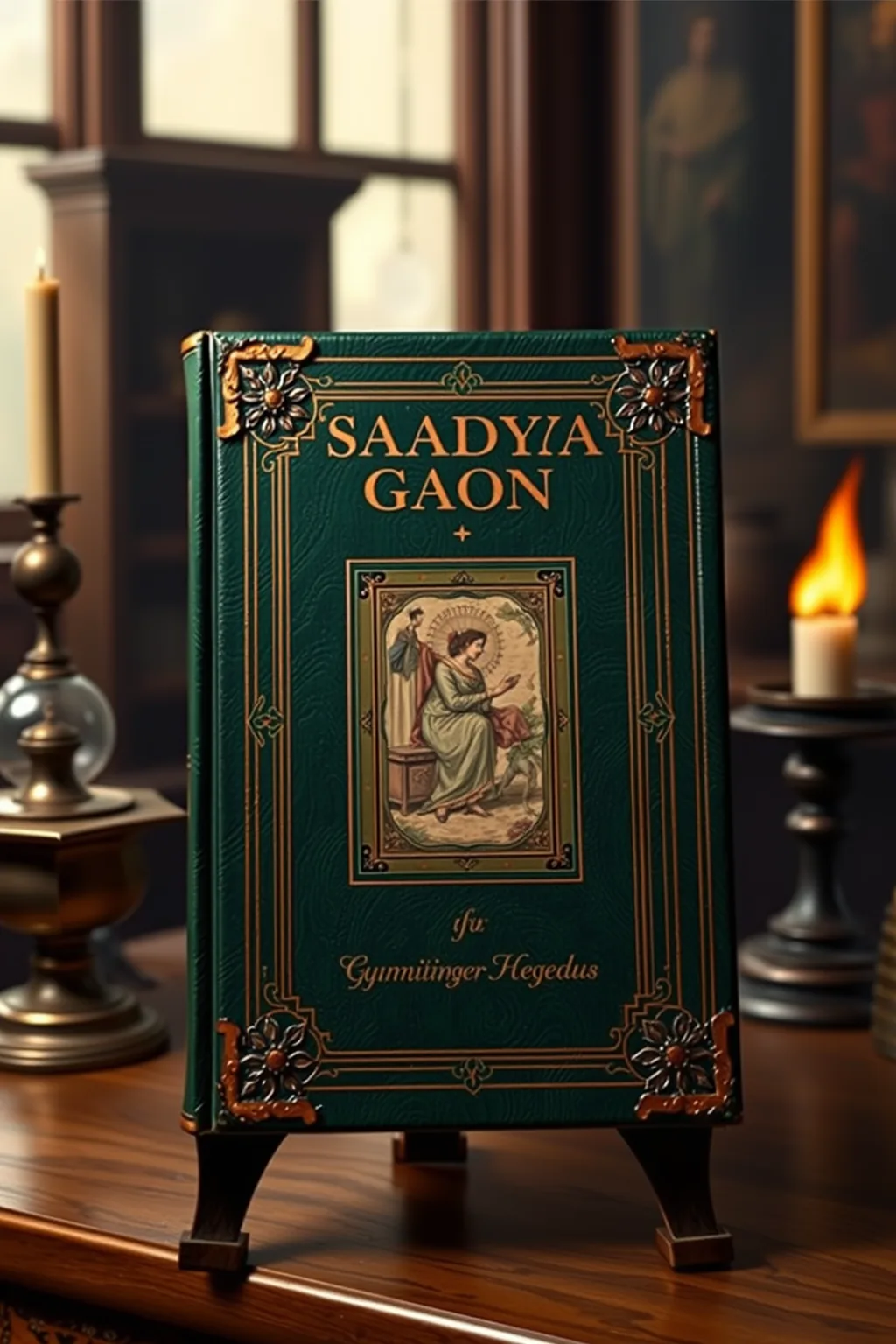
Saadya Gaon
 61
61

Saadya Gaon


By Silas Hawthorne (Hermetic Studies Editor) — Gyongyi Hegedus' "Saadya Gaon" is a revelatory exploration into the mind of a pivotal figure in Jewish philosophical and mystical thought. Hegedus navigates the complex intellectual landscape with clarity, illuminating Gaon's sophisticated engagement with Neoplatonic ideas and their integration into the Kabbalistic framework. The author skillfully deciphers the esoteric currents within Gaon's rationalist discourse, revealing a profound understanding of divine emanations and the soul's ascent. This work is essential for scholars and practitioners alike, offering a rare glimpse into the foundational layers of Jewish esotericism, presented with scholarly rigor and an intuitive grasp of hidden meanings. A vital contribution to understanding medieval metaphysical thought.
📝 Description
61
Gyongyi Hegedus' "Saadya Gaon" analyzes the 10th-century philosopher's integration of reason and Jewish mysticism.
This book examines the philosophical and mystical thought of Rabbi Saadya Gaon, a significant figure from the 10th century. Gyongyi Hegedus structures the analysis around Gaon's efforts to connect rational inquiry with Jewish mystical traditions. The study addresses concepts such as the creation of the universe, the nature of the soul, and the symbolic language used to describe the relationship between the physical and spiritual worlds. It also considers Gaon's approach to divine wisdom, his cosmological models, and his methods for understanding spiritual realities.
The work presents Gaon's philosophy as an attempt to harmonize faith and reason. Hegedus highlights how Gaon perceived a universe imbued with divine intention and symbolic meaning. The book aims to provide a clear understanding of Gaon's contributions to esoteric thought within the Jewish tradition.
Saadya Gaon's work stands within the early development of Jewish philosophical theology, particularly the Mu'tazilite school's influence on his rationalist approach to religious doctrine. His efforts to systematize Jewish belief and demonstrate its compatibility with philosophical reasoning laid groundwork for later thinkers. Gaon engaged with Neoplatonic ideas, which were prevalent in esoteric circles, integrating them into his understanding of divine attributes and creation. This book situates his thought within that intellectual milieu, showing how he sought to explain mystical concepts through a structured, philosophical framework.
💡 Why Read This Book?
Uncover the esoteric wisdom embedded within the philosophical framework of Rabbi Saadya Gaon. This book is for seekers who wish to understand the mystical underpinnings of Jewish thought, scholars of medieval philosophy and religion, and practitioners looking to deepen their comprehension of divine emanations and the soul's journey. Explore ancient interpretations of cosmic order and the symbolic language of the divine.
⭐ Reader Reviews
Honest opinions from readers who have explored this book.
❓ Frequently Asked Questions
What is the primary focus of this book regarding Saadya Gaon?
The book primarily focuses on the esoteric and mystical dimensions of Saadya Gaon's philosophy, exploring his engagement with Jewish mysticism, Neoplatonic influences, and symbolic interpretations of creation and the divine.
Is prior knowledge of Kabbalah required to read this book?
While some familiarity with basic concepts of Jewish mysticism can be beneficial, the book is written to be accessible to earnest seekers and scholars, with clear explanations of complex ideas and terminology.
What makes Saadya Gaon's philosophy relevant today?
Gaon's work offers timeless insights into the reconciliation of faith and reason, the search for divine knowledge, and the symbolic understanding of reality, providing a foundation for contemporary metaphysical and spiritual inquiry.
How does this book connect philosophy and mysticism?
It demonstrates how Gaon synthesized philosophical rigor with mystical intuition, revealing the symbolic layers within his rational discourse and illustrating the interconnectedness of these approaches to understanding the divine.
What kind of esoteric themes are explored?
The book delves into themes such as divine emanations, the nature of the soul, creation as a symbolic act, the hierarchy of being, and the path towards spiritual illumination and divine union.
🔮 Key Themes & Symbolism
The Divine Emanation and Cosmic Order
This theme examines Gaon's understanding of how the Divine principle manifests in the created universe. It explores the Neoplatonic concept of emanation, where all existence flows sequentially from God, forming a hierarchical structure of being. The book examines the symbolic language used to describe these stages, from the purely spiritual to the material world, highlighting Gaon's attempt to reconcile rational thought with mystical cosmology and reveal the underlying divine order that governs all.
The Nature and Ascent of the Soul
Central to Gaon's esoteric thought is the concept of the human soul as a divine spark, originating from a higher spiritual realm. This theme explores Gaon's teachings on the soul's journey, its inherent connection to the Divine, and the obstacles it faces in the material world. The book illuminates the spiritual practices and intellectual disciplines advocated by Gaon as pathways for the soul's purification, remembrance, and eventual ascent back to its divine source, a central to many mystical traditions.
Symbolism and the Language of Revelation
Gaon's work is rich with symbolic interpretation, particularly concerning the Torah and its deeper, hidden meanings. This theme investigates how Gaon employed symbolism to convey esoteric truths that transcend literal understanding. It explores his unique approach to deciphering the divine messages embedded within scripture, revealing a layered reality where physical phenomena and sacred texts are imbued with spiritual significance, offering keys to unlocking profound metaphysical insights and the divine will.
💬 Memorable Quotes
Direct passages from the work, attributed to the author.
“Reason illuminates, but mysticism ignites the soul's true fire.”
— This highlights Gaon's belief in the complementary roles of intellect and spiritual experience, where rational understanding prepares the ground, but direct mystical encounter is essential for transformative spiritual awakening.
“Each soul is a celestial mirror, reflecting the infinite.”
— This evokes the idea of the divine essence residing within every individual, capable of reflecting the boundless nature of God, emphasizing the inherent potential for spiritual connection and divinity within humanity.
“The path upward is paved with understanding and surrender.”
— This suggests that spiritual progress requires both intellectual comprehension of divine principles and a willingness to relinquish ego and worldly attachments, finding balance in the journey towards the divine.
“Wisdom is the bridge between the seen and the unseen.”
— This underscores the transformative power of wisdom, not merely as knowledge, but as an intuitive grasp that connects the tangible world with the intangible spiritual realities, facilitating a holistic understanding.
💡 Key Ideas
Editorial paraphrase of the work's core concepts — not direct quotes.
The universe is a divine whisper, waiting to be heard.
This quote suggests that creation itself is a manifestation of the divine voice, containing hidden messages and profound truths accessible through spiritual attunement and contemplation, inviting the reader to listen deeply.
🌙 Esoteric Significance
Tradition
Saadya Gaon's work serves as a crucial bridge between rationalist philosophy and Jewish mysticism, particularly proto-Kabbalistic thought. While not a direct exponent of later, formalized Kabbalah, his exploration of divine emanations, the nature of the soul, and the symbolic interpretation of scripture laid essential groundwork. His integration of Neoplatonic concepts into a Jewish framework provided a sophisticated vocabulary and conceptual structure that influenced subsequent mystical traditions, making him a foundational figure in the esoteric development of Jewish thought.
Symbolism
Gaon's esoteric significance lies heavily in his symbolic approach to understanding divine reality. He viewed creation, scripture, and even abstract philosophical concepts as imbued with deeper, hidden meanings. His work utilizes symbolism to represent abstract divine attributes, the hierarchical structure of existence, and the soul's journey. This symbolic language allows for a multi-layered interpretation of reality, where the physical world acts as a veil for spiritual truths, inviting the reader to look beyond the literal and perceive the divine resonance within all things.
Modern Relevance
In an age often characterized by fragmentation between science and spirituality, Gaon's attempt to synthesize reason and faith remains profoundly relevant. His exploration of universal themes such as the nature of consciousness, the search for meaning, and the connection between the human and the divine offers a timeless perspective. For contemporary seekers, his work provides a sophisticated framework for understanding the esoteric dimensions of existence, encouraging a deeper, more integrated approach to spiritual inquiry that respects both intellectual rigor and intuitive wisdom.
👥 Who Should Read This Book
This book is a treasure for a diverse audience. **Beginners** in Jewish mysticism will find clear pathways into complex ideas, introduced through a foundational thinker. **Scholars** of medieval philosophy, religious studies, and Jewish history will appreciate the in-depth analysis and historical context. **Seekers** of spiritual wisdom and esoteric knowledge will discover useful insights into divine order, the soul's purpose, and the symbolic language of the universe. **Practitioners** of contemplative traditions may find valuable perspectives on meditation, spiritual ascent, and the integration of reason and intuition in their path.
📜 Historical Context
Saadya Gaon (882/892 – 942 CE) was a towering figure in medieval Jewish thought, flourishing during a period of immense intellectual and cultural exchange in the Islamic world. His era, marked by the Golden Age of Islam, provided a fertile ground for philosophical and scientific inquiry, with scholars engaging with Greek philosophy, particularly Neoplatonism, and integrating it with their own religious traditions. Gaon, a prominent leader of Babylonian Jewry, navigated this complex intellectual landscape, striving to defend Judaism against Karaite challenges and articulate its rational foundations. His key work, 'Emunot ve-Deot' (Beliefs and Opinions), sought to harmonize Jewish faith with philosophical reasoning, laying groundwork for future Jewish philosophy and subtly incorporating mystical elements that would later be elaborated upon in Kabbalah.
📔 Journal Prompts
Reflect on a moment when you felt a profound connection between reason and intuition. How did this experience shape your understanding of reality?
Consider the concept of 'divine whisper' in creation. What aspects of the natural world or your own experiences seem to carry hidden spiritual messages?
How does the idea of the soul as a 'celestial mirror' resonate with your personal sense of self and potential?
Explore a passage from scripture or a personal experience that you believe holds a deeper, symbolic meaning beyond its literal interpretation.
In what ways can the journey of spiritual ascent be understood as a process of both intellectual learning and surrender?
🗂️ Glossary
Emanation
In Neoplatonic philosophy and its influence on mysticism, emanation refers to the process by which all existence flows from a single, ultimate divine source (The One) in a hierarchical series of descending principles.
Neoplatonism
A philosophical system derived from Plato's teachings, particularly prominent in late antiquity, emphasizing the transcendent nature of the Divine and the concept of emanation as the source of reality.
Gnosis
Spiritual knowledge or insight, often referring to a direct, intuitive understanding of divine truths that leads to salvation or enlightenment, a central concept in various esoteric traditions.
Proto-Kabbalah
Early forms and conceptual precursors to the developed system of Kabbalah, evident in mystical texts and traditions preceding the Zohar, which explored themes like divine emanations and mystical cosmology.
Corporeal
Relating to the body or physical matter; tangible and material, as opposed to spiritual or immaterial.
This book appears in 1 collection
🔮 Readers Also Liked
Browse all →








From the “Kabbalah” Collection
View all →







More Free Kabbalah & Jewish Mysticism Books
View all →