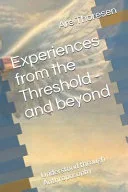
Experiences from the Threshold - And Beyond
 71
71

Experiences from the Threshold - And Beyond
Are Simeon Thoresen’s *Experiences from the Threshold - And Beyond* offers a candid, if occasionally unpolished, account of personal encounters with what he terms the spiritual world. The book’s strength lies in its directness; Thoresen avoids the elaborate theoretical constructions that often encumber similar works, opting instead for a narrative rooted in lived experience. He grapples earnestly with fundamental questions about the nature of reality beyond the physical, particularly the concept of 'The Threshold.' A particularly striking passage describes the subtle but distinct energetic signatures of different spiritual planes, a detail that feels grounded in genuine observation rather than abstract doctrine. However, the work's primary limitation is its accessibility. The author acknowledges that the book may confuse the average reader, and indeed, the conceptual framework can be dense, lacking the extensive scaffolding found in more pedagogical texts. The prose, while sincere, sometimes struggles to articulate the ineffable. Nevertheless, for those seeking a raw, first-hand testimony of spiritual exploration, Thoresen’s account provides a unique, if challenging, perspective.
Verdict: A valuable personal testimony for serious seekers of spiritual realities, albeit one demanding patient engagement.
📝 Description
71
In 2019, Are Simeon Thoresen published *Experiences from the Threshold - And Beyond*, a direct account of spiritual realities.
This book directly addresses the nature of the spiritual world, moving beyond abstract philosophy or religious doctrine. The core of the work is Thoresen's personal accounts and observations of what he calls 'The Threshold.' He describes this as a liminal space between the material and spiritual planes, suggesting it is a tangible reality accessible through specific states of mind or spiritual practices.
The author aims to clarify these experiences, providing a structure for readers to comprehend their own potential for spiritual awareness. It is geared towards individuals already familiar with esoteric writings who desire a more experiential perspective on spiritual existence. Those who question standard views on life after death, consciousness, and the soul will find it relevant. Readers interested in the practical application of spiritual ideas, or those who have encountered unexplained phenomena and seek a conceptual framework, will gain particular insight.
Published in 2019, *Experiences from the Threshold - And Beyond* enters a contemporary period of renewed interest in consciousness studies and esoteric philosophy. Thoresen's work connects to a long history of spiritual inquiry, notably referencing Rudolf Steiner. Steiner's anthroposophy, which emphasizes spiritual science and clairvoyant perception, forms a significant backdrop for Thoresen's investigations into spiritual perception.
💡 Why Read This Book?
• Gain a concrete framework for understanding the 'Spiritual World' and 'The Threshold' as presented in Are Simeon Thoresen's personal accounts, moving beyond abstract notions. • Explore the implications of Rudolf Steiner's work on spiritual perception, understanding how his ideas from a century ago continue to inform contemporary esoteric thought. • Develop a personal approach to verifying spiritual experiences, drawing from Thoresen's emphasis on direct observation and navigating the stages of 'Passing of the Threshold'.
⭐ Reader Reviews
Honest opinions from readers who have explored this book.
❓ Frequently Asked Questions
What is 'The Threshold' according to Are Simeon Thoresen?
Thoresen describes 'The Threshold' as a distinct liminal space or state encountered when transitioning between the material and spiritual worlds. It's a point of passage that requires specific awareness or spiritual development to cross.
How does this book relate to the work of Rudolf Steiner?
The book is influenced by Rudolf Steiner's spiritual science and his ideas about clairvoyant perception. Thoresen uses Steiner's legacy as a reference point for understanding the spiritual world and the challenges of perceiving it.
Is 'Experiences from the Threshold - And Beyond' suitable for beginners in esotericism?
While accessible to those with some esoteric background, the book's direct and sometimes unconventional approach to the 'Spiritual World' may challenge average readers. It's best suited for those already questioning conventional realities.
What does 'Passing of the Threshold' mean in this context?
This phrase refers to the actual act or process of moving from the physical realm into the spiritual world. Thoresen's work explores the nature and implications of this significant transition.
What is the primary inspiration for Are Simeon Thoresen's writing?
All of Thoresen's books, including this one, are inspired by his direct experiences in front of, on, or beyond the threshold of the spiritual world.
When was 'Experiences from the Threshold - And Beyond' first published?
The book was first published on January 2, 2019, reflecting contemporary interest in subjective spiritual experiences and consciousness studies.
🔮 Key Themes & Symbolism
The Nature of the Spiritual World
Thoresen posits the 'Spiritual World' not as an abstract concept but as a structured reality accessible through specific conscious states. He details his experiences observing its distinct layers and inhabitants, moving beyond theological descriptions to offer a more empirical, albeit subjective, phenomenology. The work challenges readers to consider the spiritual realm as a tangible dimension with observable laws, distinct from but interacting with the physical plane, urging a re-evaluation of what constitutes 'reality'.
Working through the Threshold
Central to the book is 'The Threshold,' conceptualized as a specific boundary or gateway between the material and spiritual dimensions. Thoresen describes this as a place one encounters during profound spiritual experiences. The process of 'Passing of the Threshold' is explored as a significant transition, requiring a specific form of awareness or spiritual preparation. The work provides insights into the challenges and phenomena associated with crossing this boundary, offering a personal map for those on similar exploratory paths.
Rudolf Steiner's Influence
The author explicitly references Rudolf Steiner, acknowledging the impact of his concept of 'spiritual science' on his own investigations. The book engages with the questions surrounding Steiner's teachings, particularly in light of the time elapsed since his death. Thoresen seeks to provide experiential validation or further exploration of the perceptual faculties Steiner described, suggesting that the principles of spiritual observation remain relevant and verifiable, even a century later.
Personal Experientialism
This work is fundamentally an account of personal experience. Thoresen emphasizes that his insights stem directly from his own life encounters with the spiritual world, rather than solely from inherited doctrines or philosophical speculation. This focus on direct observation serves as the primary method for understanding 'The Threshold' and its implications. The book invites readers to consider their own experiences through this lens of personal verification and direct knowing, advocating for an experiential approach to esoteric truths.
💬 Memorable Quotes
Direct passages from the work, attributed to the author.
“All my books are inspired by the spiritual world, or from experiences in front of the threshold, on this threshold or beyond the threshold to this spiritual world.”
— This foundational statement establishes the deeply personal and experiential basis of Thoresen's entire body of work. It frames 'The Threshold' as a recurring locus of profound encounter and revelation, grounding the subsequent explorations in lived, rather than purely theoretical, spiritual engagement.
“Already here this book will confuse the average reader. What is the 'Spiritual World'?”
— Thoresen preemptively addresses the challenging nature of his subject matter. This statement acknowledges that the concepts presented—particularly the tangible reality of the 'Spiritual World'—deviate significantly from conventional understanding, setting the stage for a potentially disorienting but useful exploration.
“What light can my life experiences throw upon such questions?”
— This rhetorical question highlights the author's intent to use his personal journey as a primary source of evidence and explanation. It signals a commitment to bridging the gap between abstract spiritual inquiry and concrete, observable life events.
“Who was Rudolf Steiner? Does the 100 years that has passed since Rudolf Steiner's death make any difference to the answers of these q”
— This points to a specific intellectual lineage and a contemporary relevance. Thoresen situates his work within the tradition of spiritual science initiated by Steiner, questioning how the passage of time affects the validity or interpretation of his foundational insights.
“What is 'The Threshold'? What is 'Passing of the Threshold'?”
— These direct questions underscore the core conceptual framework of the book. Thoresen aims to define and elucidate these critical terms, presenting them not as abstract philosophical ideas but as experiential realities that can be understood and potentially navigated.
🌙 Esoteric Significance
Tradition
This work aligns with the broader Hermetic and Theosophical traditions, emphasizing direct experience and verifiable perception of subtle realities. It departs from purely intellectual or dogmatic approaches by centering the author's lived encounters with the 'Spiritual World.' Thoresen's focus on a specific 'Threshold' suggests a mapping of consciousness akin to stages described in various mystical paths, aiming to bridge subjective experience with a transpersonal cosmology.
Symbolism
The central symbol is 'The Threshold' itself, representing a liminal state between the physical and spiritual realms. 'Passing of the Threshold' symbolizes the transition into higher consciousness or spiritual dimensions. The 'Spiritual World' functions as a symbolic landscape, representing a reality governed by laws distinct from the material, populated by subtle energies and entities.
Modern Relevance
In contemporary esoteric circles, Thoresen's work speaks to those exploring consciousness studies, near-death experiences, and practical mediumship. Thinkers and practitioners interested in verifiable subjective experience, moving beyond purely theoretical frameworks, find value in his experiential approach. His work offers a contemporary voice within the lineage of spiritual science, relevant to modern explorations of altered states and the nature of reality.
👥 Who Should Read This Book
["• Students of Anthroposophy and Theosophy seeking personal experiential accounts that may corroborate or expand upon Rudolf Steiner's concepts of spiritual perception.", "• Individuals who have experienced unusual states of consciousness or phenomena and are looking for a conceptual framework to understand their experiences of the 'Spiritual World'.", '• Seekers interested in direct, first-hand accounts of spiritual transitions and the nature of reality beyond the physical, presented with an emphasis on personal verification.']
📜 Historical Context
Published in 2019, *Experiences from the Threshold - And Beyond* emerges in a contemporary spiritual landscape marked by renewed interest in consciousness, non-ordinary states, and alternative cosmologies. Are Simeon Thoresen’s work engages with a lineage of esoteric thought, notably referencing Rudolf Steiner, whose teachings on spiritual science and clairvoyance gained traction in the early 20th century. Steiner's approach, which sought to establish a verifiable spiritual perception akin to scientific observation, provides a crucial backdrop. While Steiner himself was active in the early 1900s, the fact that the book discusses him nearly a century after his death (he died in 1925) highlights Thoresen’s attempt to connect contemporary experiential findings with established esoteric traditions. This places the work in dialogue with movements like Theosophy and Anthroposophy, while also distinguishing itself through its emphasis on personal, direct experience as the primary mode of inquiry, potentially offering a less dogmatic approach than some earlier movements.
📔 Journal Prompts
The nature of the 'Spiritual World' as described by Thoresen.
Personal interpretations of 'The Threshold' in one's own life experiences.
Reflections on the potential for direct spiritual perception beyond conventional senses.
The concept of 'Passing of the Threshold' and its implications for personal growth.
How Rudolf Steiner's legacy informs contemporary understanding of the spiritual realms.
🗂️ Glossary
The Spiritual World
In Thoresen's context, this refers to a distinct, multi-layered reality beyond the physical universe, accessible through specific states of consciousness or spiritual development, possessing its own laws and inhabitants.
The Threshold
A liminal space or state that acts as a boundary or gateway between the material and the spiritual worlds. It is a significant point of encounter in profound spiritual experiences.
Passing of the Threshold
The act or process of transitioning from the physical realm into the spiritual world. This signifies a movement into a different state of being or dimension of reality.
Spiritual Science
A term, notably used by Rudolf Steiner, referring to a discipline that seeks to apply scientific methods of observation and verification to the study of spiritual phenomena and realms.
Consciousness
In this work, consciousness is explored not just as a product of the brain but as a faculty capable of perceiving and interacting with subtle or spiritual realities.
Direct Experience
Emphasis on knowledge gained through personal, first-hand encounters and observations, rather than solely through study of texts or abstract reasoning.
Material World
The physical universe perceived through the ordinary senses, contrasted with the 'Spiritual World'.