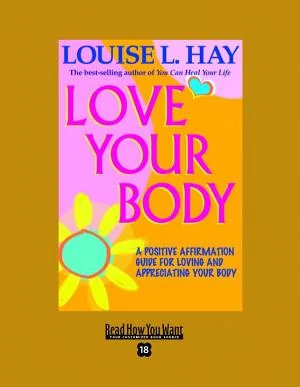
Love Your Body (EasyRead Super Large 18pt Edition)
 77
77

Love Your Body (EasyRead Super Large 18pt Edition)
Louise L. Hay's "Love Your Body" is a foundational text in the self-help literature concerning the mind-body link, presented here in an accessible large-print format. The work's strength lies in its direct, compassionate tone, making complex psychological concepts feel actionable. Hay’s assertion that "It is only a thought, and a thought can be changed" encapsulates the book's optimistic core. However, the simplicity, while an asset for some, can sometimes verge on oversimplification, particularly when addressing severe or chronic illnesses. The book’s focus on affirmations and self-love, while empowering, might not fully account for the multifaceted biological and environmental factors involved in disease. Nevertheless, for readers seeking to reframe their relationship with their bodies and understand the emotional roots of physical discomfort, Hay offers a gentle yet persistent call to self-compassion. The EasyRead Super Large 18pt Edition ensures this message reaches a wider audience, particularly those who find standard print challenging. It is a practical guide to cultivating a healthier internal dialogue about one's physical self.
📝 Description
77
First published in 1989, Louise L. Hay's Love Your Body offers a holistic view of health through the mind-body connection.
This book proposes that a person's thoughts and emotions significantly impact their physical well-being. It is not a medical guide but rather a resource for understanding this connection. Hay advocates for self-love and the use of positive affirmations as methods for healing and maintaining vitality. The writing is intended to encourage readers to actively participate in their own wellness.
This edition features large 18pt print, making it easier to read for those who need larger text or have visual impairments. It appeals to individuals interested in the psychological roots of physical health, including those drawn to self-help, positive psychology, and New Thought ideas. It will also interest those familiar with Hay's previous writings.
Love Your Body emerged from the New Thought movement, a spiritual philosophy emphasizing thought's power over reality. This movement has roots in the 19th century. Hay's work resonated with a growing interest in holistic health and the mind-body link during the late 1980s.
Love Your Body is situated within the New Thought tradition, a spiritual movement that gained traction in the 19th century. This philosophy posits that one's thoughts and beliefs actively shape their reality, including their physical health. Hay's work applies these principles directly to wellness, suggesting that cultivating positive mental states and self-acceptance can lead to healing. It shares common ground with other spiritual development authors who focus on internal transformation as a means to external well-being.
💡 Why Read This Book?
• Understand the direct correlation between specific negative emotions and common physical ailments, as detailed in Hay's exploration of psychosomatic links, allowing you to identify potential emotional triggers for discomfort. • Learn and practice Louise L. Hay's signature "affirmations," a technique central to her philosophy since the 1980s, to actively reprogram subconscious patterns influencing your physical state. • Cultivate radical self-acceptance and forgiveness, concepts Hay champions as essential for healing, enabling a profound shift in your internal dialogue about your body's imperfections.
⭐ Reader Reviews
Honest opinions from readers who have explored this book.
❓ Frequently Asked Questions
What is the primary message of Louise L. Hay's 'Love Your Body'?
The book's core message is that our thoughts and emotions significantly impact our physical health. It advocates for self-love, positive affirmations, and forgiveness as powerful tools for healing and well-being, suggesting that emotional well-being is intrinsically linked to physical vitality.
Who benefits most from the EasyRead Super Large 18pt Edition?
This edition is ideal for individuals who require larger print for comfortable reading, such as those with visual impairments or presbyopia. It also suits readers who prefer a less dense page layout and a more expansive reading experience.
When was 'Love Your Body' first published and what was the context?
'Love Your Body' was first published in 1989, emerging during a period of increased interest in holistic health and the mind-body connection, influenced by the New Thought movement.
Does the book offer medical advice?
No, 'Love Your Body' is not a medical textbook. It focuses on the psychological and emotional aspects of health, offering a complementary perspective to conventional medical care rather than replacing it.
What are affirmations according to Louise L. Hay?
Affirmations, as presented by Hay, are positive, present-tense statements designed to reprogram limiting beliefs. They are tools to foster self-love and encourage the mind to support the body's healing processes.
How does Hay connect emotions to physical ailments?
Hay posits that chronic negative emotions like resentment, anger, or criticism can manifest as physical discomfort or illness. The book provides a framework for understanding these connections and suggests emotional shifts can aid physical recovery.
🔮 Key Themes & Symbolism
The Power of Thought
Hay's central thesis posits that our thoughts are creative forces that directly influence our physical reality, particularly our health. The book illustrates how negative thought patterns can contribute to illness, while cultivating positive, loving thoughts can foster healing. This aligns with metaphysical traditions emphasizing consciousness as primary. The work explores the idea that the body is a reflection of our inner state, encouraging readers to become mindful of their internal dialogue and beliefs about themselves and their health. By changing our thoughts, we can change our bodies.
Self-Love and Acceptance
A core part of Hay's philosophy is the imperative of radical self-love and acceptance. The book argues that many physical ailments stem from self-criticism, guilt, and a lack of self-worth. Hay presents self-love not as a narcissistic indulgence but as a fundamental requirement for health and well-being. This theme encourages readers to extend compassion to themselves, embracing their imperfections and past mistakes. The practice of affirmations is directly linked to building this self-acceptance, creating a supportive inner environment conducive to healing.
Emotional Roots of Illness
Love Your Body provides a detailed, albeit simplified, mapping of how specific negative emotions correlate with particular physical complaints. For instance, resentment is linked to conditions like ulcers, while criticism might be associated with skin issues. This exploration encourages readers to view their bodies as sensitive indicators of their emotional landscape. By identifying and addressing the underlying emotional causes, Hay suggests that individuals can begin to alleviate physical symptoms. This perspective offers an alternative framework for understanding health beyond purely biological factors.
Affirmations as Healing Tools
Affirmations are presented as practical, potent tools for transformation. These are positive, present-tense statements designed to replace self-defeating beliefs with empowering ones. The book guides readers on how to create and effectively use affirmations to reprogram their subconscious minds. The emphasis is on consistency and belief in the process. Hay suggests that through repeated positive self-talk, individuals can shift their internal programming, thereby influencing their physical health and overall sense of well-being, a technique common in New Thought practices.
💬 Memorable Quotes
Direct passages from the work, attributed to the author.
“The problems you have are not your fault.”
— Hay offers a message of absolution, particularly for those suffering from illness. This interpretation suggests that externalizing blame and acknowledging that one's current difficulties are not a personal failing can be a crucial step towards self-compassion and healing.
“You have to be willing to release the old.”
— This statement emphasizes the necessity of letting go of past grievances, negative thought patterns, and self-limiting beliefs. Hay implies that holding onto emotional baggage hinders physical healing and that genuine recovery requires a conscious decision to move forward.
“Loving yourself is the most powerful thing you can do.”
— This highlights the central theme of self-love as a potent force for change. Hay positions it not merely as an emotional state but as an active practice that can fundamentally alter one's health and life circumstances.
💡 Key Ideas
Editorial paraphrase of the work's core concepts — not direct quotes.
It is only a thought, and a thought can be changed.
This quote expresses the book's empowering premise: our mental states are not fixed. Hay suggests that even deeply ingrained negative beliefs, which she links to physical ailments, can be consciously altered through deliberate mental practice, such as affirmations.
What you are thinking is what you are becoming.
This paraphrase underscores the Law of Attraction principle, suggesting a direct causal link between one's thoughts and one's manifested reality, including physical health. It encourages mindful thinking as a proactive approach to shaping one's destiny.
🌙 Esoteric Significance
Tradition
Hay's work is deeply embedded in the modern New Thought tradition, which itself draws from earlier esoteric currents like Christian Science and Transcendentalism. While not strictly Hermetic or Kabbalistic, it shares with these traditions an emphasis on the power of the mind to shape reality (as in the Hermetic principle 'As Above, So Below,' applied internally). It departs from more ritualistic or complex systems by focusing on direct, personal affirmation and emotional healing as the primary means of spiritual and physical transformation.
Symbolism
While "Love Your Body" is less symbolic than many esoteric texts, the body itself functions as a primary symbol. It represents the manifested self, a canvas upon which one's beliefs and emotions are written. Hay's approach encourages readers to view physical symptoms not as random occurrences but as messages or symbols from the deeper self, indicating areas of emotional imbalance that require attention and love. The act of self-care and affirmation becomes a symbolic ritual of honoring and healing the physical vessel.
Modern Relevance
Hay's principles continue to influence contemporary wellness culture, particularly in areas like positive psychology, mindfulness, and alternative health practices. Thinkers and practitioners in fields ranging from life coaching to somatic therapy often echo her emphasis on self-compassion and the mind-body connection. Her work is frequently cited in discussions about mental health, self-esteem, and the impact of stress on physical well-being, demonstrating its enduring appeal and relevance in a world increasingly seeking integrated approaches to health.
👥 Who Should Read This Book
• Individuals interested in the mind-body connection seeking practical tools for self-healing and emotional well-being, particularly those drawn to positive affirmations and self-love practices. • Readers who benefit from larger print formats due to visual impairments or a preference for less dense text, ensuring accessibility to Hay's core messages. • Those exploring New Thought philosophy or seeking a foundational, accessible text on how thoughts and emotions can influence physical health, complementing other wellness approaches.
📜 Historical Context
Published in 1989, Louise L. Hay's "Love Your Body" arrived during a burgeoning era for holistic health and self-help literature. The preceding decades had seen a growing disillusionment with purely materialistic explanations for health, paving the way for movements like New Thought, which emphasizes the power of consciousness and belief. Hay's work found fertile ground alongside contemporaries such as Bernie Siegel, whose "Love, Medicine & Miracles" (1986) also explored the mind-body connection in healing. While Hay's approach was rooted in positive affirmations and emotional well-being, Siegel often drew on clinical observations of cancer patients. Unlike the more scientifically rigorous, though still controversial, work of Candace Pert on neuropeptides and emotion, Hay's teachings were primarily philosophical and spiritual. The book resonated with a public eager for accessible tools to empower their own health journeys, offering a counterpoint to the often-impersonal nature of conventional medicine.
📔 Journal Prompts
Your body's current sensations and the emotional states they might reflect.
A recurring physical discomfort and the affirmations you could use to address its potential emotional root.
The concept of self-forgiveness and how it applies to a past health challenge.
Identifying one limiting belief about your body and formulating a positive counter-affirmation.
The practice of radical self-acceptance and its impact on your physical vitality.
🗂️ Glossary
Affirmation
A positive, present-tense statement used to reprogram subconscious beliefs and encourage positive change. Hay emphasizes their role in shifting one's mindset towards health and self-love.
Mind-Body Connection
The principle that mental and emotional states (mind) are intrinsically linked to physical health and bodily functions (body). Hay's work is a primary exploration of this concept.
New Thought
A spiritual movement emphasizing the power of thought and belief to shape reality, including physical health. Hay's work is a key text within this tradition.
Psychosomatic
Relating to physical symptoms or disease that are caused or aggravated by mental factors such as stress or emotional turmoil.
Self-Love
A state of appreciation for oneself that grows from actions that support our physical, psychological, and spiritual growth. Hay posits it as crucial for healing.
Emotional Release
The process of acknowledging, processing, and letting go of pent-up or suppressed emotions, which Hay suggests is vital for physical health.
EasyRead Super Large 18pt Edition
A specific print format designed for maximum readability, featuring significantly larger font size (18 point) and ample spacing, beneficial for visually impaired readers.
This book appears in 1 collection
🔮 Readers Also Liked
Browse all →








From the “Affirmations” Collection
View all →





More Free Occult Philosophy Books
View all →