Essence of the Upanishads

 73
73

Essence of the Upanishads
Eknath Easwaran’s "Essence of the Upanishads" offers a remarkably clear entry point into some of the most complex philosophical discussions in human history. Easwaran, known for his accessible approach to spiritual texts, successfully distills the core ideas of these ancient Indian dialogues without sacrificing their depth. His paraphrasing of the Mahavakya 'Tat Tvam Asi' (That Thou Art) is particularly effective in conveying the Upanishads' central thesis about the unity of the individual soul and the universal consciousness. However, the book’s very accessibility might, for seasoned scholars, feel like a simplification. The dense philosophical nuances and varied interpretations found in commentaries from figures like Adi Shankara are necessarily condensed. Despite this, for the uninitiated or those seeking a direct, comprehensible grasp of Brahman and Atman, Easwaran provides a valuable service. It serves as an excellent primer, encouraging further exploration rather than claiming to be the final word.
📝 Description
73
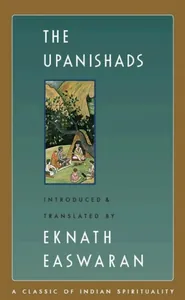
Eknath Easwaran translated the Upanishads for a modern audience starting in the late 20th century.
This book presents Eknath Easwaran's interpretation of the Upanishads, ancient Sanskrit texts dating to at least 800 BCE. These writings are central to Hindu thought and address core questions about existence, consciousness, and reality. Easwaran aimed to make these teachings accessible by simplifying their complex philosophical and linguistic elements.
The work is suitable for anyone interested in the philosophical foundations of Eastern spirituality and its relevance today. Readers do not need prior knowledge of Sanskrit or Indian philosophy. It will appeal to students of comparative religion, those who practice meditation, and individuals contemplating the nature of the self.
The Upanishads arose in India around 800 to 200 BCE, a time of significant intellectual and spiritual development. They marked a turn from ritual to introspection, focusing on the Self (Atman) and ultimate reality (Brahman). These texts have significantly influenced Hindu, Buddhist, and Jain traditions.
The Upanishads are foundational texts within the Advaita Vedanta tradition of Hinduism. They represent a shift towards internal contemplation of the divine, seeking to understand the unity of the individual soul (Atman) with the universal consciousness (Brahman). This introspective approach, focused on realizing the true nature of reality beyond sensory perception, aligns with contemplative and mystical paths found across various spiritual traditions. Easwaran's rendition makes these deep philosophical insights available to those outside traditional Indian religious studies.
💡 Why Read This Book?
• Gain a direct understanding of the concept of Brahman, the ultimate reality, as explained through Easwaran's lucid interpretations, providing a foundational concept in Hindu philosophy not easily grasped elsewhere. • Learn about the Atman, the individual self, and its profound connection to Brahman, a core teaching that offers a different perspective on identity and consciousness than Western thought. • Explore the practical implications of Maya, the concept of cosmic illusion, and how recognizing it can lead to a less attachment-bound experience of the world, as presented in the Upanishadic dialogues.
⭐ Reader Reviews
Honest opinions from readers who have explored this book.
❓ Frequently Asked Questions
When were the Upanishads originally composed?
The Upanishads are believed to have been composed over a long period, with the earliest ones dating back to at least 800 BCE, during a significant era of philosophical development in ancient India.
What is the central message of the Upanishads?
The central message revolves around the identity of the individual soul (Atman) with the ultimate reality (Brahman), often expressed as 'Tat Tvam Asi' or 'That Thou Art'.
Who was Eknath Easwaran?
Eknath Easwaran (1910-1999) was an Indian spiritual teacher and author known for making the spiritual traditions of India accessible to a Western audience, emphasizing meditation and practical application.
What is 'Brahman' in the context of the Upanishads?
Brahman represents the supreme, unchanging, infinite, and all-pervading consciousness or reality that is the source and sustainer of all existence.
How do the Upanishads relate to Hinduism?
They are considered the concluding part of the Vedas, forming the philosophical basis for Vedanta, a major school of Hindu thought, and influencing many subsequent traditions.
What does 'Maya' refer to in these texts?
Maya refers to the concept of illusion or cosmic deception, suggesting that the perceived material world is not the ultimate reality, obscuring the true nature of Brahman.
🔮 Key Themes & Symbolism
The Unity of Existence
The Upanishads, as interpreted by Easwaran, consistently point towards the non-dualistic nature of reality. The concept of Brahman as the singular, underlying consciousness that permeates everything is central. This challenges the ordinary perception of separateness, suggesting that the individual self (Atman) is identical to this universal consciousness. This perspective offers a radical reorientation, moving from an ego-centric view to one of cosmic interconnectedness, a core part of Advaita Vedanta.
The Nature of the Self
Easwaran elucidates the Upanishadic exploration of Atman, the true Self, which is often obscured by the ego and worldly desires. Unlike the transient personality, Atman is eternal, unchanging, and divine. Realizing this inner essence is presented not as an intellectual exercise but as a direct experiential understanding. The texts guide the seeker inward, away from the distractions of the phenomenal world, towards the silent, luminous core of being.
Liberation from Illusion
A significant theme is the concept of Maya, the veil of illusion that creates the appearance of a separate, material reality. The Upanishads suggest that suffering arises from attachment to this illusory world and the mistaken identification with the ego. Easwaran's interpretation focuses on how spiritual practice and direct knowledge can pierce this veil, leading to liberation (moksha) from the cycle of suffering and rebirth.
Path of Knowledge (Jnana Yoga)
The Upanishads are a primary source for Jnana Yoga, the path of knowledge. Easwaran highlights the Upanishadic emphasis on inquiry, contemplation, and the discerning intellect as tools for spiritual realization. This involves understanding the distinction between the real (Brahman) and the unreal (the phenomenal world), leading to direct experiential insight rather than mere intellectual assent. It is a path of profound self-discovery.
💬 Memorable Quotes
Direct passages from the work, attributed to the author.
“'Tat Tvam Asi' (That Thou Art)”
— This foundational Mahavakya captures the Upanishadic revelation: the individual soul is not separate from the ultimate divine reality. It’s a direct assertion of unity, challenging the perceived duality between the self and the cosmos.
“The Self is the lord of all beings, the king of all beings.”
— This highlights the Upanishadic view of Atman not as a subservient entity, but as the sovereign essence within, the true ruler of one's existence, often hidden by the ego.
“The universe is Brahman.”
— A concise statement of the Upanishadic worldview, asserting that all that exists, seen and unseen, is a manifestation of the singular, all-encompassing consciousness, Brahman.
“He who knows that the Self is to be heard, to be reflected on, to be meditated upon...”
— This points to the systematic approach required for realizing the Self: first hearing the teachings, then deep reflection, and finally sustained meditation to internalize the truth.
“Where there is illusion, there is no awareness.”
— This contrasts the state of being deluded by Maya with true spiritual awareness, suggesting that the recognition of illusion is a step towards enlightenment.
🌙 Esoteric Significance
Tradition
The Upanishads are foundational to the Vedanta school of Hindu philosophy, which is deeply intertwined with esoteric traditions like Yoga and Tantra. While not solely an esoteric text in the Western sense, its exploration of consciousness, the nature of reality (Brahman), and the individual soul (Atman) provides a metaphysical framework that informs many esoteric practices aimed at liberation and self-realization.
Symbolism
Key symbols include the Om (Aum), representing the primordial sound and the totality of existence; the lotus, symbolizing purity, spiritual unfolding, and the connection between the material and divine; and the journey inwards, symbolizing the process of withdrawing from external distractions to discover the inner Self (Atman). Fire (Agni) often symbolizes knowledge and purification.
Modern Relevance
Contemporary spiritual teachers, meditation practitioners, and philosophers globally draw heavily from Upanishadic concepts. Thinkers like Aldous Huxley, Carl Jung, and numerous modern yoga and Vedanta instructors reference its teachings on consciousness, the self, and non-duality. Its influence is evident in mindfulness practices, transpersonal psychology, and the ongoing dialogue between Eastern and Western philosophical thought.
👥 Who Should Read This Book
• Students of comparative religion and philosophy seeking to understand the roots of major Eastern spiritual traditions. • Individuals interested in meditation and mindfulness practices who wish to explore the philosophical underpinnings of self-awareness and consciousness. • Seekers of profound existential answers interested in concepts like Brahman, Atman, and the nature of reality beyond the material.
📜 Historical Context
The Upanishads emerged during a dynamic period in ancient India, roughly from 800 to 200 BCE, a time marked by the flourishing of the Vedic tradition and the rise of competing philosophical systems like early Buddhism and Jainism. These texts represent a significant shift from the earlier Vedic focus on ritual (yajna) towards introspective inquiry into the nature of reality, consciousness, and the Self (Atman). They formed the philosophical culmination of the Vedas, known as Vedanta. While not a single event, their compilation and dissemination occurred during the lifespan of figures like Buddha (c. 563 – 483 BCE) and Mahavira, indicating a shared intellectual climate of spiritual seeking. The reception was primarily within the Brahminical traditions, gradually shaping the core tenets of Hinduism, though their philosophical depth also influenced ascetics and thinkers across different nascent traditions.
📔 Journal Prompts
Reflect on the concept of Atman as presented in the Upanishads.
Consider the implications of 'Tat Tvam Asi' for your perception of self and others.
How does the idea of Maya challenge your everyday assumptions about reality?
What does the Upanishadic emphasis on inquiry suggest about the path to knowledge?
Explore the connection between Brahman and the world around you.
🗂️ Glossary
Brahman
The ultimate, unchanging, infinite, and all-pervading reality or consciousness that is the source and sustainer of all existence.
Atman
The individual soul or true Self, often described as eternal, unchanging, and ultimately identical with Brahman.
Maya
Cosmic illusion or deceptive appearance; the power that conceals the true nature of reality (Brahman) and creates the perception of a diverse, material world.
Moksha
Liberation or release from the cycle of birth, death, and rebirth (samsara); the ultimate spiritual goal in many Indian traditions.
Jnana Yoga
The yoga or path of knowledge, emphasizing wisdom, inquiry, and direct experiential understanding of the Self and ultimate reality.
Vedas
The ancient and most sacred scriptures of Hinduism, comprising hymns, rituals, and philosophical discussions. The Upanishads are considered the concluding part.
Samsara
The continuous cycle of birth, death, and rebirth, driven by karma, from which liberation (moksha) is sought.
🔮 Readers Also Liked
Browse all →









More by Eknath Easwaran
All books →




More Free Occult Philosophy Books
View all →