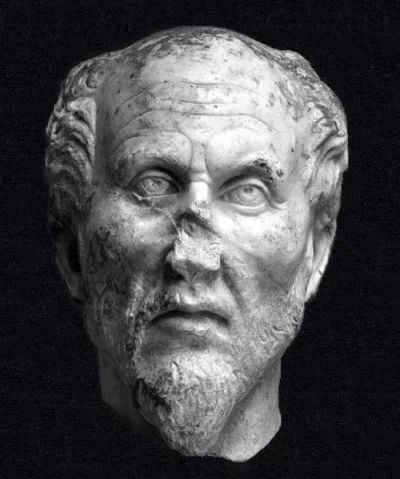
Plotinus
Plotinus, founder of Neoplatonism, described a transcendent 'One' from which reality emanates, influencing Western philosophy and mysticism.
Plotinus, a Hellenistic Greek philosopher born in Roman Egypt around 204 CE, is recognized as the originator of Neoplatonism. His philosophical system, which profoundly impacted late antiquity, the Middle Ages, and the Renaissance, centers on a hierarchical structure of reality emanating from a supreme, unknowable principle called 'The One'.
His student Porphyry compiled Plotinus' writings into the Enneads. Plotinus' philosophy posits that all existence flows from 'The One,' which is beyond being and comprehension. From 'The One' emanate the Intellect (Nous) and then the Soul (Psyche), with the material world being the furthest and least perfect manifestation. This concept of emanation, rather than creation ex nihilo, provided a framework for understanding the relationship between the divine and the material that influenced numerous religious and mystical traditions.
Philosophical Foundations and Key Concepts
Plotinus is credited as the founder of Neoplatonism, a philosophical school that emerged from Platonic thought. His metaphysics outlines a divine hierarchy originating from a supreme, utterly transcendent principle known as 'The One.' This 'One' is described as being beyond all categories of existence, indivisible, and unknowable. From 'The One' emanates the Intellect (Nous), which contains all forms and ideas, and subsequently the Soul (Psyche), which animates the cosmos and individual beings. The material world is considered a distant reflection or imitation of these higher realities, seen as a lesser form of being. Plotinus' emphasis on the inherent distrust of materiality and the body reflects a common Platonic sentiment, viewing the physical realm as a shadow of a more genuine, intelligible existence.
Life and Influence
Born in Roman Egypt around 204 CE, Plotinus studied under Ammonius Saccas in Alexandria, a philosopher within the Platonic tradition. After eleven years of study, he traveled to Persia with the Roman army to explore Eastern philosophies, eventually returning to Rome where he established his school. His teachings attracted a diverse group of students, including prominent figures and members of the Roman Senate. Plotinus' philosophical system, termed 'Neoplatonism' by later scholars, proved immensely influential, shaping the thought of pagan, Jewish, Christian, Gnostic, and early Islamic mystics and metaphysicians for centuries. His ideas on the nature of the divine, emanation, and the soul's journey toward the One have deeply impacted theological and spiritual discourse.
The Enneads and Mystical Experience
The primary source for Plotinus' philosophy is the Enneads, a collection of essays compiled and edited by his student Porphyry. These writings detail his metaphysical system, including the concept of 'The One' as the ultimate source of all reality. Plotinus also described the possibility of experiencing 'The One' directly, a mystical union where the individual transcends multiplicity and becomes one with the divine. This experience is not one of seeing, but of being that which is seen. His final recorded words, 'Try to raise the divine in yourselves to the divine in the all,' encapsulate this pursuit of spiritual ascent and unity with the cosmos.
Key Ideas
- The One: A supreme, transcendent, unknowable principle beyond being.
- Emanation: The process by which reality flows from The One through successive stages (Intellect, Soul, Matter).
- Mimesis: The material world as a reflection or imitation of higher, intelligible realities.
- Mystical Union: The possibility of direct experience and unity with The One.
Notable Quotes
“We ought not even to say that he will see, but he will be that which he sees, if indeed it is possible any longer to distinguish between seer and seen, and not boldly to affirm that the two are one.”
“Once you have uttered 'The Good,' add no further thought: by any addition, and in proportion to that addition, you introduce a deficiency.”
“Try to raise the divine in yourselves to the divine in the all.”
Books by Plotinus
9 free public domain books · Read online or download