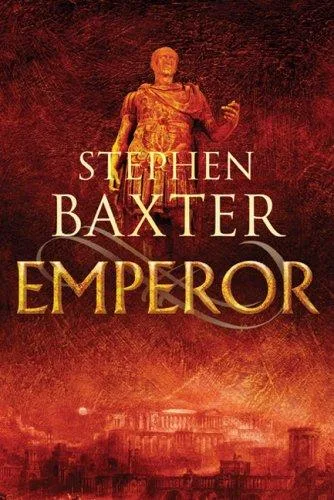
Emperor
 72
72

Emperor
Stephen Baxter's "Emperor" is a colossal, ambitious undertaking that often buckles under its own conceptual weight. While the sheer scale of its evolutionary narrative is impressive, the human element feels largely sidelined, serving more as a vehicle for philosophical exposition than a compelling emotional core. The book excels in its detailed, hard-science approach to speculative futures, particularly in its depiction of the 'Xee' and their biological adaptations. However, the narrative pacing can become glacial, with extended passages devoted to explaining complex biological and cosmological theories. The eventual confrontation with the 'Supermind' offers a theoretically fascinating, if somewhat abstract, climax. "Emperor" offers a unique, albeit cold, vision of what might await our species.
📝 Description
72
Stephen Baxter's 2006 novel Emperor considers humanity's cosmic destiny.
Emperor by Stephen Baxter, published in 2006, is a science fiction novel that examines humanity's long-term future across vast stretches of time. It moves beyond individual character arcs to contemplate the evolution of consciousness and the ultimate fate of the universe. The narrative projects a future where humanity, or its successor species, faces significant existential challenges and radical changes necessary for continued existence. Baxter's work engages with large-scale scientific concepts and philosophical questions about survival and transformation.
The novel is structured around the idea of a 'supermind' or collective consciousness that humanity might achieve. It considers how such a transformation would alter the very nature of existence and our place within the cosmos. The book also touches upon the concept of artificial intelligence and its potential role in the future of sentient life, posing questions about what it means to be human when confronted with technological and evolutionary leaps. It is a work that prioritizes grand ideas over conventional plot.
While not strictly an esoteric text, Emperor engages with themes resonant in esoteric traditions, particularly those concerned with humanity's ultimate spiritual or evolutionary trajectory. It echoes ideas found in concepts of collective consciousness, the evolution of the soul, and the eventual transcendence of the material form. The novel's focus on humanity's destiny across cosmic timescales and its potential transformation into a higher form of being aligns with certain mystical or philosophical visions of spiritual progress and cosmic purpose. It asks what lies beyond the current human condition, a question central to many esoteric inquiries.
💡 Why Read This Book?
• Understand the potential trajectory of human evolution across vast cosmic epochs, as explored through Baxter's detailed biological and sociological projections. • Grasp the concept of "parenthood" as a cosmic imperative, a driving force behind advanced civilizations' actions, as depicted in the novel's later stages. • Contemplate the nature of consciousness and intelligence beyond biological limitations, particularly through the depiction of the Xee and their unique evolutionary path.
⭐ Reader Reviews
Honest opinions from readers who have explored this book.
❓ Frequently Asked Questions
What is the central conflict in Stephen Baxter's Emperor?
The central conflict revolves around the long-term survival of humanity's lineage, facing existential threats from cosmic events and the need to evolve or adapt to ensure continuation across billions of years.
When was Stephen Baxter's Emperor first published?
Emperor by Stephen Baxter was first published in 2006.
What kind of science fiction is Emperor?
Emperor is best described as hard science fiction, focusing on plausible scientific extrapolation, evolutionary biology, cosmology, and grand-scale speculative futures.
Does Emperor focus on individual characters?
No, Emperor largely eschews a traditional focus on individual characters. It prioritizes the exploration of vast timescales, evolutionary processes, and species-level destinies over personal narratives.
What are some key concepts explored in Emperor?
Key concepts include deep time evolution, species-level survival imperatives, the nature of advanced alien life (like the Xee), and the ultimate fate of consciousness in the universe.
Is Emperor part of a series?
Emperor is part of Stephen Baxter's "Destiny's Children" series, which explores humanity's long-term future, though it can be read as a standalone work.
🔮 Key Themes & Symbolism
Deep Time Evolution
The novel is a profound meditation on evolution stretched across billions of years, far beyond typical human lifespans or historical narratives. Baxter meticulously details how species, particularly humanity's distant descendants, might adapt and transform to survive cataclysmic universal changes and the eventual heat death of the universe. This is not merely biological adaptation but also the evolution of consciousness and societal structures on an unfathomable scale.
Cosmic Imperatives
A core theme is the concept of 'parenthood' extended to a cosmic scale. Advanced civilizations, having secured their own futures, turn their attention to ensuring the continuation of life and consciousness itself. This drives the actions of the novel's later entities, who act not out of malice but from a profound, almost biological, drive to seed and protect future generations of intelligent life across the cosmos.
The Nature of Consciousness
Baxter probes the boundaries of what constitutes intelligence and consciousness. The Xee, a highly evolved alien species, possess a form of distributed, collective consciousness that challenges human-centric definitions. The narrative explores how consciousness might persist and transform even as physical forms change or become obsolete, suggesting that the continuation of awareness is a primary goal of advanced life.
Existential Survival
At its heart, Emperor is about survival, not of individuals, but of the concept of humanity or intelligent life. It confronts the ultimate challenges posed by the universe itself – stellar evolution, galactic collisions, and the eventual end of all physical processes. The novel presents survival as a monumental, multi-generational, and species-wide endeavor requiring radical transformation.
💬 Memorable Quotes
Direct passages from the work, attributed to the author.
“The universe was a battlefield. Life was a war.”
— This statement expresses the novel's premise that existence, especially intelligent existence, is a constant struggle against entropy and cosmic forces. It frames evolution not as a passive process but an active, often brutal, fight for survival across immense timescales.
“Parenthood was the ultimate destiny.”
— This refers to the drive of advanced civilizations to ensure the continuation of life beyond their own existence. It's a biological imperative writ large, where the creation and nurturing of future intelligent species becomes the primary purpose of the most advanced beings.
“The mind could survive the body.”
— This reflects the novel's exploration of consciousness as something potentially separable from biological form. It suggests that intelligence and awareness can persist and evolve through non-corporeal means or radically different physical substrates.
“We are the children of the stars.”
— A poetic expression of humanity's (and other life's) origins in stellar nucleosynthesis. It links the fundamental building blocks of life to the cosmic processes, underscoring the deep connection between life and the universe's physical evolution.
“The future was not a place, but a process.”
— This highlights the novel's emphasis on change and evolution as the defining characteristic of the future. It's not a static destination but a continuous unfolding of possibilities driven by cosmic and biological forces.
🌙 Esoteric Significance
Tradition
While not explicitly occult, "Emperor" engages with themes that resonate with esoteric traditions concerned with cosmic cycles and ultimate transformation, particularly Gnostic and Hermetic ideas about creation, dissolution, and the potential for consciousness to transcend material limitations. It carries the cyclical views of time found in some Eastern philosophies and the grand cosmological narratives that underpin many mystical systems, positing humanity's evolutionary journey as a process of cosmic apotheosis or transcendence.
Symbolism
The novel utilizes the "Egg" as a potent symbol of potential, containment, and the origin of new realities, a concept that echoes alchemical notions of the prima materia and the vessel of transformation. The vast, indifferent cosmos itself serves as a symbol of the Absolute or the divine, against which life's struggle for meaning and continuation plays out. The "Xee," with their distributed consciousness and biological engineering, can be seen as representing advanced, almost god-like, evolutionary stages or alternative forms of being.
Modern Relevance
Contemporary thinkers and practitioners in transhumanism and accelerationism find traces of their ideas in Baxter's vision of radical human evolution and technological transcendence. The novel's exploration of consciousness beyond biological constraints also informs discussions in artificial intelligence ethics and the philosophy of mind. Furthermore, its grand cosmological scope provides a backdrop for contemplating humanity's place in the universe, a theme relevant to modern environmentalism and existential philosophy.
👥 Who Should Read This Book
• Readers fascinated by extreme timescales and the ultimate fate of humanity, who appreciate hard science fiction grounded in biological and cosmological principles. • Those interested in speculative evolution and posthumanist concepts, seeking a detailed exploration of how species might fundamentally change to survive cosmic challenges. • Philosophically inclined science fiction enthusiasts who enjoy grand, concept-driven narratives that prioritize ideas and universal questions over individual character arcs.
📜 Historical Context
Published in 2006, Stephen Baxter's "Emperor" emerged during a period of intense interest in hard science fiction that pushed the boundaries of speculative extrapolation. It followed Baxter's own "Manifold" trilogy and aligned with the "transhumanist" and "posthumanist" themes prevalent in authors like Alastair Reynolds and Charles Stross. The intellectual currents of the early 2000s, marked by advancements in genetics, cosmology (like the discovery of dark energy), and artificial intelligence, provided fertile ground for Baxter's exploration of deep time and species evolution. While not subject to specific censorship, the novel's challenging concepts and vast scale positioned it as a work for dedicated fans of epic, concept-driven sci-fi, distinct from more character-focused space operas or cyberpunk narratives. Its reception was generally positive among genre critics, who recognized its ambition and rigorous scientific grounding.
📔 Journal Prompts
The concept of cosmic parenthood and its implications for species destiny.
Reflecting on the Xee's distributed consciousness and its challenge to human selfhood.
The universe as a "battlefield" for life; what does this metaphor suggest about existence?
The Egg as a symbol of potential and cosmic origin.
Contemplating the evolution of consciousness across billions of years.
🗂️ Glossary
Xee
A highly evolved, non-humanoid alien species encountered in the novel. They possess a form of collective, distributed consciousness and have mastered advanced biological engineering, playing a significant role in the long-term fate of life.
Deep Time
Refers to geological and cosmological timescales, vastly exceeding human historical or biological lifespans. Baxter uses this concept to explore evolution and survival over billions of years.
Cosmic Egg
A metaphorical or literal construct within the novel representing a potential new universe or a contained environment for the seeding of future life, symbolizing origin and transformation.
Parenthood (Cosmic)
The drive of advanced civilizations to ensure the continuation and propagation of life and consciousness across the universe, acting as guardians or progenitors for future species.
Supermind
A hypothetical, ultimate form of unified consciousness that could emerge from the convergence of advanced intelligences, representing a potential endpoint for sentient evolution.
Heat Death of the Universe
A theoretical end-state of the universe where all energy has been evenly distributed, leading to a cessation of all physical processes and activity. Baxter's novel grapples with how life might persist or adapt even in such extreme conditions.
Destiny's Children
The series title to which 'Emperor' belongs, signifying the overarching theme of humanity's (or life's) long-term evolutionary trajectory and ultimate fate.
🔮 Readers Also Liked
Browse all →









More by Stephen Baxter
All books →
More Free Occult Philosophy Books
View all →