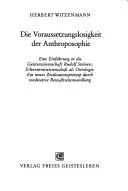
Die Voraussetzungslosigkeit der Anthroposophie
 76
76

Die Voraussetzungslosigkeit der Anthroposophie
Witzenmann’s approach to Anthroposophy in Die Voraussetzungslosigkeit der Anthroposophie is refreshingly direct, eschewing hagiography for intellectual scrutiny. His central thesis, that the movement may not be as free of presuppositions as it claims, is a vital point for anyone deeply invested in Rudolf Steiner's work. The book excels in its detailed analysis of how certain concepts, like the perception of spiritual worlds, are presented and how they might implicitly rely on prior acceptance of a specific worldview. A minor limitation lies in its dense prose, which can make the core arguments challenging to access for those not already familiar with philosophical discourse. The discussion surrounding the nature of 'spiritual research' and its validation is particularly incisive, forcing a reconsideration of what constitutes evidence within this domain. It’s an essential, if demanding, text for critical Anthroposophists.
📝 Description
76
Herbert Witzenmann's 1986 book, Die Voraussetzungslosigkeit der Anthroposophie, questions Anthroposophy's own foundational ideal.
Published in 1986, Herbert Witzenmann's Die Voraussetzungslosigkeit der Anthroposophie scrutinizes the core principle of Anthroposophy, often translated as 'unconditionality' or 'lack of presuppositions.' Witzenmann examines whether the movement, as presented and received, genuinely lives up to this ideal of being free from unexamined assumptions. The book probes the very nature of knowledge and perception as they relate to Rudolf Steiner's extensive writings and teachings.
This work is directed at those deeply involved with Anthroposophy who are willing to undertake critical self-assessment. It also speaks to scholars of spiritual movements and comparative religion interested in the logical structures and philosophical foundations of such philosophies. Readers focused on epistemology within spiritual or esoteric contexts will find Witzenmann's arguments particularly engaging.
Emerging in the latter half of the 20th century, this text engages with Anthroposophy's established global influence in areas like education and medicine. Witzenmann's critical perspective arises within an intellectual climate that saw philosophical scrutiny of established ideas. The book challenges uncritical acceptance of Anthroposophical principles, aiming to provide a more intellectually grounded approach for its adherents and for those studying spiritual philosophies.
💡 Why Read This Book?
• Gain a framework for critically assessing the foundational assumptions of spiritual movements, inspired by Witzenmann's 1986 analysis of Anthroposophy's 'unconditionality.' • Understand the specific epistemological challenges Witzenmann raises regarding the validation of spiritual-scientific research, as detailed in the book's core arguments. • Examine the concept of 'Voraussetzungslosigkeit' as applied to esoteric traditions, learning how to differentiate between truly open inquiry and implicit belief systems.
⭐ Reader Reviews
Honest opinions from readers who have explored this book.
❓ Frequently Asked Questions
What is the primary focus of Herbert Witzenmann's Die Voraussetzungslosigkeit der Anthroposophie?
The book primarily focuses on critically examining the claim of 'unconditionality' or 'lack of presuppositions' within Anthroposophy, as developed by Rudolf Steiner.
When was Die Voraussetzungslosigkeit der Anthroposophie first published?
Herbert Witzenmann's Die Voraussetzungslosigkeit der Anthroposophie was first published in 1986.
Who is the author Herbert Witzenmann?
Herbert Witzenmann was a German philosopher and author known for his critical engagement with Anthroposophy and its philosophical underpinnings.
What does 'Voraussetzungslosigkeit' mean in the context of this book?
'Voraussetzungslosigkeit' translates to 'unconditionality' or 'lack of presuppositions,' and the book questions whether Anthroposophy truly embodies this principle.
Is this book suitable for beginners in Anthroposophy?
The book is best suited for those with a solid understanding of Anthroposophy and an interest in critical philosophical analysis, rather than absolute beginners.
What is the main critique offered in the book?
The main critique is that Anthroposophy, despite its aims, may operate with certain unexamined presuppositions, particularly concerning the nature of spiritual perception and knowledge.
🔮 Key Themes & Symbolism
The Ideal of Unconditionality
Witzenmann meticulously dissects the Anthroposophical claim to 'Voraussetzungslosigkeit'—operating without prior assumptions. He probes whether the framework established by Rudolf Steiner, particularly regarding the perception of spiritual realities, inherently requires a degree of prior belief or a specific philosophical orientation that contradicts this ideal. The work scrutinizes the very methods proposed for spiritual research, questioning their ability to stand entirely free from presuppositions.
Epistemology of Spiritual Science
A significant focus is placed on the epistemology underpinning spiritual science. How can one objectively verify or validate knowledge gained through non-material perception? Witzenmann explores the potential gap between subjective spiritual experience and the demand for verifiable, universally accessible knowledge, a core challenge for many esoteric systems seeking to bridge the material and the spiritual realms.
Critical Reception of Steiner's Work
The book implicitly engages with the reception of Rudolf Steiner's extensive teachings. By questioning the lack of presuppositions, Witzenmann encourages a more critical, less dogmatic approach to Anthroposophy. This theme is crucial for understanding how esoteric movements evolve and maintain intellectual rigor, moving beyond mere acceptance to active, critical engagement with their foundational texts and figures.
Philosophical Underpinnings
Witzenmann’s work is grounded in philosophical inquiry, examining Anthroposophy through the lens of logic and epistemology. It seeks to identify the implicit philosophical commitments that may underlie the spiritual-scientific worldview presented by Steiner. This approach is vital for situating Anthroposophy within broader philosophical discourse and understanding its intellectual architecture.
💬 Memorable Quotes
Direct passages from the work, attributed to the author.
“Spiritual perception must be critically assessed for its epistemological validity.”
— This captures Witzenmann's concern with how one validates knowledge gained through non-physical means, emphasizing the need for a philosophical basis to support claims of spiritual insight.
“The acceptance of spiritual-scientific findings often rests on implicit assumptions.”
— This interpretation points to Witzenmann's critique that belief in Anthroposophical concepts may depend on accepting certain worldviews or premises without explicit acknowledgment.
“Is Anthroposophy truly free of presuppositions, or does it establish its own?”
— This question captures the core of Witzenmann's inquiry, challenging the movement's self-perception and urging a deeper look at its actual philosophical basis.
“The nature of evidence for spiritual realities is a key area of investigation.”
— This emphasizes Witzenmann's focus on the criteria for proof and validation when dealing with phenomena that lie outside conventional empirical observation.
💡 Key Ideas
Editorial paraphrase of the work's core concepts — not direct quotes.
The claim of 'unconditionality' in Anthroposophy requires rigorous examination of its own foundational premises.
This paraphrase highlights Witzenmann's central argument: that the ideal of operating without prior assumptions within Anthroposophy is not self-evident and warrants critical scrutiny of its own inherent starting points.
🌙 Esoteric Significance
Tradition
This work engages deeply with the tradition of Anthroposophy, a spiritual scientific movement initiated by Rudolf Steiner. While departing from a purely devotional stance, it seeks to clarify the philosophical and epistemological foundations of Anthroposophy, positioning it within a lineage of Western esoteric thought that values rigorous inquiry and conceptual clarity, albeit with a critical lens.
Symbolism
The central 'symbol' Witzenmann engages with is not a visual motif but the abstract concept of 'Voraussetzungslosigkeit' (unconditionality). He treats this ideal as a guiding principle whose adherence must be constantly tested. Another implicit symbolic element is the 'spiritual world' itself, which Witzenmann examines not as a given, but as a domain whose perception and knowledge require careful epistemological consideration.
Modern Relevance
Witzenmann's critique remains relevant for contemporary esoteric thinkers and practitioners, including those in Anthroposophy, Integral Spirituality, and broader consciousness studies. His emphasis on critical self-reflection and epistemological clarity provides a valuable tool for assessing the validity and underlying assumptions of any spiritual or metaphysical system in the 21st century.
👥 Who Should Read This Book
• Students and practitioners of Anthroposophy seeking a deeper, critical understanding of its philosophical underpinnings and the concept of 'Voraussetzungslosigkeit.' • Scholars of esoteric movements and comparative religion interested in the intellectual and philosophical challenges faced by spiritual scientific paths. • Readers with an interest in epistemology and the philosophy of knowledge, particularly as applied to non-material or spiritual domains of inquiry.
📜 Historical Context
Published in 1986, Herbert Witzenmann's Die Voraussetzungslosigkeit der Anthroposophie emerged during a period when Anthroposophy, founded by Rudolf Steiner in the early 20th century, had solidified its influence in various cultural spheres like Waldorf education and biodynamic agriculture. Witzenmann's work stood in contrast to more devotional or uncritical approaches within the movement, aligning with a broader trend of critical philosophical engagement with esoteric traditions. While figures like the Frankfurt School's Theodor Adorno offered critiques of ideology and consciousness, they did not directly engage with Steiner's specific work. Witzenmann's text served as a crucial internal critique, prompting introspection among Anthroposophists regarding the intellectual rigor and philosophical underpinnings of their path, particularly concerning the concept of knowledge acquisition in the spiritual realm.
📔 Journal Prompts
The ideal of 'Voraussetzungslosigkeit' in relation to personal spiritual practice.
How do the epistemological challenges of spiritual science, as explored by Witzenmann, affect your understanding of verifiable knowledge?
Reflecting on the presuppositions within your own belief system.
The critical examination of Rudolf Steiner's concepts as presented by Witzenmann.
Differentiating between an 'unconditional' approach and an approach based on implicit assumptions.
🗂️ Glossary
Voraussetzungslosigkeit
A German term meaning 'unconditionality,' 'lack of presuppositions,' or 'freedom from preconditions.' Witzenmann uses it to critically examine whether Anthroposophy operates without prior assumptions.
Anthroposophy
A spiritual philosophy founded by Rudolf Steiner, aiming to provide insights into the spiritual nature of reality and humanity's place within it through 'spiritual science.'
Spiritual Science
The term used by Rudolf Steiner to describe his method of investigating the spiritual world through specific faculties of consciousness, distinct from conventional empirical science.
Epistemology
The branch of philosophy concerned with the theory of knowledge, investigating its nature, scope, and justification, particularly relevant to how spiritual knowledge is acquired and validated.
Hermeticism
An esoteric tradition based on the purported teachings of Hermes Trismegistus, emphasizing wisdom, magic, and the interconnectedness of the cosmos, often involving symbolic interpretation.
Gnosticism
A diverse set of religious and philosophical movements in the early Christian era that emphasized knowledge (gnosis) of the divine, often involving a dualistic worldview.
Theosophy
A mystical philosophy that seeks to understand the divine nature and the universe through direct experience, often drawing from Eastern and Western esoteric traditions; influenced Steiner.
🔮 Readers Also Liked
Browse all →









More Free Occult Philosophy Books
View all →