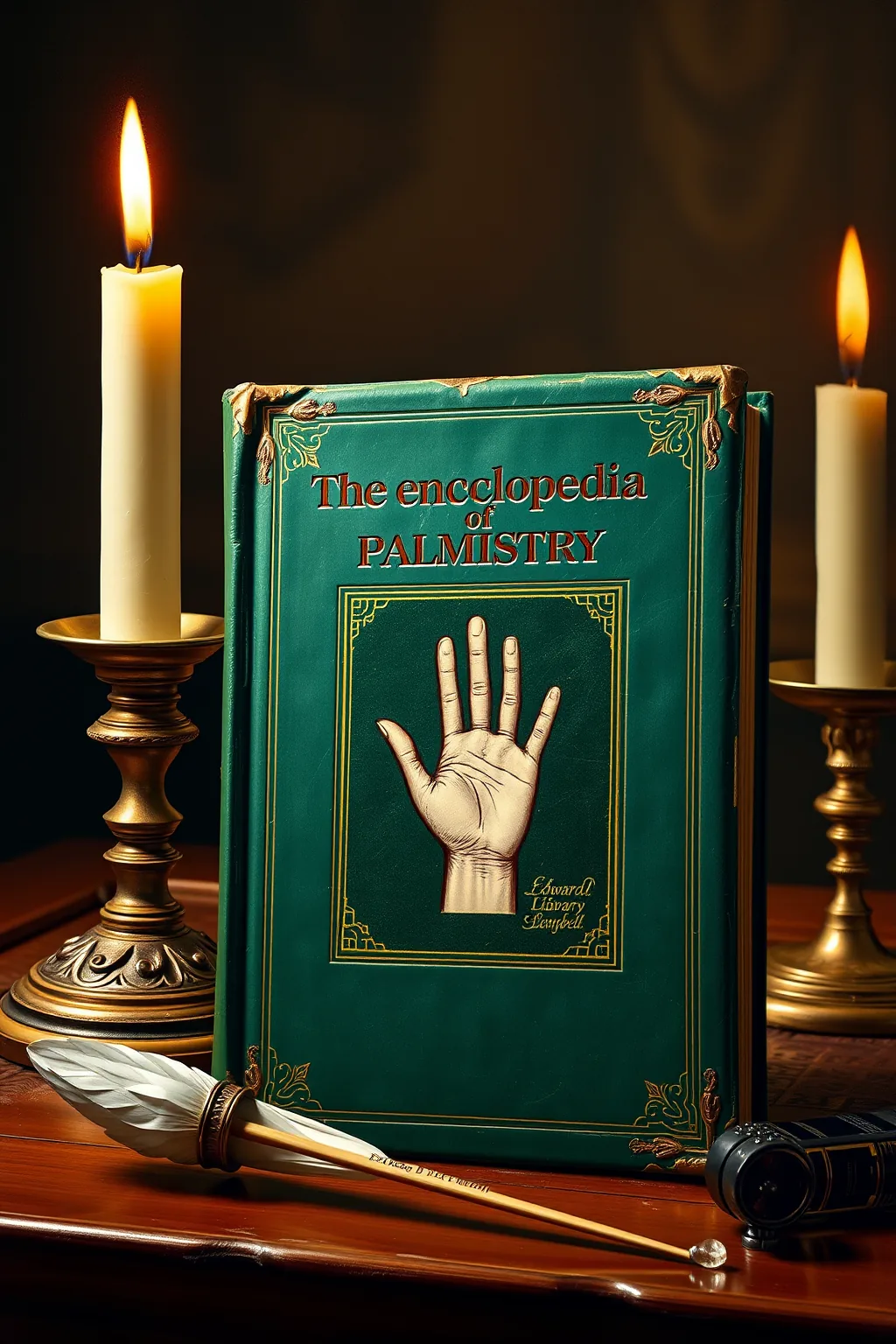
The encyclopedia of palmistry
 78
78

The encyclopedia of palmistry
Edward D. Campbell's "The Encyclopedia of Palmistry" presents a thorough, if somewhat dry, compendium of chiromantic knowledge. Its strength lies in its sheer breadth; it attempts to catalog virtually every significant feature of the hand and its purported meanings, offering a valuable reference for those who favor systematic study. For instance, its detailed breakdown of the less commonly discussed minor lines, such as the Rascette lines or the Ring of Solomon, provides a depth often absent in more introductory texts. However, the book's encyclopedic nature also proves to be its limitation. The prose, while accurate, lacks the evocative quality that might draw a reader into the more intuitive aspects of palmistry. It functions more as a detailed lexicon than an engaging exploration. The discussion on the various hand shapes, while extensive, could benefit from more visual aids to truly illuminate the subtle distinctions Campbell describes. Ultimately, "The Encyclopedia of Palmistry" serves best as a detailed manual for the dedicated student rather than an accessible gateway for the curious beginner.
📝 Description
78
Published in 1996, Edward D. Campbell's The Encyclopedia of Palmistry compiles extensive information on chiromancy.
Edward D. Campbell's The Encyclopedia of Palmistry, first released in 1996, presents a thorough examination of chiromancy, the practice of reading the hand. The book covers the interpretation of lines, mounts, and various hand features, aiming to be a complete reference. It is structured for anyone interested in palmistry, from those just starting out to experienced readers who want to understand its complex systems in detail. Campbell's approach is systematic, encouraging a deep engagement with the subject rather than a superficial one.
The encyclopedia systematically breaks down palmistry into its core components. It explains the meaning of major lines like the Life, Head, and Heart lines, as well as minor lines and the different mounts, such as Venus, Jupiter, and Saturn. The book also discusses how hand shapes, finger lengths, and nail characteristics relate to personality traits and life trajectories. Additionally, it touches on how planetary influences and astrological correspondences connect with the hand.
Campbell's work enters a tradition of hand-reading that has existed for thousands of years across many cultures. Although published in the late 20th century, palmistry has seen periods of renewed interest, notably during the Victorian spiritualist movement and the counter-culture periods of the mid-20th century. This book consolidates this historical knowledge, making it accessible in a structured way for modern readers.
💡 Why Read This Book?
• Gain a comprehensive understanding of hand shapes and their associated elemental classifications, a core concept first systematically explored by figures like D'Arpentigny in the 19th century, allowing you to analyze a person's fundamental disposition. • Master the interpretation of all major and minor palm lines, including the often-overlooked Apollo and Mercury lines, enabling a more nuanced reading of an individual's talents and life trajectory. • Explore the significance of the hand's mounts and their relationship to planetary energies, a concept central to esoteric traditions, providing insight into innate drives and potentials.
⭐ Reader Reviews
Honest opinions from readers who have explored this book.
❓ Frequently Asked Questions
When was "The Encyclopedia of Palmistry" first published?
The book was first published in 1996, making it a relatively modern compilation of historical palmistry knowledge.
Does the book cover hand shapes?
Yes, "The Encyclopedia of Palmistry" dedicates significant attention to the various hand shapes and their associated characteristics, linking them to elemental correspondences.
What are the main lines discussed in the book?
The encyclopedia meticulously details the interpretation of the primary lines: the Life Line, Head Line, and Heart Line, alongside numerous minor lines.
Is "The Encyclopedia of Palmistry" suitable for beginners?
While comprehensive, its encyclopedic format may be best suited for those with some prior interest or a preference for detailed reference works, rather than absolute beginners seeking a gentle introduction.
Does the author, Edward D. Campbell, discuss the mounts of the hand?
Indeed, the book provides extensive coverage of the mounts on the palm, such as the Mount of Venus and the Mount of Jupiter, explaining their significance.
Can I learn about finger and nail analysis from this book?
Yes, "The Encyclopedia of Palmistry" includes sections on the analysis of finger lengths and nail shapes, adding further layers to a chiromantic reading.
🔮 Key Themes & Symbolism
Hand Shape Analysis
Campbell's work extensively categorizes hand shapes, linking them to elemental qualities derived from ancient Greek philosophy: Earth, Air, Fire, and Water. Each shape—spade, square, triangle, oval—is associated with a distinct set of personality traits, behavioral tendencies, and life approaches. The book details not only the primary shapes but also hybrid forms, offering a nuanced framework for understanding an individual's fundamental disposition and how they interact with the world around them.
The Major and Minor Lines
A central focus of the encyclopedia is the meticulous examination of palm lines. Beyond the well-known Life, Head, and Heart lines, Campbell details numerous lesser-known lines such as the Apollo line (creativity), Mercury line (communication), and various influence lines. Each line, its origin, termination, and any breaks or markings, is analyzed for its potential impact on health, fortune, intellect, and emotional life, providing a detailed cartography of personal destiny.
The Mounts and Their Meanings
The book examines the significance of the fleshy pads on the palm, known as mounts. Each mount—Venus, Jupiter, Saturn, Apollo, Mercury, Mars, and Luna—is associated with specific planetary energies and human characteristics. The development and prominence of these mounts are interpreted to reveal an individual's innate desires, strengths, and areas of potential challenge, offering a layer of analysis that complements the study of the lines.
Finger and Nail Morphology
Complementing the analysis of lines and mounts, Campbell's encyclopedia also explores the interpretive significance of finger lengths and nail shapes. The proportions of the fingers relative to the palm and each other, as well as the form and condition of the fingernails, are presented as indicators of character and temperament. This holistic approach underscores the belief that every physical aspect of the hand contributes to a complete chiromantic reading.
💬 Memorable Quotes
Direct passages from the work, attributed to the author.
“The hand is a map of the person.”
— This concise statement captures the core principle of palmistry: that the physical characteristics of the hand serve as a symbolic representation of an individual's inner nature and life path.
“The Life Line indicates vitality and major life events, not literal lifespan.”
— This clarifies a common misconception about the Life Line, emphasizing that its interpretation relates to the quality and significant occurrences of life rather than a predetermined end date.
“A well-developed Mount of Jupiter suggests ambition and leadership qualities.”
— This highlights the connection between specific physical features of the palm (the Mount of Jupiter) and associated personality traits like leadership, ambition, and self-confidence.
“The clarity and depth of the Head Line reveal intellectual capacity.”
— This points to the diagnostic power of the Head Line in palmistry, suggesting that its physical attributes directly correlate with an individual's cognitive abilities and mental processes.
“Minor lines offer nuances to the broader narrative of the major lines.”
— This emphasizes the detailed information provided by less prominent lines, suggesting that they add complexity and specific insights to the overall interpretation derived from the main lines of the palm.
🌙 Esoteric Significance
Tradition
Campbell's work draws heavily from the Western esoteric tradition of chiromancy, which has roots stretching back to ancient Greece and was significantly developed during the Renaissance and Victorian eras. While not explicitly aligned with a single school like Hermeticism or Kabbalah, it synthesizes elements common to many divination systems that seek to map the microcosm (the individual) to the macrocosm (the universe), often through symbolic correspondences with astrology and classical elements.
Symbolism
Key symbols in "The Encyclopedia of Palmistry" include the major lines (Life, Head, Heart) which represent fundamental aspects of existence, vitality, intellect, and emotion. The mounts, named after classical deities (Venus, Jupiter, etc.), symbolize specific archetypal energies and drives. Hand shapes themselves, categorized by elements (Earth, Air, Fire, Water), offer symbolic representations of personality types, echoing ancient philosophical frameworks.
Modern Relevance
Contemporary practitioners of Western esotericism, particularly those interested in comparative divination or psychological astrology, often reference comprehensive palmistry texts like Campbell's. Its systematic approach appeals to those seeking structured frameworks for understanding personality and destiny, bridging traditional chiromancy with modern psychological archetypes. It remains a foundational text for students looking to build a detailed knowledge base in hand analysis.
👥 Who Should Read This Book
• Aspiring chiromancers seeking a detailed reference manual to understand the intricate system of hand-reading, including minor lines and mounts. • Students of comparative divination interested in how palmistry aligns with or diverges from astrological and physiognomic systems. • Esoteric practitioners aiming to deepen their understanding of symbolic interpretation and its application to personal analysis through the study of the hand.
📜 Historical Context
Edward D. Campbell's "The Encyclopedia of Palmistry," published in 1996, arrived at a time when interest in esoteric subjects was experiencing a resurgence, partly fueled by New Age movements and a growing academic curiosity in occult traditions. While palmistry itself has ancient roots, reaching back to India and Greece, its modern form owes much to 19th-century figures like Adolphe Desbarolles and Jean-Baptiste Morain de Combre Montaigne, who systematized its study. Campbell's work can be seen as an attempt to consolidate this Victorian-era systematization and earlier traditions into a single, accessible volume for a late 20th-century audience. It emerged in a landscape where other forms of divination, such as Tarot and astrology, were widely popular, and it sought to provide a similarly detailed and structured approach to chiromancy, aiming to be the definitive reference work for its time, distinct from more popular or ephemeral guides.
📔 Journal Prompts
The Mount of Venus's prominence and its implications for personal drive.
The relationship between the Head Line's formation and cognitive style.
Interpreting the markings on the Life Line as indicators of vitality.
The symbolic meaning of a square-shaped hand in one's personal context.
How the clarity of the Heart Line reflects emotional expression.
🗂️ Glossary
Chiromancy
The practice of interpreting the lines, mounts, and other features of the hand to understand personality, predict future events, or assess character.
Mounts
The fleshy, raised pads on the palm, each associated with a planet and specific human characteristics, such as the Mount of Venus (love, vitality) or Mount of Jupiter (ambition, leadership).
Life Line
A major line on the palm, typically curving around the Mount of Venus, interpreted to indicate vitality, physical well-being, and significant life experiences.
Head Line
A major horizontal line across the palm, representing intellectual capacity, mental processes, and cognitive style.
Heart Line
A major horizontal line usually found in the upper palm, interpreted as relating to emotional nature, romantic relationships, and heart health.
Apollo Line
A minor line often running parallel to the Life Line or originating from the thumb area, associated with creativity, success, and artistic talent.
Rascette Lines
Horizontal lines found at the wrist crease, often interpreted as indicating health and longevity, with the uppermost line being particularly significant.
🔮 Readers Also Liked
Browse all →








More by Edward D. Campbell
All books →
More Free Occult Philosophy Books
View all →