Emotional alchemy

 74
74

Emotional alchemy
Tara Bennett-Goleman’s *Emotional Alchemy* attempts a sophisticated synthesis of neuroscience, Buddhist thought, and practical psychology. Its strength lies in articulating how early life experiences wire our emotional responses, a concept it explains with clarity and without oversimplification. The book’s detailed exploration of "emotional schemas" provides a useful lens for self-examination. However, the integration of Buddhist philosophy, while central to the thesis, sometimes feels more like an addendum than a fully realized fusion, occasionally lacking the experiential depth one might expect from a tradition so focused on practice. A particularly compelling section discusses how the brain's "fight-or-flight" response, a concept rooted in evolutionary biology, becomes chronically activated by modern stressors, leading to persistent anxiety. Despite this slight imbalance, the book offers a valuable framework for understanding the mechanics of emotional reactivity. It is a solid, if not revolutionary, contribution to the literature on emotional regulation.
📝 Description
74
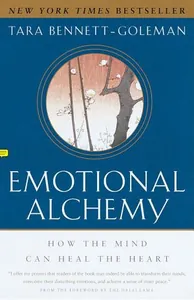
Tara Bennett-Goleman's 2001 book, Emotional Alchemy, maps how early experiences shape our emotional habits.
Published in 2001, Emotional Alchemy presents a method for understanding and changing emotional patterns. It connects psychological ideas with meditation techniques, drawing heavily on Buddhist philosophy. The book explains how our typical emotional reactions form through past experiences and brain pathways. It suggests ways to build better emotional awareness and self-control.
This book is for people who want to understand their emotions more deeply and work on personal growth. It suits those interested in the connection between the mind, feelings, and overall health. Readers who like a mix of scientific knowledge and older wisdom traditions will find it valuable. Familiarity with mindfulness, emotional intelligence, or Buddhist psychology is helpful.
Emotional Alchemy emerged in 2001, a time when public interest in emotional intelligence was growing. Bennett-Goleman's work stood out by combining neuroscience and psychology with Buddhist contemplative practices. She specifically referenced the Dalai Lama's views on compassion and emotional stability. This gave a more detailed perspective than simpler secular approaches to emotional intelligence.
💡 Why Read This Book?
• You will learn how early experiences, as detailed in the section on "emotional schemas," create enduring patterns of emotional response that can be understood and modified. • You will gain insight into the neurological underpinnings of emotional reactivity, particularly how the "fight-or-flight" response, discussed in relation to modern stressors, impacts daily well-being. • You will discover practical contemplative techniques, inspired by Buddhist psychology, to cultivate a more balanced "emotional baseline" and reduce habitual negative reactions.
⭐ Reader Reviews
Honest opinions from readers who have explored this book.
❓ Frequently Asked Questions
What is the core concept of 'emotional schemas' in Tara Bennett-Goleman's book?
Emotional schemas are deeply ingrained mental frameworks, often formed in childhood, that shape how we perceive and react to situations, influencing our emotional patterns throughout life.
How does 'Emotional Alchemy' connect neuroscience with Buddhist philosophy?
The book uses neuroscience to explain the mechanics of emotional habits and reactions, then applies Buddhist principles and contemplative practices as a path to transforming these patterns.
When was 'Emotional Alchemy' first published?
Emotional Alchemy by Tara Bennett-Goleman was first published in 2001.
What is the 'emotional baseline' according to the book?
The emotional baseline refers to the default state of one's emotional system when not actively experiencing intense emotions; the book explores how to cultivate a more resilient and positive baseline.
Does the book offer practical exercises for emotional transformation?
Yes, the book integrates practical exercises and contemplative techniques derived from Buddhist traditions to help readers develop greater emotional awareness and regulation.
Who is Tara Bennett-Goleman and what is her background?
Tara Bennett-Goleman is a psychotherapist and meditation teacher, drawing on her extensive background in both Western psychology and Eastern contemplative traditions.
🔮 Key Themes & Symbolism
Emotional Schemas
The book identifies "emotional schemas" as core blueprints for how we experience and react to the world, often originating from early life. These schemas act as filters, predisposing us to certain feelings and behaviors. For example, a schema of "abandonment" might lead to constant anxiety in relationships. Bennett-Goleman explains how these deeply embedded patterns, reinforced by neurological pathways, contribute to persistent emotional distress. Understanding their formation is presented as the first step toward alchemizing them into more adaptive responses, moving beyond reactive conditioning towards conscious choice.
Neuroscience of Emotion
Bennett-Goleman integrates findings from neuroscience to clarify the biological basis of our emotional lives. She discusses how the brain, particularly the amygdala and prefrontal cortex, processes emotional information and forms habits. The "fight-or-flight" response, a primal survival mechanism, is examined for its role in chronic stress and anxiety in modern contexts. By illustrating how neural pathways are shaped by experience, the book provides a scientific rationale for the persistence of emotional patterns and the possibility of rewiring them through focused practice and awareness.
Buddhist Contemplative Practices
Drawing significantly from Buddhist psychology, the book proposes contemplative practices as a powerful tool for emotional transformation. Techniques such as mindfulness, focused attention, and cultivating compassion are presented not merely as stress reduction methods, but as direct means to interrupt habitual emotional reactivity. These practices aim to develop insight into the nature of emotions and to foster an "emotional baseline" of equanimity and resilience, enabling individuals to respond to challenges with greater wisdom and less automatic distress.
The Alchemy of Transformation
The central metaphor of "alchemy" signifies the process of transforming base emotional reactions into more refined states of being. It suggests that difficult emotions and ingrained patterns are not immutable but can be transmuted through conscious effort and understanding. This transformation involves recognizing the "raw material" of our emotional habits, applying the "heat" of mindful awareness, and utilizing the "catalyst" of contemplative practice to achieve a more balanced, resilient, and compassionate emotional life.
💬 Memorable Quotes
Direct passages from the work, attributed to the author.
“Our emotional habits are not immutable destinies.”
— This statement suggests that the automatic, often negative, ways we react emotionally are not fixed. It implies that through conscious effort and understanding, these ingrained patterns can be altered and improved.
“The brain's survival circuits are easily triggered by modern stressors.”
— This highlights how our ancient 'fight-or-flight' mechanisms, designed for immediate physical threats, are now frequently activated by psychological and social pressures, leading to chronic anxiety and stress.
“Understanding the roots of our emotional schemas is the first step toward change.”
— This emphasizes the importance of self-awareness and introspection. By recognizing how our early experiences shaped our emotional frameworks, we gain the power to address and modify them.
“Cultivating a stable emotional baseline leads to greater resilience.”
— This concept suggests that developing an underlying sense of calm and equanimity, even amidst challenges, provides a foundation for better emotional regulation and coping.
“Mindfulness allows us to observe emotions without being consumed by them.”
— This points to the power of present-moment awareness in creating space between ourselves and our feelings, enabling a less reactive and more discerning relationship with our emotional states.
🌙 Esoteric Significance
Tradition
While not strictly adhering to a single esoteric lineage, *Emotional Alchemy* draws heavily from Buddhist psychology, a tradition rich in contemplative practices aimed at understanding the nature of mind and alleviating suffering. It aligns with the broader esoteric goal of inner transformation and liberation from conditioned states, interpreting these through a lens informed by modern neuroscience and psychotherapy. Its approach emphasizes self-mastery and the cultivation of wisdom, key tenets found across various esoteric traditions.
Symbolism
The central "alchemy" metaphor itself is symbolic, evoking the alchemical pursuit of transforming base metals into gold, paralleling the transformation of base emotional reactions into states of wisdom and equanimity. The concept of the "emotional baseline" functions as a symbol of inner stability and equilibrium, akin to the Hermetic ideal of balance. The "fight-or-flight" response can be seen as symbolizing the primal, instinctual forces within the human psyche that esoteric practices seek to understand and integrate.
Modern Relevance
This work continues to be highly relevant for contemporary mindfulness-based therapies (MBCT, MBSR) and the broader field of positive psychology. Thinkers in the contemplative neuroscience space, such as those exploring the effects of meditation on the brain, often cite or echo Bennett-Goleman's synthesis. Her approach also appeals to modern self-help movements focused on emotional intelligence and resilience, providing a more nuanced and philosophically grounded alternative to purely secular self-improvement guides.
👥 Who Should Read This Book
• Individuals interested in the intersection of psychology and spirituality, particularly those seeking to understand the neurological basis of their emotional habits. • Practitioners of meditation or mindfulness who wish to deepen their understanding of how these practices impact emotional patterns and mental well-being. • Therapists and counselors looking for integrated approaches that bridge cognitive-behavioral techniques with contemplative insights and neuroscientific findings.
📜 Historical Context
Published in 2001, *Emotional Alchemy* emerged in an era increasingly fascinated by the human mind and its potential for improvement. Daniel Goleman's 1995 bestseller *Emotional Intelligence* had already popularized the concept, creating fertile ground for further exploration. Bennett-Goleman's work distinguished itself by integrating this burgeoning field with the deep contemplative traditions of Buddhism, particularly as articulated by figures like the Dalai Lama, who was increasingly engaging with Western science. This period saw a growing dialogue between neuroscience and psychology, with researchers like Richard Davidson exploring the neural correlates of meditation. While secular approaches to emotional intelligence were common, Bennett-Goleman's direct incorporation of Buddhist philosophical underpinnings offered a distinct, spiritually informed perspective, positioning her book within a broader movement of integrating Eastern wisdom with Western psychological frameworks.
📔 Journal Prompts
The concept of "emotional schemas" and their origins.
Your own "emotional baseline" and how to cultivate its stability.
The influence of "fight-or-flight" responses on daily stress.
Identifying and alchemizing a recurring emotional habit.
The role of mindfulness in observing emotional reactivity.
🗂️ Glossary
Emotional Schemas
Deeply ingrained mental frameworks, often formed in early life, that shape perceptions and emotional responses, acting as filters for experience.
Emotional Habits
Recurring patterns of emotional reaction and behavior that become automatic through repetition and neurological conditioning.
Emotional Baseline
The default state of one's emotional system when not actively engaged with intense feelings; the book explores cultivating a more stable and positive baseline.
Fight-or-Flight Response
The body's automatic physiological reaction to perceived threats, preparing it to either confront danger or escape from it.
Mindfulness
A practice of paying attention to the present moment non-judgmentally, observing thoughts, feelings, and sensations as they arise.
Neuroplasticity
The brain's ability to reorganize itself by forming new neural connections throughout life, allowing it to adapt and change.
Contemplative Practices
Meditative and reflective techniques, often derived from spiritual traditions, used to cultivate self-awareness, insight, and emotional regulation.
🔮 Readers Also Liked
Browse all →









More by Tara Bennett-Goleman
All books →

More Free Spiritual Development Books
View all →