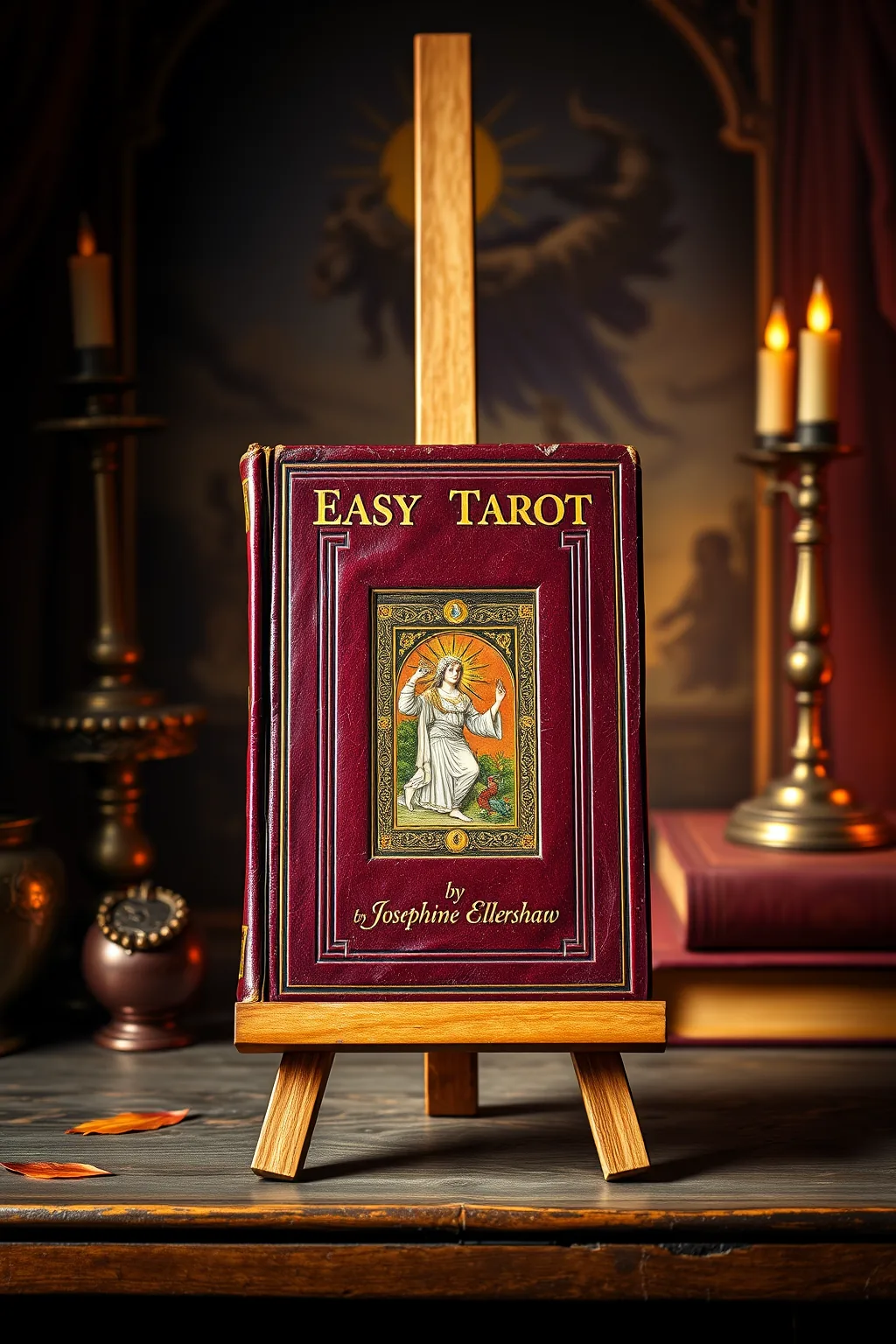
Easy Tarot
 63
63

Easy Tarot



Josephine Ellershaw's 'Easy Tarot' is a beacon for those navigating the complex currents of cartomancy. Ashcroft commends its accessible yet profound approach, stripping away intimidation to reveal the Tarot's potent esoteric underpinnings. The author masterfully deciphers the archetypal language, linking each card to universal energies and psychological truths. This is not merely a how-to guide; it's an initiation into a richer understanding of self and cosmos. Ideal for the earnest seeker ready to embrace the Tarot's transformative potential.
📝 Description
63
Josephine Ellershaw's 'Easy Tarot' first appeared in print, aiming to demystify the art of card reading.
This book presents a straightforward approach to learning Tarot card meanings and interpretation. Ellershaw breaks down the symbolism of the Major and Minor Arcana, explaining how each card relates to personal growth and intuition. The text focuses on practical application, encouraging readers to connect with the cards for guidance. It covers the foundational aspects of Tarot reading, including spreads and how to approach a reading. The goal is to make the Tarot accessible, allowing individuals to use it as a tool for self-reflection and understanding.
Ellershaw's method emphasizes developing a personal relationship with the cards rather than relying solely on memorized meanings. She details the imagery and archetypes within the deck, linking them to everyday life experiences. The book guides users through understanding the flow of a reading and how to interpret the interplay between different cards. It is designed for those new to the Tarot or those seeking a clearer, more direct method to enhance their practice.
Josephine Ellershaw's 'Easy Tarot' enters the tradition of modern Tarot literature that seeks to popularize and simplify divinatory practices. Unlike earlier, more complex grimoires or scholarly analyses, this work aims for direct engagement with the cards for personal insight. It follows in a lineage of authors who believe the Tarot's archetypes can serve as a mirror to the psyche, aiding in self-understanding and decision-making. The book's approach aligns with a broader esoteric interest in accessible tools for spiritual or psychological exploration, making traditional symbolism available to a wider audience.
💡 Why Read This Book?
Unlock the ancient language of the Tarot with Josephine Ellershaw's insightful guide. 'Easy Tarot' demystifies complex symbolism, offering a clear pathway to intuitive understanding and personal growth. Ideal for beginners eager to explore divination, and for practitioners seeking to deepen their connection to the cards' profound wisdom. Embark on a journey of self-discovery and unlock hidden insights.
⭐ Reader Reviews
Honest opinions from readers who have explored this book.
❓ Frequently Asked Questions
Is 'Easy Tarot' suitable for complete beginners?
Absolutely. Ellershaw's approach prioritizes clarity and gradual understanding, making it an ideal starting point for those new to Tarot, guiding them gently into its rich symbolism and divinatory practices.
Does the book cover all 78 Tarot cards?
Yes, 'Easy Tarot' provides comprehensive coverage of all 78 cards, including the Major and Minor Arcana, explaining their individual meanings and interconnectedness within spreads.
What kind of spreads are taught in the book?
The book introduces fundamental Tarot spreads, starting with simple layouts and progressing to more intricate patterns designed to explore various aspects of life and offer deeper insights.
Can I use any Tarot deck with this book?
While the book uses its own deck for illustration, the principles and interpretations are universally applicable to most standard Rider-Waite-Smith-based Tarot decks. It focuses on the core symbolism.
What is the philosophical significance of the Tarot as presented in this book?
Ellershaw frames the Tarot as a symbolic map of the human journey, connecting it to archetypal wisdom, psychological insights, and the unfolding of consciousness, encouraging introspection and self-awareness.
🔮 Key Themes & Symbolism
The Language of Archetypes
Ellershaw masterfully deciphers the archetypal language of the Tarot, revealing how these timeless figures and symbols represent universal human experiences and psychological states. The book illuminates how each card acts as a mirror to the inner self and the external world, providing a rich vocabulary for understanding life's intricate patterns and the deeper currents of existence. This exploration fosters a profound connection to the collective unconscious and the perennial wisdom embedded within the cards, encouraging introspection and self-awareness.
Intuition and Inner Guidance
'Easy Tarot' champions the development of personal intuition as the key to unlocking the Tarot's useful insights. Ellershaw guides readers to move beyond rote memorization, encouraging them to trust their inner voice and subjective interpretations. The book emphasizes that the Tarot is not merely a predictive tool, but a powerful catalyst for self-discovery and conscious decision-making. By honing their intuitive faculties, practitioners can engage with the cards on a deeper, more personal level, transforming readings into profound moments of inner guidance and personal empowerment.
The Journey of Self-Discovery
Fundamentally, , 'Easy Tarot' presents the Tarot as a sacred map for the soul's journey. Each card represents a stage or a challenge on the path of personal evolution, offering wisdom and guidance for navigating life's complexities. Ellershaw encourages readers to view Tarot readings not as pronouncements of fate, but as opportunities for introspection, growth, and the conscious co-creation of their destiny. This perspective transforms the Tarot into an invaluable tool for self-understanding, empowerment, and the realization of one's highest potential.
💬 Memorable Quotes
Direct passages from the work, attributed to the author.
“Symbolism is the silent language of the universe.”
— This highlights the profound importance of symbols in esoteric traditions, positing that they offer a deeper, more intuitive understanding of cosmic truths than conventional language.
“Intuition is the compass of the spiritual seeker.”
— This underscores the vital role of inner knowing and gut feeling in working through the path of spiritual development and divination, positioning it as essential guidance.
“Each card holds a universe of meaning.”
— This conveys the depth and complexity inherent in Tarot symbolism, suggesting that even a single card is rich with layers of interpretation and potential wisdom.
“The Tarot invites you to know thyself.”
— This expresses the ultimate purpose of Tarot study as presented in the book: a journey of introspection that leads to profound self-awareness and understanding.
💡 Key Ideas
Editorial paraphrase of the work's core concepts — not direct quotes.
The Tarot is a mirror to your soul.
This quote emphasizes the Tarot's role as a reflective tool, suggesting that the cards reveal not external predictions, but the inner field of the querent's thoughts, emotions, and subconscious.
🌙 Esoteric Significance
Tradition
This work is deeply rooted in the Western Esoteric Tradition, drawing heavily from Hermeticism, Kabbalah, and Jungian psychology. It views the Tarot as a microcosm of the universe and a symbolic representation of the soul's journey through its archetypal stages. The emphasis on symbolism and intuition aligns with mystical approaches that seek direct experience of the divine or hidden truths, positioning the Tarot as a tool for self-initiation and spiritual growth.
Symbolism
The core of 'Easy Tarot' lies in its elucidation of the detailed symbolism within the cards. Ellershaw guides readers to understand the alchemical, astrological, and archetypal significations embedded in each image. From the Fool's leap of faith to the Empress's creative abundance, the book deciphers these visual narratives, revealing them as keys to understanding universal principles, human psychology, and the intricate dance of life's energies.
Modern Relevance
In an age often characterized by disconnection and rapid change, 'Easy Tarot' offers a timeless pathway to introspection and grounded wisdom. Its emphasis on intuition and self-understanding resonates powerfully with contemporary seekers looking for meaning and guidance beyond superficial answers. The book provides practical tools for navigating personal challenges, fostering creativity, and cultivating a deeper connection to oneself and the subtle energies that shape our reality, making ancient wisdom relevant to modern life.
👥 Who Should Read This Book
This clear volume is a treasure for the earnest seeker at any stage of their divinatory journey. Beginners will find a welcoming and clear introduction to the esoteric language of the Tarot, clarifying its complex symbolism. Students of the occult and scholars of esoteric history will appreciate the thoughtful connections Ellershaw draws to broader mystical traditions. Seasoned practitioners seeking to deepen their intuitive understanding and refine their interpretive skills will discover fresh perspectives and renewed inspiration within these pages. It is for anyone ready to begin a profound journey of self-discovery through the timeless wisdom of the cards.
📜 Historical Context
Josephine Ellershaw's 'Easy Tarot' emerges from a rich lineage of cartomantic literature, drawing inspiration from the late 19th and early 20th-century occult revival, a period where Western esotericism experienced a resurgence. Thinkers like A.E. Waite and Pamela Colman Smith, who created the iconic Rider-Waite deck, were instrumental in popularizing Tarot as a system of divination and spiritual exploration. This era saw a fervent interest in ancient wisdom, Hermeticism, Kabbalah, and astrology, all of which deeply influenced Tarot interpretations. Ellershaw's work, while aiming for accessibility, stands on the shoulders of these pioneers, making their useful insights available to a contemporary audience eager to connect with the mystical traditions that have shaped our understanding of the Tarot for centuries.
📔 Journal Prompts
Reflect on the archetype that most appeals to you currently. How does its energy manifest in your life?
Consider a recent challenge. Which Tarot card, if any, symbolizes this situation for you, and what message does it convey?
Meditate on the Fool's journey. What 'leap of faith' is the universe inviting you to consider in your own life?
Explore the concept of the 'Shadow Self' as represented in certain Tarot cards. What hidden aspects of yourself might the Tarot help you uncover?
How can the wisdom of the Tarot be integrated into your daily decision-making process for greater clarity and intention?
🗂️ Glossary
Archetype
Universal, archaic patterns and images that derive from the collective unconscious and are the psychic counterpart of instinct. In Tarot, these are represented by the figures and situations depicted on the cards.
Cartomancy
The practice of divination using a deck of cards, most commonly the Tarot. It involves interpreting the cards' symbolism and arrangement to gain insight into past, present, and future events.
Esotericism
Knowledge or teachings that are intended only for a select group of people who are prepared to receive them. It often involves mystical, spiritual, or philosophical traditions that are not openly accessible.
Major Arcana
The 22 trump cards of a Tarot deck, representing significant life lessons, spiritual milestones, and archetypal forces. They are often seen as the 'great journey' of the soul.
Minor Arcana
The 56 cards of a Tarot deck divided into four suits (Wands, Cups, Swords, Pentacles/Coins), representing the everyday events, challenges, and experiences of life.
This book appears in 3 collections
🔮 Readers Also Liked
Browse all →









More by Josephine Ellershaw
All books →

From the “Tarot” Collection
View all →






More Free Divination & Tarot Books
View all →