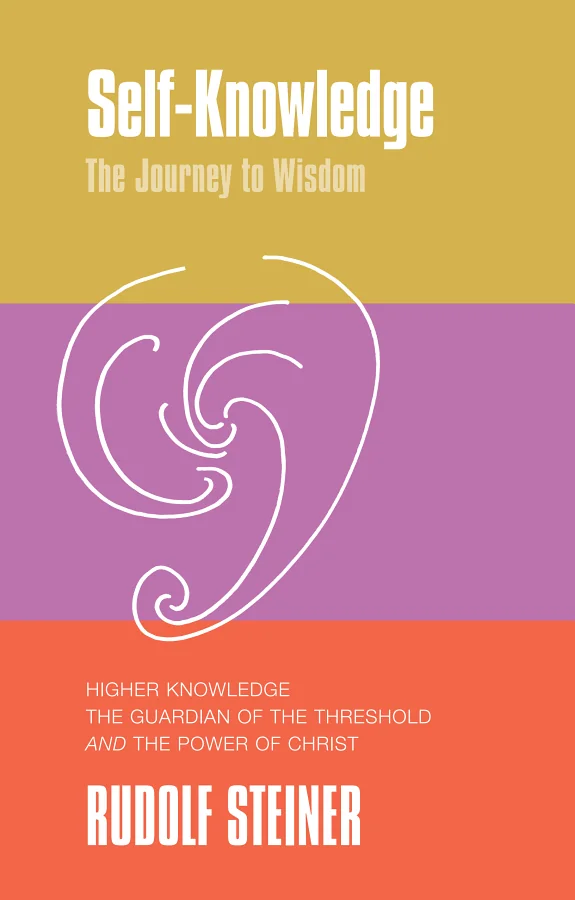
Self-Knowledge
 81
81

Self-Knowledge
Steiner's exploration of the Guardian of the Threshold in "Self-Knowledge" offers a stark, unvarnished view of spiritual progress. It eschews platitudes, directly confronting the reader with the necessity of facing one's own karmic residue and inner limitations as a fundamental step towards genuine spiritual attainment. The strength lies in its uncompromising honesty; Steiner doesn't shy away from the potentially harrowing nature of this inner confrontation, framing it as an essential crucible for transformation. A particularly striking passage discusses how the Guardian reveals the 'full reality of our untransformed nature,' a potent image for the self-discovery this work demands.
However, the density of Steiner's specific terminology and philosophical framework can present a significant barrier to entry for those unfamiliar with Anthroposophy. While the core concept of confronting the shadow is universally applicable, the specific metaphysical scaffolding might feel esoteric to a fault for newcomers. Despite this, the book's value is undeniable for those willing to engage with its demanding intellectual and spiritual landscape. It serves as a potent reminder that the path to higher knowledge is paved with rigorous self-awareness and the courage to witness one's own inner workings.
📝 Description
81
Rudolf Steiner's "Self-Knowledge" addresses the challenging figure of the Guardian of the Threshold.
Published posthumously, this work by Rudolf Steiner confronts the concept of the 'Guardian of the Threshold.' This entity is not a benevolent figure but a representation of an individual's unacknowledged negative karma and undeveloped personal traits. Steiner presents the encounter with this Guardian as a difficult but necessary step for spiritual advancement and attainment of higher knowledge. The book is aimed at serious practitioners of spiritual science and those committed to deep introspection.
It addresses individuals who seek more than superficial spiritual comfort, urging them to confront the challenging aspects of their inner being. Readers interested in Anthroposophy, theosophical ideas, or the practical workings of karma and reincarnation will find this text particularly relevant, provided they are prepared for demanding self-examination. Steiner's approach, while influenced by the esoteric currents of the early 20th century, synthesizes Eastern and Western mysticism with a focus on philosophical rigor.
Emerging from early 20th-century European esotericism, this text draws from a milieu influenced by figures like Helena Blavatsky and the Theosophical Society. Steiner, who founded Anthroposophy in 1912, developed a distinct spiritual philosophy. While the motif of a 'Guardian' appears in other esoteric traditions, such as Hermeticism and the works of Aleister Crowley, Steiner reframes it within his specific system of karma and spiritual evolution.
💡 Why Read This Book?
• You will learn how Rudolf Steiner conceptualizes the 'Guardian of the Threshold,' a potent symbol for confronting one's karmic consequences and untransformed nature, providing a unique Anthroposophical perspective on spiritual obstacles. • You will gain an understanding of why Steiner considered this difficult self-confrontation an 'essential precondition' for true spiritual initiation, moving beyond superficial spiritual practices. • You will explore the practical implications of the ancient maxim 'Know thyself' within Steiner's specific framework of karma and spiritual science, as presented in his lectures from the early 20th century.
⭐ Reader Reviews
Honest opinions from readers who have explored this book.
❓ Frequently Asked Questions
What is the Guardian of the Threshold in Rudolf Steiner's 'Self-Knowledge'?
In Steiner's work, the Guardian is an inner spiritual being that confronts the seeker with the consequences of their past negative actions and unredeemed personal traits, acting as a necessary test before entering higher spiritual realms.
Is 'Self-Knowledge' a practical guide for meditation?
While it encourages deep introspection, 'Self-Knowledge' is more of a conceptual and philosophical exploration of inner challenges rather than a manual for specific meditative techniques. It lays the groundwork for understanding the inner battles one faces.
What is Anthroposophy and how does it relate to this book?
Anthroposophy is a spiritual philosophy founded by Rudolf Steiner. This book is a key text for understanding its teachings on karma, reincarnation, and the stages of spiritual development, particularly the confrontation with the self.
When did Rudolf Steiner first present these ideas?
Rudolf Steiner lectured on these concepts extensively in the early 20th century, with many of his works, including those touching on the Guardian, being compiled and published posthumously.
How does Steiner's 'Guardian' concept differ from other spiritual traditions?
Steiner integrates the Guardian concept into his specific system of karma and spiritual evolution, emphasizing its role in revealing the direct consequences of individual actions and the necessity of conscious inner transformation.
Is 'Self-Knowledge' suitable for beginners in esoteric studies?
The book addresses advanced spiritual concepts and requires a willingness to engage with complex philosophical ideas. While beneficial, it may be challenging for those entirely new to esoteric thought or Anthroposophy.
🔮 Key Themes & Symbolism
The Guardian of the Threshold
This central motif represents the inner spiritual entity that obstructs the path to higher knowledge until the seeker has fully confronted and integrated their negative karma and unredeemed personal qualities. Steiner portrays this not as an external demon but as a manifestation of one's own inner reality, reflecting the consequences of past actions. Facing the Guardian is depicted as a crucial, albeit potentially terrifying, step in spiritual purification and the attainment of true self-awareness.
Karma and Reincarnation
The book deeply explores the principles of karma and reincarnation as understood within Anthroposophy. The Guardian's function is intrinsically tied to revealing the karmic effects of past deeds. Steiner emphasizes that understanding and working through these karmic consequences, rather than avoiding them, is essential for spiritual progress and the evolution of consciousness across lifetimes.
Spiritual Initiation
Steiner positions the encounter with the Guardian as a necessary ordeal for anyone aspiring to genuine spiritual initiation. It's presented as a purification process, clearing the way for the soul to perceive higher spiritual realities. This initiation is not granted but earned through rigorous self-examination and the courage to face one's inner 'shadow,' leading to a transformed consciousness.
The Imperative of Self-Knowledge
The work underscores the ancient injunction 'Know thyself' as the central to all spiritual development. Steiner argues that superficial self-understanding is insufficient; true knowledge involves confronting the entirety of one's being, including the aspects one prefers to ignore. This profound self-awareness is the key to overcoming the obstacles presented by the Guardian and achieving spiritual maturity.
💬 Memorable Quotes
Direct passages from the work, attributed to the author.
“The Guardian reveals the consequences of our negative actions and points to the full reality of our untransformed nature.”
— This statement expresses the core function of the Guardian figure. It's not an external judgment but an internal revelation, forcing the spiritual aspirant to confront the direct results of their past behavior and the aspects of themselves that still require significant inner work.
“This experience is said to be one of the deepest and most harrowing on the inner path...”
— Steiner acknowledges the profound difficulty of this stage of spiritual development. The confrontation is described as harrowing, highlighting that the path to higher knowledge involves facing potentially painful truths about oneself, rather than seeking comfort.
“...but is an essential precondition to any form of true initiation.”
— This emphasizes the non-negotiable nature of the Guardian encounter within Steiner's system. He asserts that genuine spiritual attainment and the ability to perceive higher worlds are impossible without first undergoing this intense process of self-confrontation and purification.
“The words ‘Know thyself’ were inscribed...”
— This is a direct reference to the famous maxim from the Temple of Apollo at Delphi. Steiner uses it to frame the entire discussion, indicating that the ultimate goal of spiritual practice is profound self-understanding, which includes facing one's own inner obstacles.
“The Guardian protects the threshold to the spiritual world.”
— This metaphorical description positions the Guardian as a gatekeeper. It prevents unprepared individuals from accessing higher spiritual knowledge prematurely, ensuring that only those who have faced their inner challenges can safely enter these elevated realms.
🌙 Esoteric Significance
Tradition
This work is a central to Anthroposophy, Rudolf Steiner's esoteric philosophy. While drawing from Western Hermeticism, Gnosticism, and Eastern thought (particularly concepts of karma and reincarnation), Steiner synthesized these elements into a unique cosmology and path of development. The Guardian concept fits within a lineage of spiritual psychology that seeks to understand the soul's journey through challenges, but Steiner's emphasis on the concrete, observable (though inner) nature of these spiritual encounters distinguishes it.
Symbolism
The primary symbol is the 'Guardian of the Threshold' itself, representing the unintegrated shadow aspects of the self and the karmic consequences of one's actions. It symbolizes the barrier to higher consciousness that is erected by one's own unresolved inner issues. The 'threshold' signifies the boundary between the ordinary human consciousness and the spiritual worlds, a boundary that can only be crossed after inner purification and self-mastery.
Modern Relevance
Steiner's ideas on the Guardian continue to influence contemporary esoteric practitioners, particularly within Anthroposophical circles and related movements like biodynamic agriculture and Waldorf education. Thinkers and groups focused on integral spirituality, karma yoga, and depth psychology often engage with Steiner's rigorous approach to self-knowledge and confronting the shadow self, seeing it as a vital component for conscious evolution in the modern age.
👥 Who Should Read This Book
• Serious students of Rudolf Steiner and Anthroposophy seeking to understand his core teachings on karma and spiritual development. • Practitioners of esoteric disciplines interested in confronting the psychological and karmic obstacles on the path to higher consciousness. • Individuals engaged in deep self-inquiry who are prepared to face challenging aspects of their own nature as a prerequisite for spiritual growth.
📜 Historical Context
Rudolf Steiner's lectures on the 'Guardian of the Threshold,' compiled in works like 'Self-Knowledge,' emerged from the fertile ground of early 20th-century European esotericism. This era saw a surge of interest in spiritualism, Theosophy, and various occult traditions, heavily influenced by figures like Helena Blavatsky. Steiner, initially associated with Theosophy, founded his own distinct path, Anthroposophy, in 1912, seeking to bridge spiritual insight with scientific and philosophical inquiry. While the concept of a threshold guardian appears in various esoteric systems, including Hermeticism and certain Gnostic texts, Steiner's interpretation is unique within his framework of karma, reincarnation, and spiritual evolution. His work offered an alternative to the more emotional or ritualistic approaches prevalent at the time, emphasizing a rigorous, almost scientific, approach to inner development. The intellectual climate was also characterized by significant advancements in psychology and philosophy, providing a backdrop against which Steiner's ideas on the subconscious and the nature of the human soul were articulated.
📔 Journal Prompts
The Guardian's revelation of negative actions: How might past deeds manifest as inner obstacles today?
Untransformed nature: Identify one personal trait you resist confronting and explore its potential karmic roots.
The threshold to higher knowledge: What inner preparations seem most necessary before seeking deeper spiritual understanding?
The maxim 'Know thyself': In what specific ways does confronting difficult truths contribute to true self-awareness?
Spiritual initiation: Reflect on the distinction between superficial spiritual seeking and the rigorous path Steiner outlines.
🗂️ Glossary
Guardian of the Threshold
An inner spiritual being or force that confronts the seeker with their unredeemed karma and shadow aspects, acting as a test before entering higher spiritual realms.
Karma
In Steiner's view, the law of cause and effect governing moral and spiritual causation, where past actions directly influence present and future experiences across lifetimes.
Spiritual Science (Anthroposophy)
Rudolf Steiner's term for his philosophical and spiritual path, aiming to investigate the spiritual world through methods akin to natural science, focusing on human evolution.
Initiation
A process of spiritual development and transformation involving direct experience of higher spiritual realities, typically requiring rigorous inner work and purification.
Untransformed Nature
Refers to the aspects of an individual's character, ego, and past actions that have not yet been purified, integrated, or consciously understood through spiritual work.
Consecration
The process of purifying the soul and consciousness, often associated with overcoming the challenges posed by the Guardian, to prepare for spiritual perception.
Spiritual Worlds
Areas of existence beyond the physical, accessible through developed spiritual perception, which Steiner described in detail within Anthroposophy.
This book appears in 1 collection
🔮 Readers Also Liked
Browse all →





From the “Anthroposophy” Collection
View all →



More Free Theosophy & Anthroposophy Books
View all →