Dream Psychology

 73
73

Dream Psychology
Freud's "Dream Psychology" remains a foundational text, though one must approach it with a critical eye, particularly when viewed through the lens of modern psychoanalytic theory and esoteric interpretation. The meticulous breakdown of dream mechanics – condensation, displacement, symbolization – offers a powerful framework for understanding the seemingly chaotic narratives of our sleeping lives. Freud's insistence on dreams as disguised wish fulfillments, a concept explored extensively in his analysis of the "specimen dream" of Irma's injection, provides a concrete starting point for interpretation. However, the work's inherent heteronormativity and its sometimes overly deterministic view of psychic life can feel restrictive to contemporary readers. The emphasis on latent content often overshadows the potential for dreams to serve other functions, such as emotional processing or creative problem-solving. Despite these limitations, the sheer intellectual rigor and the detailed exposition of the dream-work processes make it an indispensable reference for anyone seriously engaging with the psychological dimensions of symbolism and the unconscious.
📝 Description
73
Sigmund Freud's 1900 work, The Interpretation of Dreams, laid the groundwork for Dream Psychology.
Dream Psychology details Sigmund Freud's psychoanalytic theory of dreams, positing them as a direct path to understanding the unconscious mind. The book distinguishes between the manifest content, the dream as remembered, and the latent content, its hidden symbolic meaning. Freud argues that dreams function as wish fulfillment, often distorted by repression and the dream state's mechanisms. He outlines the methods for dream interpretation, focusing on free association and the analysis of dream elements. This work systematically explains how unconscious desires and conflicts manifest symbolically in dreams.
This text is crucial for understanding Freud's broader psychoanalytic system. It moves beyond simple dream cataloging to offer a theoretical framework for the unconscious. Readers will find a detailed exposition of concepts like condensation, displacement, and secondary revision as they operate in dream formation. The book is written for those ready to engage with complex psychological theory and its application to dream analysis.
While Freud's work is primarily psychological, its focus on hidden meanings and symbolic language resonates with esoteric traditions. Many esoteric paths seek to uncover deeper realities through symbols, dreams, and altered states of consciousness. Freud's methodical approach to deciphering the dream's 'royal road to the unconscious' can be seen as a secularized counterpart to older methods of divination or spiritual insight derived from visionary experiences. The book's emphasis on the hidden architecture of the psyche and its symbolic communication aligns with an interest in the unseen forces shaping human experience, a common thread in esoteric thought.
💡 Why Read This Book?
• Understand the psychoanalytic theory of wish fulfillment as the primary engine of dreams, a concept Freud detailed in his analysis of the "specimen dream" of Irma's injection. • Learn to identify and analyze the specific mechanisms of dream-work, such as condensation and displacement, as described in the foundational chapters of the text. • Grasp the historical significance of Freud's 1900 publication of "The Interpretation of Dreams," which laid the groundwork for this volume's exploration of the unconscious.
⭐ Reader Reviews
Honest opinions from readers who have explored this book.
❓ Frequently Asked Questions
What is the difference between manifest and latent dream content in Freud's work?
The manifest content is the dream as you remember it – the storyline and images. The latent content, according to Freud's "Dream Psychology," is the hidden, underlying meaning, representing repressed wishes and unconscious thoughts that are disguised by the dream-work.
When did Sigmund Freud first publish his major theories on dream interpretation?
Sigmund Freud's seminal work, "The Interpretation of Dreams," which forms the basis for "Dream Psychology," was first published in German in 1899, though it is often dated to 1900.
How does Freud's 'dream-work' relate to the unconscious?
Freud's concept of dream-work describes the mental processes (like condensation and displacement) that transform unacceptable unconscious thoughts (latent content) into the disguised images and narrative of the dream (manifest content), allowing them to bypass psychic censorship.
Can Freud's dream analysis be applied to modern dreams?
While some concepts like symbolism and wish fulfillment remain relevant, modern psychology and dream researchers offer broader perspectives beyond Freud's original framework, considering dreams for emotional regulation and cognitive processing, not solely repressed desires.
What is the significance of the 'specimen dream' in Freud's writings?
The 'specimen dream,' often referring to the analysis of Irma's injection dream, serves as Freud's primary example to illustrate the complex processes of dream-work and how to excavate the latent content from the manifest content.
Is 'Dream Psychology' a standalone book or part of a larger work?
While "Dream Psychology" can be found as a standalone volume, it primarily consists of the core theoretical exposition found within Freud's much larger and foundational work, "The Interpretation of Dreams" (1900).
🔮 Key Themes & Symbolism
The Unconscious as a Psychic Force
This work posits the unconscious not as a mere void, but as an active, dynamic realm influencing conscious thought and behavior. Freud argues that repressed desires, traumas, and instinctual drives reside here, finding their most direct, albeit disguised, expression in dreams. The book meticulously details how this hidden psychic territory operates, suggesting that understanding its mechanisms is key to comprehending human motivation and pathology. The exploration of the unconscious through dream analysis became the central to psychoanalysis, offering a radical departure from purely rationalistic models of the mind prevalent in the late 19th century.
Dream-Work as Symbolic Transformation
Freud introduces the concept of 'dream-work' as the process by which the latent, unacceptable content of a dream is transformed into the manifest content we recall. This involves mechanisms like condensation, where multiple ideas merge into a single image; displacement, where the emotional intensity of one element is shifted to another; and symbolization, where abstract concepts are represented by concrete imagery. The work argues that these transformations are not random but serve to circumvent the ego's censorship, allowing repressed material to surface in a distorted, less threatening form.
Wish Fulfillment in Dreams
A central tenet of Freud's dream theory is that dreams are primarily disguised fulfillments of repressed wishes. Even seemingly disturbing or nonsensical dreams, according to this framework, are attempts by the psyche to satisfy infantile or unacceptable desires that cannot be expressed directly in waking life. The book analyzes numerous examples, including the famous 'specimen dream' of Irma's injection, to demonstrate how these wishes are encoded within the dream's manifest content through the operations of the dream-work. This interpretation positions dreams as a vital window into an individual's deepest, often unacknowledged, desires.
Psychoanalysis and the Therapeutic Method
While "Dream Psychology" focuses on theory, it implicitly lays the groundwork for psychoanalytic therapy. By establishing dreams as a pathway to the unconscious, Freud provided a diagnostic and interpretive tool. The method of free association, where patients are encouraged to voice any thought that comes to mind, becomes crucial for unraveling the latent content of dreams. The book suggests that by understanding the symbolic language of dreams, therapists can gain insight into the roots of neuroses and psychological distress, paving the way for therapeutic intervention and healing.
💬 Memorable Quotes
Direct passages from the work, attributed to the author.
“The difference between the manifest content of a dream and its latent content is the work of the dream-work.”
— This statement defines the fundamental analytical task in Freudian dream interpretation: dissecting the remembered dream (manifest) to uncover its hidden meaning (latent) via specific psychological mechanisms.
“Dreams are the royal road to the unconscious.”
— This widely cited metaphor emphasizes Freud's view that dreams offer the most direct and revealing access to the hidden contents of the unconscious mind, serving as a primary diagnostic tool.
“Condensation combines several thoughts into one dream-image.”
— This describes one of the key mechanisms of dream-work, where multiple latent ideas or associations are compressed and represented by a single element in the manifest dream.
“Displacement shifts emotional significance from one element to another.”
— This explains another facet of dream-work, where the intensity of feeling attached to a repressed idea is transferred to a less threatening or more accessible element in the dream.
💡 Key Ideas
Editorial paraphrase of the work's core concepts — not direct quotes.
Unconscious desires are disguised as dreams.
This paraphrased concept highlights Freud's core idea that dreams are not random but serve a purpose: to express forbidden wishes in a coded form, bypassing the mind's defenses.
🌙 Esoteric Significance
Tradition
While originating in clinical psychology, Freud's work on dreams has profound resonance within modern esoteric traditions, particularly Jungian and post-Jungian psychology, which directly engage with archetypal symbolism. Esotericists often view the dream state as a liminal space, akin to altered states of consciousness sought in shamanic or mystical practices, where symbolic truths and hidden knowledge can be accessed. Freud's systematic approach to interpretation, though secular, provides a framework that many find compatible with exploring the symbolic language inherent in Hermeticism, Kabbalah, and Gnosticism, viewing the unconscious as a personal microcosm of universal forces.
Symbolism
In Freud's framework, dream symbols are not fixed but are highly personal representations of repressed desires or anxieties. However, certain recurring symbols, like those involving water (often linked to the unconscious or feminine principle), flying (freedom or sexual desire), or falling (loss of control), can be analyzed through both Freudian and esoteric lenses. The concept of the phallic symbol, for instance, while explicitly sexual for Freud, can be interpreted esoterically as a symbol of active energy, penetration of illusion, or manifestation of divine will, depending on the tradition.
Modern Relevance
Contemporary esoteric thinkers and practitioners frequently draw upon Freudian dream theory, often synthesizing it with Jungian concepts. Schools of modern occultism and depth psychology engage with dream analysis as a primary tool for self-understanding and spiritual development. Practices involving lucid dreaming, astral projection, and active imagination often incorporate Freudian insights into the symbolic language of the unconscious. Furthermore, the therapeutic applications derived from dream interpretation continue to inform various somatic and transpersonal psychologies that intersect with esoteric philosophies.
👥 Who Should Read This Book
• Aspiring psychoanalysts and psychotherapists seeking the foundational texts of dream interpretation as developed by Freud. • Students of Western Esotericism interested in the psychological underpinnings of symbolism and the unconscious mind, particularly as it relates to archetypes. • Individuals engaged in personal growth or self-exploration who wish to develop a more structured approach to understanding their own dream narratives.
📜 Historical Context
Emerging in the Vienna of 1900, Sigmund Freud's "The Interpretation of Dreams" (the foundation of "Dream Psychology") was a radical intervention into a landscape dominated by more biologically-focused or religiously-oriented explanations of the mind. At a time when psychiatry was grappling with hysteria and other nervous disorders, Freud proposed a revolutionary model centered on the unconscious, a concept explored by philosophers but rarely systematized as a driving force in mental life. His work stood in stark contrast to contemporary neurological research and the emerging field of academic psychology, which often favored empirical observation over subjective interpretation. While figures like Carl Jung would later diverge, forming analytical psychology, and Adler established individual psychology, Freud's initial formulation, particularly his emphasis on sexuality and dream analysis, generated intense debate and significant criticism, facing accusations of being unscientific and overly speculative. The book's publication marked an important moment, establishing psychoanalysis as a distinct, albeit controversial, school of thought.
📔 Journal Prompts
The manifest content of your most recent dream.
Symbols that appeared in your dreams and their potential latent meanings.
The role of censorship in disguising your unconscious desires.
How condensation might have merged disparate elements in a dream.
The perceived wish fulfillment behind a recurring dream.
🗂️ Glossary
Manifest Content
The remembered storyline and imagery of a dream as it is recalled upon waking. This is the surface-level narrative that the dream-work has constructed.
Latent Content
The hidden, underlying meaning of a dream, consisting of repressed wishes, unconscious thoughts, and desires that the dream-work transforms into manifest content.
Dream-Work
The set of psychological mechanisms (condensation, displacement, symbolization, secondary revision) that transform the latent content of a dream into its manifest content.
Condensation
A dream-work process where multiple latent thoughts, ideas, or elements are combined and represented by a single image or element in the manifest dream.
Displacement
A dream-work process where the emotional significance or intensity of a repressed idea is shifted onto a less threatening or more accessible element in the manifest dream.
Censorship
The psychic mechanism that prevents unacceptable unconscious material from reaching consciousness directly, forcing it to be disguised through the dream-work.
Wish Fulfillment
The core Freudian theory that dreams primarily serve to satisfy repressed desires or wishes, albeit in a disguised manner, to allow them to surface without disturbing sleep.
🔮 Readers Also Liked
Browse all →









More by Sigmund Freud
All books →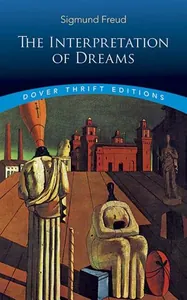





More Free Occult Philosophy Books
View all →