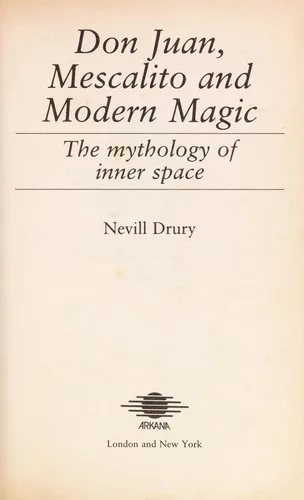
Don Juan, Mescalito and Modern Magic
 73
73

Don Juan, Mescalito and Modern Magic
Nevill Drury’s "Don Juan, Mescalito and Modern Magic" tackles a fascinating, if somewhat dated, nexus of influence: the impact of Carlos Castaneda’s writings on the Western esoteric scene. Drury’s strength lies in his meticulous tracing of how Castaneda’s narrative, particularly the introduction of Don Juan Matus and mescalito, was absorbed and reinterpreted by occultists and magicians. He effectively demonstrates the intellectual currents of the 1970s and 80s that were receptive to these ideas. However, the book’s primary limitation is its reliance on Castaneda’s framework without a critical enough distance, given later scholarship casting doubt on the authenticity of Matus. A memorable passage involves Drury dissecting how the concept of 'seeing' as described by Castaneda was adopted by contemporary magic practitioners. Ultimately, it’s a valuable historical document on a specific intellectual moment, rather than a timeless exploration of shamanism.
📝 Description
73
Nevill Drury's 1985 book examines the influence of Carlos Castaneda on modern magic.
Published in 1985, Nevill Drury's "Don Juan, Mescalito and Modern Magic" investigates the connection between indigenous shamanism and Western occultism. The book scrutinizes the impact of Carlos Castaneda's writings, particularly concerning mescalito and the figure of Don Juan Matus. Drury analyzes how altered states of consciousness, often induced by psychoactive substances, were incorporated into magical systems. This work goes beyond simple storytelling, dissecting the philosophical and practical consequences of these shamanic experiences for contemporary magic practitioners and those interested in altered states.
This volume is for serious students of esoteric history and comparative religion. It will interest readers concerned with drug culture's effect on spiritual movements in the late 20th century. The book appeals to those who question the lines between anthropology, psychology, and occult studies, especially regarding consciousness. Individuals wanting to understand the core texts and figures that shaped modern magical thought, beyond standard Western traditions, will find its analysis valuable.
The book situates itself within the late 20th-century interest in altered states of consciousness, a period marked by countercultural shifts and anthropological discoveries. Drury directly engages with the phenomenon of Carlos Castaneda's popular books, which raised questions about authenticity and philosophical depth. The work addresses a cultural moment where academic study, personal experience, and occult beliefs converged, particularly concerning shamanic practices and their integration into Western magical frameworks.
💡 Why Read This Book?
• Understand the specific impact of Carlos Castaneda's "The Teachings of Don Juan" on Western occultism in the late 20th century, a phenomenon Drury dissects. • Explore the symbolic role of mescalito as a catalyst for altered states and its integration into magical theory, as analyzed in the book's discussion of shamanic practices. • Gain insight into how the archetype of Don Juan Matus was adopted and adapted by modern magical practitioners seeking shamanic knowledge.
⭐ Reader Reviews
Honest opinions from readers who have explored this book.
❓ Frequently Asked Questions
What is the primary focus of Nevill Drury's "Don Juan, Mescalito and Modern Magic"?
The book primarily examines how Carlos Castaneda's writings on Don Juan Matus and mescalito influenced Western occultism and modern magic, particularly during the 1970s and 1980s.
When was "Don Juan, Mescalito and Modern Magic" first published?
Nevill Drury's work was first published in 1985, placing its analysis within the context of the ongoing reception of Castaneda's books.
Does the book discuss the authenticity of Carlos Castaneda's Don Juan Matus?
While Drury analyzes the influence of the figure of Don Juan Matus, the book predates much of the later academic scrutiny regarding Castaneda's authenticity. Its focus is on the *reception* of the narrative.
What role does mescalito play in the book?
Mescalito, derived from the peyote cactus, is examined as a psychoactive substance used in shamanic traditions and its perceived function as a gateway to altered states of consciousness relevant to magic.
Who are the intended readers for this book?
The book is best suited for students of esoteric history, comparative religion, and those interested in the intersection of shamanism, altered states, and Western occult traditions.
What makes this book unique compared to other works on shamanism?
Its uniqueness lies in its specific focus on the *reception* and *adaptation* of indigenous shamanic concepts, particularly those popularized by Castaneda, within the framework of Western esoteric and magical practices of the late 20th century.
🔮 Key Themes & Symbolism
Castaneda's Influence
The book critically examines the wide impact of Carlos Castaneda's "The Teachings of Don Juan" on esoteric thought. Drury details how the figure of Don Juan Matus and the concept of shamanic knowledge, as presented in Castaneda's early works from 1968 onwards, were not only read but actively integrated into the practice and theory of Western magic. This theme explores how a narrative, potentially fictional or heavily embellished, became a foundational text for a generation of occultists seeking alternative spiritual paths and methods of consciousness exploration.
Mescalito and Altered States
A central theme is the exploration of mescalito (peyote) as a sacrament and a tool for accessing non-ordinary reality. Drury examines how the shamanic use of this psychoactive substance, as depicted through Don Juan, was perceived and adopted by modern practitioners. This section analyzes the psychological and spiritual implications of such entheogenic experiences, framing them within the context of magical attainment and the expansion of consciousness beyond everyday perception.
Shamanism in Western Magic
Drury investigates the convergence of indigenous shamanic traditions and contemporary Western magical systems. The work dissects how elements of shamanic practice—such as spirit journeys, interacting with non-physical entities, and the role of the sorcerer—were reinterpreted and synthesized within established esoteric frameworks. This theme highlights the search for authentic, potent spiritual technologies, moving beyond purely ceremonial or intellectual approaches to magic.
The Sorcerer's Path
The concept of the 'sorcerer's path' is explored as a metaphor for spiritual development and the acquisition of power. Drawing from Castaneda's portrayal, Drury analyzes this path as a rigorous discipline involving self-mastery, confronting personal limitations, and engaging with the unseen world. It represents a form of practical mysticism focused on personal transformation and the development of enhanced perceptual abilities, framed within a modern magical context.
💬 Memorable Quotes
Direct passages from the work, attributed to the author.
“The sorcerer's path is one of solitary awareness.”
— This interpretation emphasizes the introspective and individualistic nature of the magical or shamanic journey as described in the book, suggesting that true power and understanding come from within.
“Don Juan Matus presented a system that appeared to offer direct access to power.”
— This highlights the appeal of Castaneda's teachings, suggesting that the character of Don Juan Matus was perceived by many occultists as a guide to practical, potent spiritual techniques unavailable elsewhere.
“Western magic sought to integrate shamanic insights.”
— This suggests a historical trend where occult practitioners looked to indigenous traditions, particularly those popularized by Castaneda, to enrich and expand their own magical systems and understanding of spiritual power.
“The exploration of altered states became a central tenet for many.”
— This reflects the broader cultural and esoteric interest in non-ordinary consciousness during the period, positioning the study of such states as crucial for spiritual and magical development.
💡 Key Ideas
Editorial paraphrase of the work's core concepts — not direct quotes.
Mescalito served as a key to unlocking hidden perceptions.
This paraphrased concept underscores the role of the psychoactive cactus in the narrative, portraying it not merely as a drug but as a symbolic and practical instrument for altering consciousness and revealing deeper realities.
🌙 Esoteric Significance
Tradition
This work fits within the broader tradition of comparative occultism and the study of comparative religion, particularly focusing on shamanic and indigenous spiritual practices as they intersect with Western esoteric systems. It represents an effort to synthesize perceived 'primal' spiritual technologies with established magical frameworks, moving beyond purely Hermetic or Kabbalistic interpretations prevalent in earlier esoteric literature.
Symbolism
The figure of Don Juan Matus symbolizes the archetypal shamanic guide, embodying esoteric wisdom and the power to initiate others into non-ordinary reality. Mescalito, the peyote cactus, functions as a potent psychoactive sacrament, a key to unlocking altered states of consciousness, and a symbol of connection to the natural and spiritual worlds, facilitating visionary experiences central to shamanic practice.
Modern Relevance
Contemporary thinkers and practitioners in fields like psychedelic-assisted therapy, neo-shamanism, and consciousness studies continue to engage with the themes Drury explores. The enduring interest in altered states, the archetype of the wise elder, and the integration of indigenous wisdom into modern spiritual paradigms show the lasting impact of the discussions initiated by Castaneda and analyzed by Drury.
👥 Who Should Read This Book
• Students of esoteric history: Those seeking to understand the intellectual currents that shaped Western occultism in the late 20th century, particularly concerning the influence of shamanism. • Practitioners interested in altered states: Individuals exploring the role of consciousness alteration in spiritual and magical development, and how these experiences have been interpreted historically. • Comparative religion scholars: Researchers examining the cross-cultural transmission of spiritual ideas and the adaptation of indigenous traditions within Western contexts.
📜 Historical Context
Published in 1985, Nevill Drury's "Don Juan, Mescalito and Modern Magic" emerged during a period of intense fascination and critical debate surrounding Carlos Castaneda's works. The counterculture of the 1960s and 70s had opened Western minds to alternative spiritualities, and Castaneda's "The Teachings of Don Juan" (1968) provided a compelling, albeit controversial, narrative of shamanism. While figures like anthropologist Margaret Mead engaged with Castaneda's early texts, academic skepticism grew regarding the authenticity of Don Juan Matus and the Yaqui practices described. Drury's book positioned itself within this milieu, analyzing how occultists and practitioners of modern magic, influenced by figures like Aleister Crowley and Dion Fortune, absorbed and adapted these shamanic concepts. The work offered a bridge between anthropological accounts, psychedelic experiences, and the evolving field of Western esotericism, a landscape also occupied by the burgeoning New Age movement.
📔 Journal Prompts
The sorcerer's path as solitary awareness: How does this concept apply to your own spiritual discipline?
Reflect on the archetype of Don Juan Matus: What qualities of a spiritual guide does this figure represent?
Mescalito's role in unlocking perceptions: Consider other symbolic keys to altered consciousness you have encountered.
The synthesis of shamanic and Western magic: What potential benefits or drawbacks arise from such integration?
Analyze the concept of 'seeing' as a magical faculty: How might this differ from ordinary sight?
🗂️ Glossary
Don Juan Matus
The purported shamanic mentor figure described in Carlos Castaneda's books, presented as a teacher of esoteric knowledge and sorcery derived from indigenous traditions.
Mescalito
A term referring to the psychoactive alkaloids derived from the peyote cactus (Lophophora williamsii), used ceremonially in indigenous North American shamanism for visionary and spiritual purposes.
Shamanism
A spiritual practice characterized by a practitioner's alleged ability to communicate with the spirit world and act as an intermediary between the human and spirit realms, often involving altered states of consciousness.
Occultism
A category of mystical or supernatural traditions that generally lie outside the mainstream religious and scientific acceptance. It often involves the study of hidden knowledge and practices such as magic, alchemy, and divination.
Altered States of Consciousness (ASC)
Any mental state significantly different from a normal waking state, often achieved through meditation, hypnosis, dreams, or the use of psychoactive substances.
Sorcerer's Path
A concept popularized by Castaneda, representing a rigorous, disciplined journey of self-discovery and spiritual power acquisition, often involving confronting illusions and mastering non-ordinary reality.
Western Magic
Esoteric traditions originating in Europe and North America, encompassing systems like Ceremonial Magic, Hermeticism, and Thelema, often distinct from Eastern or indigenous spiritual practices.
🔮 Readers Also Liked
Browse all →









More by Nevill Drury
All books →




More Free Occult Philosophy Books
View all →