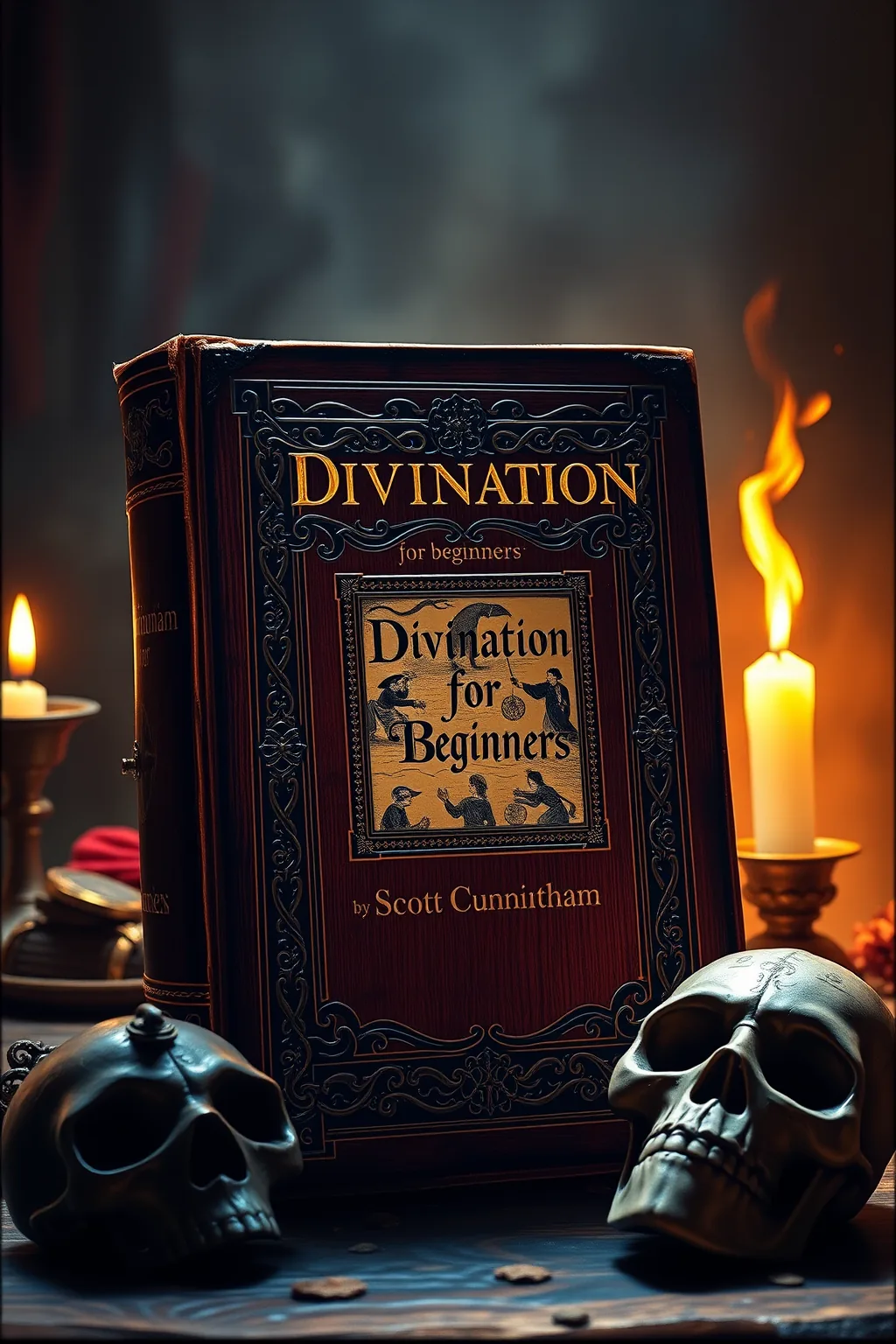
Divination for beginners
 73
73

Divination for beginners
Scott Cunningham’s "Divination for Beginners" attempts a noble goal: to strip away the theatricality that often surrounds divination and present it as a learnable skill. The strength of the book lies in its direct, unpretentious prose. Cunningham prioritizes accessibility, moving briskly through several divination methods without getting bogged down in overly academic or inaccessible theory. For instance, his explanation of how to approach a tarot spread focuses on personal resonance rather than memorizing rigid meanings, which is a refreshing take for newcomers. However, this very accessibility is also its limitation. While offering a broad overview, it sometimes sacrifices depth. The section on runes, for example, feels particularly brief, leaving the reader wanting more practical exercises or deeper etymological context. Cunningham's approach, while grounded, occasionally feels too minimalist, potentially leaving some readers with more questions than answers regarding the deeper energetic or psychological underpinnings. Despite this, for an absolute novice seeking a gentle, non-intimidating entry point into the world of divination, the book serves its purpose effectively.
📝 Description
73
Scott Cunningham's 2010 book offers a practical guide to divination, demystifying its methods for personal insight.
Published in 2010, Scott Cunningham's "Divination for Beginners" aims to make future-telling practices accessible. The book moves away from obscure language and presents techniques like tarot and runes as learnable skills. It covers a variety of methods, giving readers the basic knowledge to understand how they work and how to use them.
The approach emphasizes personal intuition over strict rules. This guide is for newcomers to divination who are drawn to symbols and understanding potential future events. It provides a clear, direct path for those avoiding complex theories. Skeptics and individuals already involved in spiritual practices looking to add new tools will find this book useful.
Cunningham's work appears in a period of renewed interest in divination, a trend that has roots in late 19th and 20th century occult revivals. While historical figures codified occult knowledge, this 2010 book targets a modern audience. It focuses on practical application rather than solely historical or theoretical study, distinguishing it from earlier esoteric texts. The book acknowledges the persistence of interest in tangible guides to ancient practices, even in the digital age.
💡 Why Read This Book?
• Gain a foundational understanding of divination principles, learning about concepts like synchronicity and intuition as introduced in Cunningham's 2010 work, "Divination for Beginners," which provides a grounded starting point. • Explore multiple divination methods, including tarot and runes, as presented in the book, allowing you to identify which tools might best align with your personal spiritual path and practice. • Develop a practical, personal approach to divination, focusing on intuitive interpretation and energetic connection as emphasized throughout "Divination for Beginners," empowering you to use these tools for self-reflection.
⭐ Reader Reviews
Honest opinions from readers who have explored this book.
❓ Frequently Asked Questions
Is Scott Cunningham's 'Divination for Beginners' suitable for someone with absolutely no prior knowledge of esoteric practices?
Yes, "Divination for Beginners," first published in 2010, is specifically designed for individuals with no prior experience. Scott Cunningham deliberately avoids complex jargon, focusing on clear explanations and practical steps for common divination methods.
What specific divination methods does Scott Cunningham cover in his book?
The book covers a range of methods, including an introduction to tarot card interpretation, the use of runes, pendulum dowsing, and other symbolic systems that can be used for divination.
Does 'Divination for Beginners' teach deterministic fortune-telling?
No, Cunningham's approach emphasizes divination as a tool for insight, intuition development, and understanding potential paths, rather than fixed, unavoidable future events. The work highlights free will within a divinatory context.
What is the core philosophy behind divination as presented by Cunningham?
The core philosophy revolves around concepts like synchronicity (meaningful coincidences) and the development of personal intuition. Cunningham encourages readers to trust their inner guidance when interpreting symbolic systems.
When was 'Divination for Beginners' by Scott Cunningham originally published?
Scott Cunningham's "Divination for Beginners" was first published in 2010, making it a relatively contemporary guide to the practice of divination.
How does this book differ from more complex occult texts on divination?
Unlike more complex texts that might delve deeply into historical lineages or intricate ceremonial aspects, "Divination for Beginners" focuses on practical application and personal connection to the tools, making it highly accessible for newcomers.
🔮 Key Themes & Symbolism
Intuitive Connection
The book strongly advocates for developing personal intuition as the primary tool in divination. Cunningham posits that while tools like tarot or runes provide symbols, it is the diviner's inner knowing that truly unlocks their meaning. This theme encourages readers to move beyond rote memorization of meanings and instead cultivate a dialogue with their subconscious and the energetic field surrounding the reading. The work suggests that intuition acts as a bridge, connecting the individual to the subtle energies and symbolic language of the universe.
Synchronicity and Meaning
A central concept explored is synchronicity, the principle of meaningful coincidences. Cunningham explains how seemingly random events or card draws are not mere chance but hold significant meaning for the querent. This theme frames divination not as predicting a fixed future, but as interpreting the symbolic messages that arise in alignment with present circumstances. It encourages a worldview where the universe communicates through patterns and symbols, inviting the diviner to become attuned to these messages.
Practical Application of Tools
The work focuses on making esoteric tools accessible for everyday use. Cunningham explains practices like tarot and rune casting, presenting them as straightforward methods for gaining clarity and self-understanding. The emphasis is on learning the mechanics of using specific tools, such as shuffling tarot cards or drawing runes, and then applying them in a personal, grounded way. This theme aims to empower beginners by showing them that divination is a skill that can be learned and integrated into their lives.
Archetypal Symbolism
Cunningham touches upon the role of archetypes within divination systems, particularly in tarot. Archetypes are presented as universal patterns of human experience and imagery that resonate deeply. The book suggests that these symbols within tools like tarot cards tap into a collective unconscious, providing a rich source of insight. Understanding these archetypal underpinnings allows for a more profound interpretation of the messages received during a divination session.
💬 Memorable Quotes
Direct passages from the work, attributed to the author.
“Intuition is the primary tool of the diviner.”
— This statement captures Cunningham's emphasis on personal inner guidance. It suggests that external tools are conduits, but the true understanding and meaning derived from divination stem from the diviner's own developed intuitive capacity.
“Synchronicity is the meaningful coincidence of events.”
— This highlights a core principle of divination as presented in the book. It posits that the 'random' selection of cards or runes isn't arbitrary but carries significant, often symbolic, meaning relevant to the individual's situation.
“Divination is a tool for self-discovery, not predetermined fate.”
— This interpretation reframes the purpose of divination. Instead of seeing it as a rigid prophecy of what will happen, the work suggests it's a method for gaining clarity, understanding current energies, and exploring potential paths, thereby empowering the individual.
“Learn the basic meanings, then trust your gut.”
— This practical advice guides beginners on how to approach divination tools like tarot. It balances the need for foundational knowledge with the crucial element of personal interpretation and intuitive feeling.
“Every symbol has a story waiting to be told.”
— This evocative phrase encourages engagement with the symbolic language of divination. It suggests that each element within a reading, whether a card or a rune, contains layers of meaning that can be uncovered through careful observation and intuition.
🌙 Esoteric Significance
Tradition
While not explicitly aligning with a single esoteric lineage like Hermeticism or Kabbalah, Cunningham's work draws broadly from Western esoteric traditions that emphasize symbolic interpretation and intuition. It bridges the gap between ancient divinatory practices and modern self-help movements. The approach prioritizes personal gnosis and direct experience over adherence to rigid doctrines, a characteristic found in various mystical paths that seek an inner knowing rather than external authority.
Symbolism
The book engages with symbolism primarily through the lens of tools like tarot cards and runes. In tarot, archetypal imagery represents fundamental human experiences and psychological states. Runes, with their Norse origins, are presented as potent symbols carrying elemental and cosmic significance. Cunningham guides readers to connect with these symbols not just intellectually but intuitively, understanding them as keys to unlocking deeper layers of meaning relevant to personal life.
Modern Relevance
Cunningham's accessible style continues to influence contemporary practitioners and authors in the fields of modern witchcraft, intuitive development, and self-care spirituality. His emphasis on practical application and personal intuition appeals to many seeking to integrate divination into everyday life, making his work a foundational text for those exploring spirituality outside traditional religious frameworks. His approach is often cited in online communities and by practitioners focused on psychological and personal growth applications of divination.
👥 Who Should Read This Book
• Aspiring diviners seeking a clear, step-by-step introduction to tools like tarot and runes, who appreciate a practical, no-nonsense approach to esoteric subjects. • Individuals interested in developing their intuition and understanding the concept of synchronicity as presented in Scott Cunningham's 2010 work, looking for guidance on how these apply to divination. • Skeptics curious about the mechanics and potential benefits of divination, who prefer a grounded explanation that avoids overly dogmatic or complex spiritual theories.
📜 Historical Context
Scott Cunningham's "Divination for Beginners," published in 2010, arrived during a period of widespread accessibility to esoteric knowledge, partly fueled by the internet. This era saw a significant departure from the more academic and often secretive approaches to occultism prevalent in the late 19th and early 20th centuries, influenced by figures like Aleister Crowley and the Golden Dawn. While earlier authors focused on intricate magical systems and historical lineages, Cunningham's work reflects a contemporary spiritual milieu characterized by a desire for practical, personalized spirituality. It aligns with a broader trend of New Age thought that seeks to integrate ancient practices into modern life for self-help and personal growth, differing from the more rigorous, ceremonial magic traditions or the philosophical explorations found in Hermeticism. The book's straightforward presentation stands in contrast to the denser theoretical works of contemporaries or predecessors who might have explored the Kabbalistic underpinnings of tarot, for example. Its reception was part of a continuous, evolving interest in divination techniques that have seen periods of both embrace and suppression throughout history.
📔 Journal Prompts
The role of intuition in interpreting a rune spread.
How synchronicity manifests in daily life, beyond divination.
The archetypal resonance of a specific tarot card.
Personal connection to a divination tool's history.
Ethical considerations when offering divinatory guidance.
🗂️ Glossary
Divination
The practice of seeking knowledge about the future or the unknown by supernatural means, often through the interpretation of omens, symbols, or patterns.
Intuition
The ability to understand something immediately, without the need for conscious reasoning; inner knowing or gut feeling, considered a primary tool in divination.
Synchronicity
The occurrence of events that appear meaningfully related but lack a causal connection, often interpreted as significant messages or guidance.
Tarot
A deck of 78 cards featuring symbolic imagery, used for divination and self-exploration by interpreting the relationships between cards in a spread.
Runes
Ancient Germanic alphabetic symbols, each with a name and associated meanings, used for divination, magic, and writing.
Archetype
A universal, inherited pattern of thought or imagery derived from the collective unconscious, often found in symbolic systems like tarot.
Querent
The person for whom a divination reading is performed; the individual seeking insight or answers.
🔮 Readers Also Liked
Browse all →







More by Scott Cunningham
All books →



More Free Divination & Tarot Books
View all →



![The New-England primre [sic] improved.](/img/thumb/the-new-england-primre-sic-improved.webp)