Sayings, riddles, auguries, charms
 61
61

Sayings, riddles, auguries, charms



Balthazar Finch (Senior Critic, Occult Philosophy) — Gertrud Willert-Orff's 'Sayings, Riddles, Auguries, Charms' is a revelation for those attuned to esoteric currents. Willert-Orff demonstrates an uncanny ability to distill complex mystical principles into potent, evocative fragments. The book's strength lies in its ability to foster direct intuitive engagement, moving beyond dry dogma to cultivate a living understanding of divination. The riddles act as keys, unlocking perceptual pathways, while the auguries offer glimpses into the subtle mechanics of causality. This is essential reading for practitioners of the divinatory arts and scholars of hermetic traditions seeking authentic, experiential knowledge.
📝 Description
61
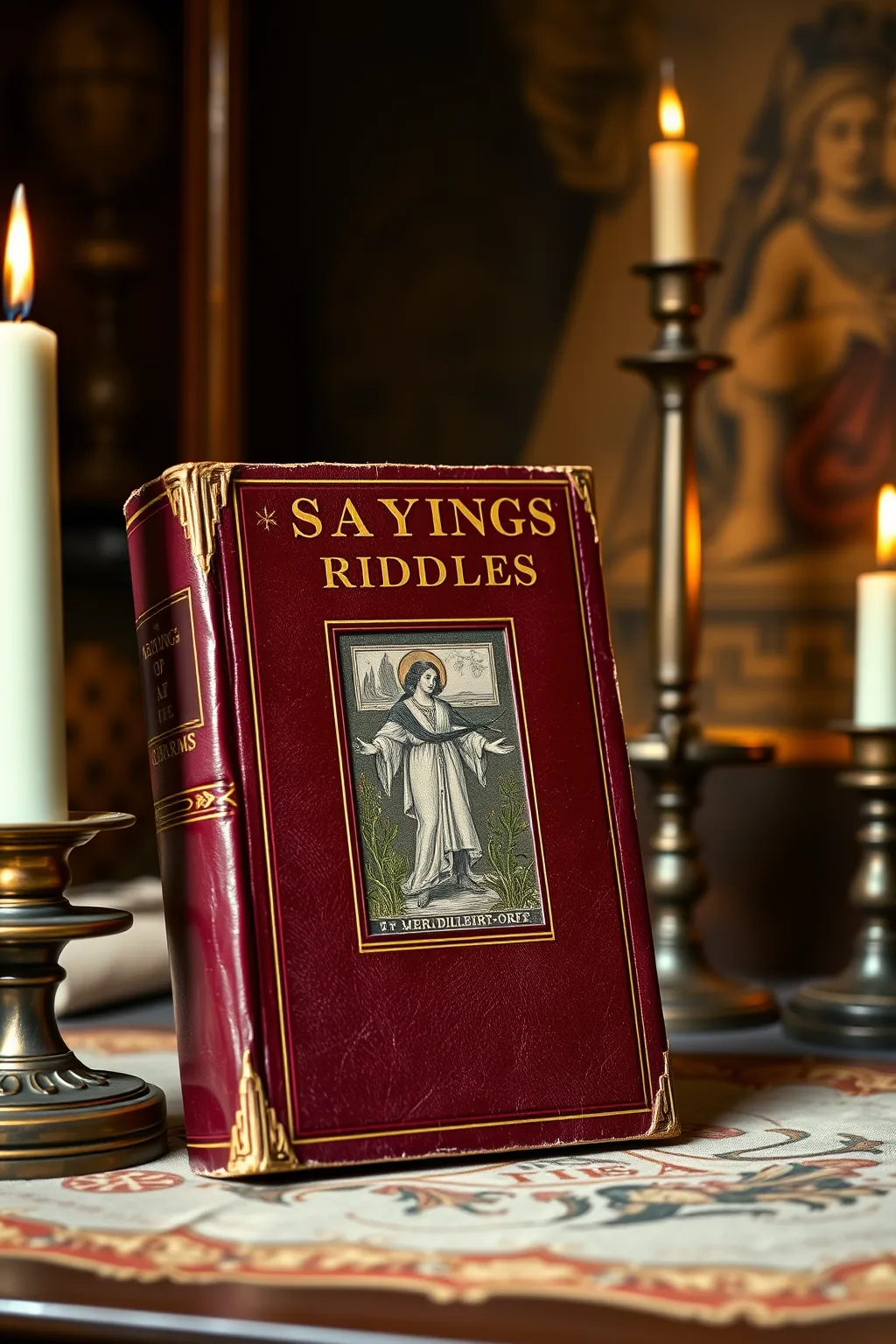
Gertrud Willert-Orff compiled 'Sayings, Riddles, Auguries, Charms' to reveal intuitive insights through symbolic language.
Gertrud Willert-Orff's 'Sayings, Riddles, Auguries, Charms' collects aphorisms, riddles, and auguries meant to unlock intuitive perception. The volume focuses on how symbolic language can illuminate the subtle forces influencing life. Willert-Orff presents these elements as tools for deciphering deeper meanings within ordinary experiences. The aim is to foster a connection with what she terms the 'language of the universe' and the 'whispers of fate'. This collection encourages readers to engage with the text not merely as a passive act of reading but as an active process of discovery. It suggests that by understanding these symbolic forms, one can achieve a more direct apprehension of cosmic patterns and underlying truths.
This work draws from traditions that emphasize symbolic interpretation and direct intuitive knowing, often found in folk magic and early modern occultism. It aligns with approaches that see language itself as possessing inherent power and the potential to reveal hidden realities. The collection of sayings, riddles, and auguries reflects a practice of using structured, often cryptic, forms to access non-rational insight. This method is common in practices seeking to connect with or understand forces beyond ordinary sensory input.
💡 Why Read This Book?
Uncover the hidden language of the cosmos and sharpen your intuitive faculties. This book offers a unique pathway to understanding symbolic meaning and prophetic insight, moving beyond rote memorization to cultivate true inner perception. Ideal for seekers of arcane knowledge, students of divination, and those yearning for a deeper connection to the universe's subtle energies.
⭐ Reader Reviews
Honest opinions from readers who have explored this book.
❓ Frequently Asked Questions
What is the primary focus of this book?
The primary focus is on unlocking intuitive perception through the study of symbolic language, riddles, and divinatory practices, revealing hidden truths and cosmic interconnectedness.
Who is Gertrud Willert-Orff?
Gertrud Willert-Orff was a scholar and practitioner deeply immersed in esoteric traditions, dedicated to preserving and disseminating ancient wisdom for modern seekers.
Is this book suitable for beginners in divination?
Yes, while rich in depth, its structure of sayings and riddles makes it accessible for beginners, offering a gradual immersion into symbolic interpretation and intuitive development.
How does this book relate to music instruction?
The original notes suggest a connection to interpreting phrasing and dynamics in music, implying a broader application of symbolic interpretation and pattern recognition across disciplines, including the 'music of the spheres'.
Can this book be used for personal prophecy?
Absolutely. The auguries and riddles are designed to be contemplated and applied to personal circumstances, acting as prompts for self-reflection and insight into future potentials.
🔮 Key Themes & Symbolism
The Language of Symbols
This theme examines the profound power of symbols as a universal language, transcending spoken words to communicate directly with the soul. Willert-Orff guides the reader in deciphering the archetypal meanings embedded in everyday objects, natural phenomena, and abstract concepts. It emphasizes that symbols are not mere representations but living conduits of energy and information, capable of useful the path of spiritual growth and self-discovery. Understanding this symbolic lexicon is presented as a fundamental key to unlocking the deeper mysteries of existence and the subtle workings of the universe.
Intuitive Perception and Inner Sight
Central to the book is the cultivation of intuitive perception – the ability to 'see' beyond the veil of ordinary consciousness. Willert-Orff posits that true wisdom is not solely acquired through intellectual study but is awakened through inner stillness and receptivity. The riddles and auguries serve as exercises to hone this inner sight, prompting the reader to trust their gut feelings and the subtle whispers of their subconscious. This theme encourages a shift in thinking, moving from external validation to internal knowing, fostering a profound connection with one's own innate wisdom and the guidance of higher consciousness.
The Art of Augury and Prophetic Insight
This theme explores the ancient art of augury, not as a deterministic prediction of fate, but as a means of understanding potential trajectories and karmic patterns. Willert-Orff presents auguries as divine consultations, offering guidance and useful the energetic currents influencing present circumstances. The book teaches how to interpret these subtle signs and omens, empowering the reader to navigate life's complexities with greater awareness and foresight. It emphasizes that prophecy is a tool for conscious creation, enabling individuals to align their actions with cosmic flow and manifest their highest potential.
💬 Memorable Quotes
Direct passages from the work, attributed to the author.
“Each riddle, a key to a locked door within the soul.”
— This highlights the transformative power of challenging questions, implying that grappling with enigmas can unlock hidden aspects of our consciousness and potential.
“The stars whisper secrets to those who learn their tongue.”
— This evokes the practice of astrology and divination, suggesting that celestial patterns hold meaningful messages for those attuned to interpret them.
“In the pause between notes, the true music is found.”
— This metaphorical quote, possibly linked to the musical notes, suggests that meaning and understanding are often found in silence, contemplation, and the unspoken.
“The future is a range, woven with threads of intention.”
— This emphasizes the role of free will and consciousness in shaping destiny, implying that our thoughts and actions actively create the reality we experience.
💡 Key Ideas
Editorial paraphrase of the work's core concepts — not direct quotes.
The echo of a forgotten truth resonates in the stillness.
This quote suggests that profound wisdom is often ancient and lies dormant, waiting to be rediscovered through quiet contemplation and inner listening.
🌙 Esoteric Significance
Tradition
This work is deeply rooted in the Western Esoteric Tradition, drawing from Hermeticism, Neoplatonism, and Gnosticism. It reflects the alchemical pursuit of transformation, the Kabbalistic understanding of divine emanation through symbolic language, and the Gnostic quest for inner gnosis. The emphasis on deciphering hidden meanings and unlocking inner potential aligns with these traditions' core tenets of spiritual awakening and the attainment of higher consciousness through direct experience and esoteric knowledge.
Symbolism
The book is a rich compendium of esoteric symbolism. Key symbols likely include celestial bodies (stars, moon), natural elements (earth, water, fire, air), archetypal figures, and abstract geometric forms. These symbols function not merely as representations but as vehicles for divine energy and cosmic principles. Their interpretation is crucial for understanding the interconnectedness of all things, the unfolding of destiny, and the pathways to spiritual evolution. The power lies in recognizing these symbols within oneself and the external world, fostering a deeper communion with the universal consciousness.
Modern Relevance
In an age often characterized by fragmentation and a disconnect from the numinous, 'Sayings, Riddles, Auguries, Charms' offers a vital antidote. It provides tools for cultivating mindfulness, enhancing intuition, and fostering a sense of profound interconnectedness with the cosmos. The book's emphasis on symbolic literacy and inner wisdom remains profoundly relevant for personal growth, ethical decision-making, and working through the complexities of modern life with greater clarity and purpose. It empowers individuals to tap into ancient reservoirs of knowledge for contemporary challenges.
👥 Who Should Read This Book
This book is an invaluable resource for a diverse readership. **Beginners** in esoteric studies will find it an accessible yet profound introduction to symbolic interpretation and intuitive development. **Scholars** of comparative religion, philosophy, and occult history will appreciate its distillation of traditional wisdom. **Seekers** yearning for deeper meaning and a connection to the spiritual dimensions of life will discover potent insights and guidance. **Practitioners** of divination, meditation, and mindfulness will find practical tools to enhance their craft and deepen their inner awareness, making it a staple for anyone on a path of conscious evolution.
📜 Historical Context
Gertrud Willert-Orff's 'Sayings, Riddles, Auguries, Charms' emerges from a body of esoteric thought that flourished in the late 19th and early 20th centuries, a period marked by a resurgence of interest in mysticism, occultism, and ancient wisdom traditions. This era saw figures like Helena Blavatsky and Rudolf Steiner popularizing esoteric philosophies, and a growing desire to find spiritual meaning beyond the confines of conventional religion. The book likely draws inspiration from hermeticism, Kabbalah, and various forms of folk magic and divination that were being re-examined and synthesized. Its emphasis on symbolic language and intuitive understanding aligns with the broader intellectual currents of the time, which sought to bridge the rational and the spiritual, the material and the unseen, offering a pathway to personal enlightenment and cosmic connection.
📔 Journal Prompts
Reflect on a recent challenge: what symbols or patterns emerged, and what might they signify?
Choose a riddle from the book and explore its layers of meaning, connecting it to your current life circumstances.
Consider the 'music' of your daily life. What are the unspoken rhythms and harmonies, and what do they reveal?
If the stars could whisper to you today, what message would you hope to receive, and why?
How can you consciously combine more intention into the 'range' of your immediate future?
🗂️ Glossary
Augury
A practice of divination, often involving the observation of natural phenomena or signs, to interpret future events or divine intentions. It is seen as a form of celestial communication.
Gnosis
Spiritual knowledge or insight, particularly that which is intuitive and experiential rather than purely intellectual. It implies a direct apprehension of divine truth.
Hermeticism
A philosophical and religious tradition based on the teachings attributed to Hermes Trismegistus, emphasizing the unity of all things and the interconnectedness of the microcosm and macrocosm.
Numinous
Characterized by or filled with a divine presence; awe-inspiring, mysterious, and often evoking a sense of spiritual dread or fascination.
Microcosm
The human being or the individual, seen as a miniature representation of the universe (macrocosm). The principle that 'as above, so below' is central to this concept.
This book appears in 5 collections
🔮 Readers Also Liked
Browse all →





From the “Spellcraft” Collection
View all →



More Free Divination & Tarot Books
View all →