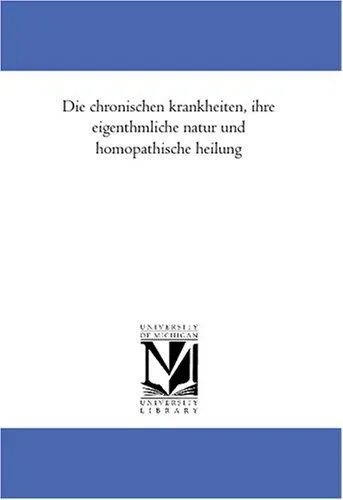
Die chronischen Krankheiten
 83
83

Die chronischen Krankheiten
Hahnemann's 'Die chronischen Krankheiten' is not a casual read; it's a dense, systematic exploration of chronic disease that demands careful attention. The true strength lies in its rigorous detailing of symptoms and the groundbreaking concept of miasms as underlying constitutional factors, a radical departure from contemporary humoral pathology. However, the sheer volume of information and the specific, sometimes archaic, terminology can present a significant barrier for those unfamiliar with homeopathic literature. The detailed symptom pictures, particularly for psora, are remarkable in their scope, illustrating Hahnemann's meticulous observation. A limitation is the inherent difficulty in applying the text directly without a solid grounding in homeopathic principles and materia medica. It is a foundational text, best approached as a deep dive into the 'why' behind chronic prescribing, rather than a simple remedy reference. This work remains a cornerstone for understanding the philosophical and etiological framework of classical homeopathy.
📝 Description
83
Samuel Hahnemann published 'Die chronischen Krankheiten' in 1828, moving beyond acute conditions to address long-term ailments.
Published in 1828, Samuel Hahnemann's 'Die chronischen Krankheiten' (The Chronic Diseases) shifts focus from acute illnesses to the systematic study of chronic conditions. Hahnemann proposed that many long-term diseases originate from improperly treated acute episodes or inherited constitutional predispositions, which he categorized as psora, syphilis, and sycosis. The book details his method for observing the complete symptom picture of a patient, stressing the necessity of tailoring treatment to the individual.
This work is directed at practitioners and students of classical homeopathy committed to understanding Hahnemann's principles for managing chronic disease. It also holds interest for medical historians and scholars of alternative healing, particularly those examining 19th-century European medical thought. Readers interested in constitutional remedies and the philosophical basis for restoring long-term health will find significant material here.
In 'Die chronischen Krankheiten,' Hahnemann engaged with vitalistic ideas prevalent in 19th-century European thought. His concept of constitutional susceptibility and the notion of inherited miasms (psora, syphilis, sycosis) suggest a framework for understanding disease that extended beyond purely physical symptoms. This approach aligns with esoteric traditions that view health and illness as influenced by deeper, often unseen forces or inherited patterns, proposing a holistic perspective on the human constitution.
💡 Why Read This Book?
• Gain a foundational understanding of Hahnemann's theory of chronic miasms (psora, syphilis, sycosis), which posits underlying constitutional causes for long-term ailments that differ from acute sickness. • Learn to recognize the intricate symptom pictures Hahnemann meticulously described for various chronic conditions, enabling a more nuanced approach to patient assessment than simple symptom matching. • Explore the historical context of 19th-century medicine and Hahnemann's radical challenge to prevailing treatments, offering a unique perspective on the evolution of alternative healing practices.
⭐ Reader Reviews
Honest opinions from readers who have explored this book.
❓ Frequently Asked Questions
What is the primary focus of 'Die chronischen Krankheiten'?
This work by Samuel Hahnemann focuses on the theory and treatment of chronic diseases, differentiating them from acute illnesses. It introduces his concept of miasms as the underlying constitutional causes for these long-term ailments.
Who is Samuel Hahnemann and why is he significant?
Samuel Hahnemann (1755-1843) was a German physician who founded homeopathy. 'Die chronischen Krankheiten' is one of his major works, elaborating on his principles of healing through highly diluted substances.
What are the 'miasms' discussed in the book?
Hahnemann identified three primary chronic miasms: psora (often described as the root of many skin and systemic issues), syphilis, and sycosis. He believed these were the fundamental causes of most chronic diseases.
When was 'Die chronischen Krankheiten' first published?
The original German publication of 'Die chronischen Krankheiten' was in 1828. This text is considered a crucial follow-up to his earlier work on acute diseases.
How does this book differ from Hahnemann's 'Organon of the Medical Art'?
'Organon' lays out the general principles and philosophy of homeopathy, while 'Die chronischen Krankheiten' specifically applies these principles to the complex domain of chronic disease management and theory.
Is this book suitable for beginners in homeopathy?
While foundational, 'Die chronischen Krankheiten' is quite dense and detailed. It is best suited for students and practitioners who have a basic understanding of homeopathic principles and materia medica.
🔮 Key Themes & Symbolism
Chronic Miasms
The central theoretical framework of the book is Hahnemann's concept of chronic miasms. He posits that most chronic illnesses are not isolated events but manifestations of deeper, inherited or acquired constitutional weaknesses. He identifies three primary miasms: psora, syphilis, and sycosis. Psora, often described as a primal itch or eruption, is considered the most common and fundamental, leading to a vast spectrum of internal complaints when suppressed. Syphilis and sycosis, originating from venereal infections, also develop into chronic pathological states. Understanding these miasms is crucial for identifying the root cause of the disease and selecting the appropriate long-term remedy.
Individualization of Treatment
Consistent with homeopathic philosophy, 'Die chronischen Krankheiten' emphasizes the absolute necessity of individualizing treatment. Hahnemann meticulously details how chronic diseases present with a unique constellation of mental, emotional, and physical symptoms in each patient. He argues against a one-size-fits-all approach, stressing that effective treatment requires a deep understanding of the patient's specific symptom picture, history, and constitutional makeup. The selection of a remedy must correspond not just to a named disease but to the totality of the individual's suffering, guided by the principle of similia similibus curentur.
Suppression vs. Eradication
A significant theme is Hahnemann's critique of conventional medical practices of his time, which he believed often suppressed symptoms rather than eradicating the underlying disease. He argued that suppressing acute illnesses or superficial manifestations of chronic miasms with harsh treatments only drives the disease deeper into the constitution, leading to more serious chronic conditions. True healing, according to Hahnemann, involves the gradual and complete eradication of the disease process from its root, allowing the body's vital force to regain its natural balance.
The Role of the Vital Force
Implicit throughout 'Die chronischen Krankheiten' is Hahnemann's concept of the 'vital force' (or ' Lebenskraft'), the animating principle that governs the body's health. He viewed disease as a disturbance of this vital force. Chronic diseases represent a profound and persistent disruption of this force, often stemming from the miasmatic influences. Homeopathic treatment aims to gently stimulate the vital force, enabling it to overcome the disease state and restore itself to a condition of health. The remedies are seen as catalysts for the vital force's self-healing capabilities.
💬 Memorable Quotes
Direct passages from the work, attributed to the author.
“The chronic maladies are those which develop slowly and last for years, often throughout a person's entire life.”
— This statement defines the core subject of the book, distinguishing chronic diseases from acute ones by their slow onset and prolonged duration, setting the stage for Hahnemann's detailed examination of their nature.
“It is not the name of the disease that is of importance, but the totality of the symptoms.”
— This highlights Hahnemann's principle of individualization in homeopathy, asserting that effective treatment depends on understanding the unique symptom picture of the patient, rather than just the label of the illness.
“Psora is the most ancient, the most common, and the most destructive of all the chronic diseases.”
— This emphasizes the central role of psora in Hahnemann's miasmatic theory, identifying it as the primary, pervasive root from which many chronic ailments allegedly develop.
“The physician must also know the effects of the medicines, and in what manner each of them produces its effects.”
— This points to the importance of Materia Medica and understanding the pathogenetic power of remedies, essential for matching the remedy's action to the patient's symptoms.
💡 Key Ideas
Editorial paraphrase of the work's core concepts — not direct quotes.
The physician's highest calling is to restore the sick to health, which is called healing.
This quote underscores Hahnemann's therapeutic goal: not merely symptom management but the complete restoration of health, aligning with the homeopathic ideal of treating the whole person.
🌙 Esoteric Significance
Tradition
Hahnemann's work, particularly 'Die chronischen Krankheiten,' fits within the Western esoteric tradition, specifically its vitalistic and holistic branches. It draws from older humoral theories but reinterprets them through a lens of an underlying energetic disturbance (the miasms) affecting the body's vital force. While not directly Kabbalistic or Gnostic, it shares with these traditions an interest in hidden causes, subtle influences, and the interconnectedness of the physical and non-physical aspects of health. It represents a practical application of vitalistic philosophy to medicine, seeking to restore balance through subtle energetic means.
Symbolism
The three primary miasms – psora, syphilis, and sycosis – function as potent symbolic archetypes within Hahnemann's system. Psora, often linked to itching, eruptions, and a sense of being "afflicted," can be seen as symbolizing primal suffering, impurity, or an unresolved shadow aspect. Syphilis symbolizes destructive, invasive forces, often associated with decay and aggression. Sycosis represents unnatural growths and a sense of being "stuck" or burdened. These symbolic representations go beyond mere disease categories, pointing to deeper patterns of disharmony within the individual's constitution.
Modern Relevance
The concepts explored in 'Die chronischen Krankheiten' continue to influence contemporary holistic health practices. Many modern homeopaths, naturopaths, and integrative medicine practitioners still reference Hahnemann's miasmatic theory when addressing complex chronic conditions. Thinkers in psychosomatic medicine and some transpersonal psychology approaches also find resonance in the idea of deep-seated constitutional patterns influencing physical health. The emphasis on individualization and the holistic view of the patient remains a touchstone for alternative and complementary health modalities.
👥 Who Should Read This Book
• Homeopathic practitioners and advanced students seeking to deepen their understanding of chronic disease etiology and Hahnemann's original therapeutic strategies. • Historians of medicine and alternative healing modalities interested in the development of 19th-century medical thought and Hahnemann's specific contributions. • Individuals exploring vitalistic philosophies and their application to health, seeking a foundational text that links constitutional predispositions to chronic ailments.
📜 Historical Context
Published in 1828, 'Die chronischen Krankheiten' emerged during a period when medical understanding was rapidly evolving but still largely dominated by theories of humoral imbalance and invasive treatments. Samuel Hahnemann's work stood in stark contrast to the prevailing allopathic methods, such as bloodletting and purging, which he viewed as harmful suppressive measures. His concept of chronic miasms – psora, syphilis, and sycosis – as the underlying causes of long-term illness offered a new etiological framework that challenged the mechanistic views of emerging scientific medicine. While figures like Rudolf Virchow were pioneering cellular pathology, Hahnemann focused on vitalistic principles and the individual's constitutional state. The reception of his work was polarized; while it gained a dedicated following among homeopathic practitioners, it was largely dismissed or criticized by the established medical community, often facing accusations of being unscientific or lacking empirical proof.
📔 Journal Prompts
The concept of psora as the root of many chronic ailments.
Hahnemann's distinction between acute and chronic disease presentations.
The physician's role in eradicating disease versus merely suppressing symptoms.
The individual symptom totality as the basis for remedy selection.
The symbolic meaning of syphilis and sycosis as chronic miasms.
🗂️ Glossary
Miasm
In Hahnemann's theory, a chronic miasm is an underlying constitutional predisposition or morbid principle believed to be the fundamental cause of chronic diseases. The three primary miasms are psora, syphilis, and sycosis.
Psora
Hahnemann's term for the most common and fundamental chronic miasm, often associated with skin affections (like itching and eruptions) and believed to be the root of many other chronic diseases when suppressed.
Syphilis
One of the three chronic miasms identified by Hahnemann, originating from the venereal disease of the same name, believed to manifest in destructive and invasive chronic pathological states.
Sycosis
The third chronic miasm in Hahnemann's system, related to the venereal disease condylomata, manifesting in chronic conditions characterized by growths and specific pathological changes.
Vital Force (Lebenskraft)
The animating principle of life, according to Hahnemann. Disease is seen as a disturbance of the vital force, and homeopathic treatment aims to restore its healthy functioning.
Totality of Symptoms
The complete picture of a patient's symptoms, including mental, emotional, and physical aspects, which Hahnemann considered essential for accurately selecting a homeopathic remedy.
Similia Similibus Curentur
The fundamental principle of homeopathy, meaning 'like cures like.' It states that a substance that causes symptoms in a healthy person can cure similar symptoms in a sick person.
🔮 Readers Also Liked
Browse all →








More by Samuel Hahnemann
All books →




More Free Occult Philosophy Books
View all →