Reine Arzneimittellehre

 71
71

Reine Arzneimittellehre
Hahnemann's Organon of the Healing Art is less a book and more a foundational document for a medical philosophy that continues to provoke and persist. Its meticulous structure, detailing the "Law of Similars" and the "Vital Force," reveals a mind rigorously attempting to codify an emergent healing art. The strength lies in its systematic approach to individualizing treatment, a stark contrast to the one-size-fits-all methods of his era. A limitation, however, is the inherent difficulty for modern readers to fully grasp the context of 19th-century medical understanding without extensive background. The detailed discussion on "drug proving" in the later editions, for instance, while crucial to homeopathy's development, requires significant interpretive effort today. The work ultimately stands as a challenging, yet essential, exploration of an alternative paradigm in medicine.
📝 Description
71
Samuel Hahnemann published his Organon of the Healing Art in 1817, detailing his new system of homeopathy.
Reine Arzneimittellehre, known in English as the Organon of the Healing Art, is Samuel Hahnemann's primary text on homeopathy. First appearing in 1817, the book articulates the principles and practice of this system of medicine. It explains the concept of "like cures like," the use of highly diluted substances, and the necessity of analyzing individual symptoms to choose remedies. Hahnemann elaborates on his reasoning, moving beyond simple prescription to establish a philosophical basis for healing.
The text is intended for practitioners and dedicated students of homeopathy, presenting the original structure conceived by its originator. Medical historians studying the evolution of alternative treatments and scholars of 19th-century science and philosophy will also find it of interest. Individuals examining the energetic and vitalistic dimensions of health and medicine will discover substantial material for their research.
Published in the early 19th century, Reine Arzneimittellehre arose during a time of rapid scientific progress and widespread use of aggressive medical practices such as bloodletting. Hahnemann's approach represented a significant shift, advocating a gentler, personalized method. It contested the prevailing humoral pathology and allopathic treatments of the era, generating considerable discussion and opposition from the established medical community.
Hahnemann's work is situated within a broader 18th and 19th-century intellectual current that questioned purely materialist explanations of disease. This period saw a resurgence of interest in vitalistic philosophies, which posited an animating life force distinct from physical matter. Homeopathy's emphasis on "like cures like" and the use of "energetic" dilutions aligns with vitalistic and some esoteric traditions that view illness as a disturbance of this life force, treatable by stimulating the body's own healing energies. It reflects a departure from the mechanistic views of the body prevalent in mainstream allopathic medicine of the time.
💡 Why Read This Book?
• Understand the "Law of Similars": Learn the core homeopathic principle of "like cures like," a concept central to understanding how remedies are selected based on symptom totality, as first systematically detailed by Hahnemann. • Explore the "Vital Force": Grasp Hahnemann's concept of the Lebenskraft, the energetic principle governing health, and how its disturbance is understood as the root of disease in this system. • Study "Drug Provings": Discover the method Hahnemann developed for testing substances on healthy individuals to catalogue their potential medicinal effects, forming the basis of the homeopathic Materia Medica.
⭐ Reader Reviews
Honest opinions from readers who have explored this book.
❓ Frequently Asked Questions
When was Samuel Hahnemann's Reine Arzneimittellehre first published?
Samuel Hahnemann's Reine Arzneimittellehre, also known as the Organon of the Healing Art, saw its first edition published in 1817. This seminal work laid out the foundational principles of homeopathy.
What is the central principle of homeopathy as described in the Organon?
The central principle is "similia similibus curentur," or "like cures like." The Organon explains that a substance capable of producing symptoms in a healthy person can cure similar symptoms in a sick person.
What is the "Vital Force" in Hahnemann's theory?
The "Vital Force" (Lebenskraft) is an animating, energetic principle that Hahnemann believed governs the body's health and functions. Disease, according to his theory, is a disturbance of this force.
How did Hahnemann determine the effects of remedies?
Hahnemann used a method called "drug proving" (Arzneiprüfung). Healthy volunteers ingested substances to meticulously document the physical, mental, and emotional symptoms they produced, creating the Materia Medica.
Is Reine Arzneimittellehre still relevant today?
Yes, Reine Arzneimittellehre remains the foundational text for classical homeopathy. Its principles and methods continue to be studied and practiced by homeopaths worldwide, influencing alternative and complementary medicine.
What historical medical practices did Hahnemann's work challenge?
Hahnemann's Organon challenged the prevailing medical practices of the late 18th and early 19th centuries, such as bloodletting and the use of toxic substances, advocating for a gentler, individualized approach.
🔮 Key Themes & Symbolism
The Law of Similars
This is the cornerstone principle of homeopathy, articulated rigorously in Reine Arzneimittellehre. Hahnemann's "similia similibus curentur" posits that a substance that induces a specific set of symptoms in a healthy individual can be used to treat similar symptoms in a diseased individual. The text details how to match the totality of a patient's unique symptoms – physical, mental, and emotional – to the documented effects of a particular remedy, a process central to the art of homeopathic prescribing.
The Vital Force
Hahnemann's concept of the Lebenskraft, or Vital Force, is central to understanding his view of health and disease. He theorized that this dynamic, animating energy is responsible for maintaining the organism's well-being. Illness arises when this force is disturbed or weakened. The Organon explains that homeopathic remedies act not by directly affecting the physical body in an allopathic sense, but by stimulating the Vital Force to restore itself and overcome the morbid derangement.
Drug Provings
The methodology for discovering the healing properties of substances, known as "drug provings" (Arzneiprüfung), is meticulously outlined. Hahnemann insisted that the effects of medicinal substances could only be accurately ascertained by administering them to healthy individuals and observing the resulting symptoms. These observations, compiled in works like the Materia Medica Pura, form the basis of homeopathic knowledge, providing the symptom pictures against which patient conditions are matched.
Individualization of Treatment
A radical departure from the standardized treatments of his time, Hahnemann's Organon strongly emphasizes the unique nature of each illness and each patient. He argues against treating diseases as abstract entities, instead focusing on the specific constellation of symptoms presented by the individual. This principle of individualization is what guides the selection of the most similar remedy, ensuring a personalized therapeutic approach.
💬 Memorable Quotes
Direct passages from the work, attributed to the author.
“The physician's highest and only calling is to restore the sick to health, to cure, as it is termed.”
— This opening statement from the Organon defines the fundamental purpose of medical practice from Hahnemann's perspective. It sets a clear, unequivocal goal for the physician, emphasizing restoration and healing above all else, and framing the subsequent principles as means to achieve this singular objective.
“The physician must not only know the disease but also understand the remedy.”
— This highlights the dual requirement for effective homeopathic practice. It's not enough to diagnose; one must also possess a deep knowledge of the medicinal substances and their specific effects on the human organism, acquired through meticulous drug provings.
“The highest degree of the cure is rapid, gentle, and permanent restoration of health.”
— This ideal outcome of homeopathic treatment, as described by Hahnemann, sets a standard for efficacy. It prioritizes not just healing, but doing so efficiently, with minimal discomfort to the patient, and with lasting results.
💡 Key Ideas
Editorial paraphrase of the work's core concepts — not direct quotes.
Disease is nothing more than a morbid derangement of the vital force.
This paraphrased concept captures Hahnemann's view of pathology. It frames illness not as a material invasion or structural defect primarily, but as a disturbance in the body's inherent energetic or animating principle, the Vital Force.
The totality of symptoms must be considered.
This paraphrased concept underscores the importance of a holistic assessment in homeopathy. Hahnemann stressed that the physician must consider all the patient's signs and symptoms – physical, mental, and emotional – to accurately select the most appropriate remedy.
🌙 Esoteric Significance
Tradition
Hahnemann's work, while presented as a scientific system, draws implicitly from vitalistic philosophies prevalent in the late 18th and early 19th centuries, which posited an animating life force distinct from purely physical or chemical processes. It shares conceptual ground with Hermetic and alchemical ideas regarding potentization and the energetic nature of healing substances, though Hahnemann sought to systematize these into a reproducible medical practice. The emphasis on individual energy and subtle influences places it adjacent to, if not directly within, the broader esoteric traditions concerned with unseen forces governing life.
Symbolism
The "Vital Force" (Lebenskraft) itself functions as a key symbolic concept, representing the irreducible life principle inherent in all living beings. The process of "potentization," or serial dilution and succussion, can be seen as a symbolic representation of energetic refinement and amplification, akin to alchemical processes aimed at extracting the quintessence of a substance. The "totality of symptoms" symbolizes the interconnectedness of the being, where physical manifestations are seen as expressions of a deeper energetic imbalance.
Modern Relevance
Contemporary practices in energy medicine, quantum healing, and certain branches of holistic psychology echo Hahnemann's focus on vitalistic principles and subtle energetic interactions. Thinkers and practitioners in fields like mind-body medicine and vibrational healing often reference the underlying concepts of the Vital Force and the energetic signature of remedies. The emphasis on individualized, symptom-based healing continues to inspire alternative practitioners seeking to address root causes rather than merely suppress symptoms.
👥 Who Should Read This Book
• Students of classical homeopathy: Individuals committed to learning and practicing homeopathy according to its original principles will find this text indispensable for understanding Hahnemann's foundational concepts and methodology. • Medical historians: Researchers interested in the evolution of medical thought and practice in the 19th century will gain crucial insights into a major alternative medical movement that arose in opposition to prevailing allopathic treatments. • Esoteric scholars: Those exploring vitalistic philosophies, the history of healing arts, and the intersection of science and subtle energies will find significant material in Hahnemann's theoretical framework and therapeutic approach.
📜 Historical Context
Reine Arzneimittellehre emerged in the early 19th century, a period when European medicine was dominated by practices like bloodletting, purging, and the use of toxic substances, often based on humoral theories or emerging chemical understandings. Samuel Hahnemann, a physician trained in these methods, became increasingly disillusioned by their ineffectiveness and harm. His work, first published in 1817, offered a starkly different paradigm: homeopathy, based on the principle of "like cures like" and the use of highly diluted, potentized remedies. This radical departure challenged the established medical authorities and practices, including the prevailing allopathic school. Hahnemann's ideas were met with both fervent support from a growing number of followers and fierce opposition from the medical establishment, leading to considerable debate and even persecution in some regions, notably Germany.
📔 Journal Prompts
The concept of the Vital Force (Lebenskraft) as the seat of health and disease.
Hahnemann's "Law of Similars" and its application to symptom matching.
The process of "drug proving" (Arzneiprüfung) and its role in constructing the Materia Medica.
The physician's duty to achieve "rapid, gentle, and permanent restoration of health."
The individualization of treatment versus generalized disease classifications.
🗂️ Glossary
Similia Similibus Curentur
Latin for "like cures like." This is the fundamental principle of homeopathy, stating that a substance causing symptoms in a healthy person can cure similar symptoms in a sick person.
Lebenskraft
German for "Vital Force." Hahnemann's term for the animating, energetic principle that governs the body's health and functions. Disease is seen as a disturbance of this force.
Arzneiprüfung
German for "drug proving." The process of testing medicinal substances on healthy individuals to systematically document the symptoms they produce, forming the basis of the homeopathic Materia Medica.
Materia Medica
A compilation of the known effects of medicinal substances on the healthy human body, as determined through drug provings. It serves as a reference for selecting homeopathic remedies.
Potentization
The process of preparing homeopathic remedies through serial dilution and succussion (vigorous shaking). It is believed to increase the energetic or curative properties of the substance.
Totality of Symptoms
The complete picture of a patient's condition, encompassing all physical, mental, and emotional symptoms, which must be considered when selecting the most similar remedy in homeopathy.
Allopathy
A term coined by Hahnemann to describe the conventional medical practices of his time, which he contrasted with homeopathy. It typically involved using remedies that produced opposite effects to the symptoms of the disease.
🔮 Readers Also Liked
Browse all →









More by Samuel Hahnemann
All books →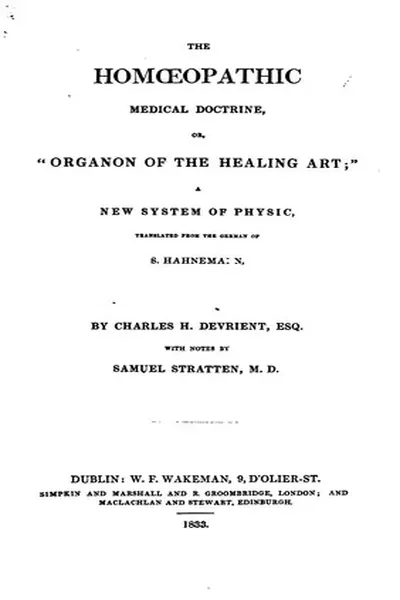




More Free Occult Philosophy Books
View all →