Organon der rationellen Heilkunde

 80
80

Organon der rationellen Heilkunde
Hahnemann's 'Organon' is a formidable text, laying out a medical system that, even over a century after its initial conception, provokes strong reactions. Its strength lies in its absolute logical consistency, presenting a worldview where disease is not merely a collection of physical symptoms but a disturbance of a vital energy, addressable by energetic means. The meticulous detailing of the 'law of similars' and the process of potentization in Sections 260-294, for instance, demonstrates a commitment to a unified theory of healing. However, its primary limitation for the modern reader is its inherent reliance on concepts like the 'vital force,' which remain outside the purview of current scientific validation, making acceptance contingent on a philosophical embrace of its premises. The work is undeniably a foundational document for a significant branch of alternative medicine, demanding engagement on its own terms.
📝 Description
80
Samuel Hahnemann published Organon der rationellen Heilkunde in 1810, detailing a new system of healing.
Organon der rationellen Heilkunde is Samuel Hahnemann's systematic exposition of homeopathy. Published first in 1810, it lays out the principles behind his therapeutic method. Hahnemann proposed that a substance causing symptoms in a healthy person could cure similar symptoms in a sick person if given in a highly diluted form. The book explains this 'law of similars' and the process of 'potentization,' which involves serial dilution and succussion.
Hahnemann wrote the Organon as a critique of 19th-century medical practices, which often involved harsh treatments like bloodletting. His work offered a different approach that appealed to those seeking gentler remedies. The book addresses the theoretical foundations and practical application of his philosophy. It is a primary source for understanding the intellectual basis of homeopathy and its development as a medical movement.
Hahnemann's work emerged from a milieu where vitalistic philosophies and theories of unseen life forces were common. His concept of "potentization" involved serial dilution and succussion, a process that he believed increased the "spirit like" medicinal power of a substance. This focus on energetic properties and the manipulation of substances beyond their material form aligns with esoteric traditions that explore hidden forces and correspondences in nature. The "Organon" sought to systematize these ideas into a coherent healing art, distinct from both materialist medicine and purely mystical approaches.
💡 Why Read This Book?
• Learn the core principle of 'similia similibus curentur' that underpins homeopathy, as systematically explained by Hahnemann himself in the early sections of the Organon. • Understand the concept of 'potentization' and its role in creating homeopathic remedies, a process detailed with specific instructions for dilution and succussion. • Grasp Hahnemann's theory of the 'vital force' and its significance in his understanding of health and disease, a central philosophical tenet presented throughout the text.
⭐ Reader Reviews
Honest opinions from readers who have explored this book.
❓ Frequently Asked Questions
When was the first edition of Organon der rationellen Heilkunde published?
The first edition of Samuel Hahnemann's Organon der rationellen Heilkunde was published in 1810, with subsequent editions appearing throughout his life, and the edition referenced here dating to 1921.
What is the central principle of homeopathy discussed in the Organon?
The central principle is 'similia similibus curentur,' or 'like cures like,' which posits that a substance capable of producing symptoms in a healthy person can cure similar symptoms in a sick person.
What does Hahnemann mean by 'vital force' in the Organon?
Hahnemann refers to the 'vital force' (vis vitalis) as the animating, non-material energy that sustains life and health. He believed disease was a disturbance of this force.
How are homeopathic remedies prepared according to the Organon?
Remedies are prepared through a process called 'potentization,' involving serial dilution with water or alcohol and vigorous shaking (succussion), which Hahnemann believed increased their dynamic power.
Who was Samuel Hahnemann?
Samuel Hahnemann (1755-1843) was a German physician, apothecary, and founder of homeopathy. He developed his system of medicine based on the law of similars and potentization.
Is Organon der rationellen Heilkunde still relevant today?
Yes, the Organon remains the foundational text for homeopathy, studied by practitioners and students worldwide to understand the rationale and methodology of this healing system.
🔮 Key Themes & Symbolism
Law of Similars
The central to Hahnemann's system, 'similia similibus curentur,' is thoroughly articulated. It posits that a substance that causes specific symptoms in a healthy individual can, in highly diluted form, cure similar symptoms in a diseased individual. The Organon details how to identify these correspondences, moving beyond symptomatic observation to an energetic understanding of disease and cure. This principle contrasts sharply with allopathic medicine, which often seeks to suppress symptoms with contraries, and forms the basis for remedy selection and application within homeopathy.
The Vital Force
Hahnemann's concept of the 'vital force' (vis vitalis) is central to his philosophy. He viewed it as an immaterial, dynamic energy that governs the organism, responsible for maintaining health. Disease, in this framework, is not a material invasion but a disharmony or derangement of this vital force. The Organon explains how remedies work by stimulating and rebalancing this force, enabling the body's inherent healing capacity to restore itself. This vitalistic perspective is a key differentiator from purely materialistic medical models.
Potentization and Dilution
The Organon provides a detailed methodology for preparing homeopathic remedies through a process Hahnemann termed 'potentization.' This involves serial dilution of a medicinal substance, typically with alcohol or water, interspersed with vigorous shaking or succussion. Hahnemann argued that this process not only removed the crude material toxicity of the substance but also liberated and amplified its inherent energetic power. The specific ratios and number of succussions are crucial, forming a systematic approach to remedy preparation.
Miasms and Chronic Disease
Beyond acute ailments, Hahnemann addressed the nature of chronic diseases, identifying underlying 'miasms' as the root cause. These are considered long-standing, inherited predispositions or constitutional weaknesses that manifest in chronic suffering. The Organon explores how these miasms, such as psora, syphilis, and sycosis, influence the development of chronic conditions and how homeopathic treatment, guided by the law of similars, aims to address these fundamental disturbances rather than just superficial symptoms.
💬 Memorable Quotes
Direct passages from the work, attributed to the author.
“The physician's high and only mission is to restore the sick to health, to cure, as it is termed.”
— This statement captures Hahnemann's fundamental purpose for the physician: to facilitate healing. It emphasizes the goal of restoring health, framing the physician's role as an agent of restoration rather than merely symptom management or disease suppression.
“In curable cases, the disease is overcome by the internal, vital force, aided by the physician’s medicine, and the vital force becomes free and the disease is extinguished.”
— This highlights the collaborative role of medicine and the body's inherent 'vital force.' The remedy acts as a catalyst, empowering the body's own healing mechanisms to eradicate the illness, rather than the medicine acting as a direct combatant.
“It is not possible to cure in any other way, or to remove the totality of the symptoms, than by means of the similar remedy.”
— This is a direct assertion of the 'law of similars' as the exclusive path to true cure. It implies that any deviation from this principle will not result in a complete eradication of the disease, but rather a partial or temporary alleviation.
“The physician must be a teacher for the patient and for those around him.”
— This emphasizes the educational aspect of the physician's role. Beyond administering remedies, the physician is tasked with informing the patient about their condition and the principles of healing, fostering a partnership in the recovery process.
“The force of the medicine is increased by the succussion.”
— This refers to the process of potentization, specifically the vigorous shaking (succussion) of the remedy during its preparation. Hahnemann believed this action dynamically enhances the medicinal power of the diluted substance.
🌙 Esoteric Significance
Tradition
Hahnemann's work draws heavily from vitalistic traditions, which posit an inherent life force animating all living beings, a concept found in Hermeticism and various alchemical philosophies. While not strictly Kabbalistic or Gnostic, his emphasis on an unseen energetic principle governing health and disease aligns with the broader esoteric understanding of reality as being more than purely material. The Organon can be seen as an attempt to systematize and apply these vitalistic principles within a medical framework, creating a bridge between metaphysical concepts and tangible healing practices.
Symbolism
The primary symbolic concept is the 'vital force' itself, representing the invisible animating principle of life, akin to the 'anima mundi' or world soul in some traditions. The process of 'potentization' through dilution and succussion can be viewed as a symbolic purification and energetic refinement, transforming a material substance into a spiritualized medicine. The 'law of similars' itself can be interpreted symbolically, suggesting a cosmic resonance or correspondence between the ailment and its cure, reflecting the Hermetic principle of 'as above, so below.'
Modern Relevance
Contemporary practitioners of homeopathy continue to rely on the Organon as their foundational text. Beyond classical homeopathy, its principles have influenced other energetic medicine modalities and the holistic health movement. Thinkers and practitioners in fields like naturopathy, bioenergetic medicine, and even some branches of quantum healing acknowledge Hahnemann's work as a precursor or parallel development, exploring the relationship between consciousness, energy, and physical well-being in ways that resonate with modern scientific inquiry into subtle energies.
👥 Who Should Read This Book
• Aspiring and practicing homeopaths seeking to understand the philosophical and methodological roots of their discipline directly from the founder's work. • Students of medical history and alternative therapies interested in the development of non-allopathic healing systems in the 19th century. • Individuals exploring vitalistic philosophies and energetic models of health and disease, wishing to engage with a seminal text that systematized such concepts for practical application.
📜 Historical Context
Samuel Hahnemann's 'Organon der rationellen Heilkunde' emerged in the early 19th century, a period marked by significant ferment in medical thought. The established medical practice of the time often involved harsh treatments like bloodletting, purging, and toxic mineral compounds, which Hahnemann vehemently criticized. His work offered a radical alternative based on his 'law of similars,' contrasting with the prevailing allopathic approach. Contemporary physicians like those within the Viennese School of Medicine, known for their empirical observations, were developing different diagnostic methods, but Hahnemann's vitalistic and energetic framework stood apart. The initial publication in 1810 and subsequent editions faced considerable skepticism and outright hostility from the medical establishment, leading to periods of difficulty for Hahnemann and his followers. Despite this opposition, the enduring principles outlined in the Organon, particularly the 1921 edition, attest to its lasting influence on alternative healing practices.
📔 Journal Prompts
The concept of the vital force and its disturbance as the origin of disease.
Hahnemann's rationale for the 'law of similars' as the sole path to cure.
The process of potentization and its perceived energetic amplification.
The physician's role as educator and facilitator of healing.
The distinction between acute and chronic disease according to miasmatic theory.
🗂️ Glossary
Similia Similibus Curentur
Latin for 'like cures like,' the fundamental principle of homeopathy stating that a substance causing symptoms in a healthy person can cure similar symptoms in a sick person.
Vital Force (Vis Vitalis)
Hahnemann's concept of an immaterial, dynamic energy that animates the body and maintains health. Disease is seen as a derangement of this force.
Potentization
The process of preparing homeopathic remedies through serial dilution and succussion (vigorous shaking), which Hahnemann believed increased the remedy's dynamic power.
Succussion
The vigorous shaking or striking of a diluted medicinal substance during the process of potentization, considered essential for increasing its energetic effect.
Miasm
In homeopathic theory, an underlying chronic constitutional predisposition or disease state (e.g., psora, syphilis) believed to be the root cause of chronic illnesses.
Allopathy
A term coined by Hahnemann to describe the conventional medical practice of his time, which used remedies that produced effects different from or opposite to the symptoms of the disease.
Organon
A systematic treatise or treatise on principles, referring to Hahnemann's foundational work on the philosophy and practice of homeopathy.
🔮 Readers Also Liked
Browse all →









More by Samuel Hahnemann
All books →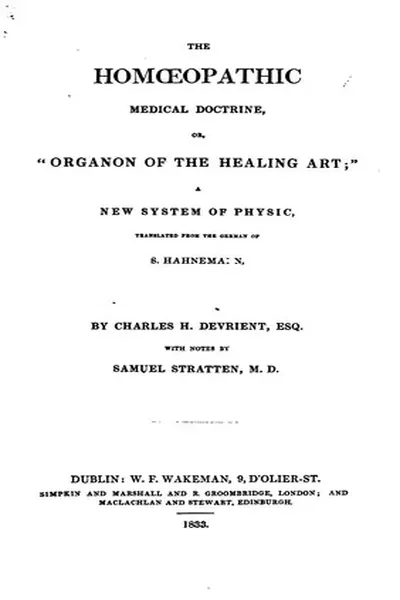




More Free Occult Philosophy Books
View all →