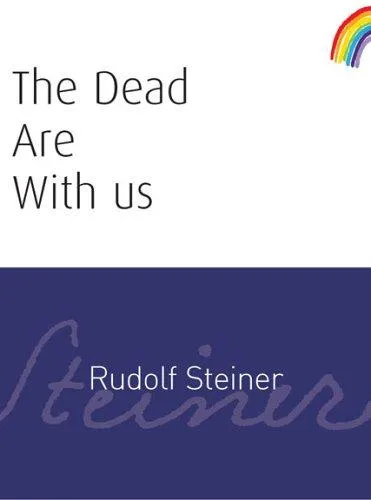
Dead Are with Us
 82
82

Dead Are with Us
Rudolf Steiner's *Dead Are with Us* presents a formidable challenge, not in its prose, but in its conceptual density. The work, a compilation of lectures, offers an intricate map of the post-mortem journey, a territory Steiner charted with his characteristic blend of empirical spiritual observation and philosophical rigor. He outlines the soul's progression through various spiritual realms with a clarity that can be startling, particularly when discussing the karmic consequences of earthly actions. The strength lies in its systematic approach; Steiner doesn't merely suggest possibilities but builds a detailed, logical edifice of spiritual science. However, a significant limitation for the uninitiated is the sheer volume of specialized terminology and the inherent difficulty in visualizing the non-physical realms he describes. For instance, his detailed exposition of the 'etheric body' and its role after death requires considerable mental effort to grasp. The lectures on the 'spiritual hierarchies' are particularly demanding, demanding a sustained focus. Despite these hurdles, the book provides a unique, internally consistent framework for contemplating mortality. It is a profound, albeit demanding, exploration of spiritual continuity.
📝 Description
82
Rudolf Steiner's lectures in *Dead Are with Us* address the continuity of consciousness after death.
Rudolf Steiner's *Dead Are with Us* compiles lectures from 1909-1914, a period of intense development in his spiritual science. The book examines the spiritual realities behind human existence, focusing on the state of the soul after death. Steiner presents a cosmology where death is a transition, not an end, within a larger cycle. He discusses the nature of spiritual hierarchies and how human actions influence the afterlife. The work aims to show the connection between the physical and spiritual realms, encouraging a life aware of its eternal aspects.
This text is most relevant for individuals familiar with Anthroposophy, Steiner's spiritual philosophy, or those curious about his views on life, death, and reincarnation. It will also interest students of esoteric Christianity and karma, particularly those seeking detailed accounts of cosmic evolution and the soul's development. Readers who value philosophical thought rooted in spiritual observation, rather than rigid dogma, will find significant content. It is also useful for those studying comparative religion and Western esotericism, offering insight into a major 20th-century thinker's ideas on spiritual phenomena.
Published in 1985, *Dead Are with Us* originates from lectures given by Rudolf Steiner between 1909 and 1914. This was a formative period for his spiritual science, occurring within a broader European interest in Theosophy and occult movements. Steiner’s lectures during this time helped articulate his distinct vision, particularly after his departure from the Theosophical Society in 1913 to establish the Anthroposophical Society. The work reflects early developments in his comprehensive spiritual philosophy.
💡 Why Read This Book?
• Learn about Steiner's specific model of the post-mortem journey, including the detailed stages of the soul's experience after death, which offers a unique perspective beyond general reincarnation theories, as discussed in the lectures from the period around 1909-1914. • Understand the role of 'spiritual hierarchies' and their influence on human evolution, a core tenet of Anthroposophy that provides a structured cosmic context for life's challenges, distinct from other esoteric cosmologies. • Explore the concept of 'karma' as presented by Steiner, focusing on how earthly deeds actively shape the soul's experience in subsequent spiritual states, offering practical ethical considerations for daily life.
⭐ Reader Reviews
Honest opinions from readers who have explored this book.
❓ Frequently Asked Questions
What is the primary focus of Rudolf Steiner's *Dead Are with Us*?
The book focuses on the spiritual realities of life after death, the continuity of consciousness, and the soul's journey through various spiritual realms and karmic processes.
When were the lectures that make up *Dead Are with Us* originally delivered?
The lectures were originally delivered by Rudolf Steiner in the early 20th century, likely between 1909 and 1914, though the book was first published in 1985.
What is the 'etheric body' as described by Steiner in this work?
The etheric body, also known as the life or formative body, is presented as a non-physical energetic structure that sustains the physical body and carries vital forces; it plays a significant role in the soul's experience after death.
How does Steiner's view of death differ from conventional perspectives?
Steiner views death not as an end, but as a transition, a doorway to a continued conscious existence in spiritual realms where karmic work and further evolution take place.
Who founded the spiritual philosophy discussed in this book?
The spiritual philosophy discussed, Anthroposophy, was founded by Rudolf Steiner, an Austrian philosopher, esotericist, and social reformer.
Is this book suitable for beginners in esoteric studies?
While accessible to those with some background in esoteric thought, the book's detailed terminology and complex concepts may present a challenge for absolute beginners without prior exposure to Steiner's work.
🔮 Key Themes & Symbolism
The Soul's Post-Mortem Journey
The work meticulously outlines the soul's passage through the spiritual worlds after physical death. Steiner describes distinct phases, including the experience of the 'Music of the Spheres' and the soul's immersion in the memory of its earthly life. This journey is not passive; the soul actively works through karmic patterns and spiritual impressions. The lectures emphasize that consciousness persists and evolves, offering a detailed, structured cosmology of the afterlife that goes far beyond generalized notions of reincarnation and spiritual realms.
Spiritual Hierarchies and Cosmic Evolution
Steiner introduces the concept of 'spiritual hierarchies'—angelic beings, archangels, and higher orders—who guide the evolution of the cosmos and humanity. These beings are presented as active participants in the spiritual processes underlying existence. The book explores how these hierarchies influence human development, offering a framework for understanding destiny and the larger cosmic plan. This concept provides a context for the soul's individual journey, situating it within a grander, divinely orchestrated evolutionary process.
Karma and Rebirth
Central to Steiner's teachings is the principle of karma, understood not as fate, but as a dynamic law of cause and effect operating across lifetimes. *Dead Are with Us* elaborates on how earthly actions, thoughts, and intentions create karmic consequences that the soul must work through in subsequent incarnations. The book details how karma influences the conditions of rebirth and the challenges faced by the soul, offering a perspective that emphasizes personal responsibility and the potential for spiritual growth through conscious engagement with these laws.
Ahrimanic and Luciferic Influences
Steiner identifies 'Ahrimanic' and 'Luciferic' as opposing spiritual forces that can impact human development. Luciferic forces tend to inflate the ego and promote premature spiritualization, while Ahrimanic forces pull humanity towards materialism and a purely intellectual, soulless existence. The lectures discuss how individuals must navigate these influences with discernment to achieve balanced spiritual development. Understanding these forces is crucial for the soul's progress, particularly during the post-mortem phases as it works through its earthly experiences.
💬 Memorable Quotes
Direct passages from the work, attributed to the author.
“Death is not an end, but a transformation.”
— This core tenet suggests that physical demise is merely a transition, leading to continued conscious existence and development in non-physical realms.
“The soul carries its earthly deeds into the spiritual worlds.”
— This highlights the principle of karma, emphasizing that actions and intentions on Earth have lasting consequences that shape the soul's post-mortem experience.
“We must develop inner senses to perceive spiritual realities.”
— Steiner advocates for cultivating inner faculties, suggesting that direct spiritual perception is possible through dedicated inner work and training.
“Spiritual hierarchies guide cosmic and human evolution.”
— This points to the existence of higher beings who actively participate in and influence the unfolding of existence, providing a structured cosmic order.
“The etheric body's work continues after physical death.”
— This concept posits that the vital forces sustaining life and form extend beyond the physical body, playing a role in the soul's post-mortem existence.
🌙 Esoteric Significance
Tradition
This work is firmly rooted in Rudolf Steiner's unique system of Anthroposophy, which itself draws from and synthesizes elements of Western esotericism, including Hermeticism, Gnosticism, Kabbalah, and Rosicrucianism, reinterpreted through his specific spiritual-scientific method. It departs from traditional Theosophy by placing a central emphasis on the cosmic significance of Christ and a detailed evolutionary path for Earth and humanity, guided by specific spiritual hierarchies.
Symbolism
The lectures implicitly engage with profound symbolic concepts. The 'spiritual hierarchies' represent a cosmic order of beings, akin to angelic orders in traditional theology but understood through Steiner's specific spiritual-scientific lens. The 'etheric body' symbolizes the principle of life and formative forces, distinct from the physical and psychic realms. The cycle of 'death and rebirth' itself functions as a potent symbol of continuous transformation and karmic reckoning, underscoring the interconnectedness of all existence.
Modern Relevance
Contemporary Anthroposophists continue to study and apply Steiner's teachings in areas like Waldorf education, biodynamic agriculture, and anthroposophical medicine. Thinkers exploring consciousness studies and the nature of reality often engage with Steiner's detailed descriptions of spiritual realms and the soul's journey. His work remains a significant reference point for those seeking a comprehensive, theosophically-inspired cosmology that addresses the profound questions of life, death, and spiritual evolution in the modern era.
👥 Who Should Read This Book
• Students of Rudolf Steiner's spiritual science seeking a deeper understanding of his cosmology regarding life after death and karmic processes, particularly those who have engaged with his earlier works. • Researchers in comparative religion and esoteric history interested in the development of early 20th-century spiritual movements and the distinct path forged by Steiner apart from Theosophy. • Individuals grappling with questions of mortality and the meaning of life who are open to a detailed, philosophical approach to spiritual realities and the continuity of consciousness.
📜 Historical Context
Rudolf Steiner delivered the lectures that form *Dead Are with Us* during a central period of his independent work, likely between 1909 and 1914. This era was marked by intense spiritual and philosophical inquiry across Europe. While the Theosophical Society, from which Steiner had recently departed, was a significant force, his own developing Anthroposophy offered a distinct, Christ-centered spiritual science. Contemporaries like Annie Besant and C.W. Leadbeater were influential within Theosophy, presenting different esoteric cosmologies. Steiner's approach, emphasizing empirical spiritual research and the specific evolutionary path of humanity, diverged sharply from the more syncretic or Eastern-influenced Theosophical doctrines. His work engaged with the spiritual currents of the time, including a growing interest in reincarnation and occultism, but critically reoriented them within a Western, specifically Christian, esoteric framework, differentiating him from the broader occult revival.
📔 Journal Prompts
The soul's experience immediately after death as described in the lectures.
The specific functions of the spiritual hierarchies in human evolution.
Your understanding of karma before and after encountering Steiner's perspective.
The distinction between Luciferic and Ahrimanic influences in contemporary life.
The role of the etheric body in maintaining life and its post-mortem significance.
🗂️ Glossary
Spiritual Science
Rudolf Steiner's term for his method of investigating the spiritual world through inner perception and disciplined thinking, aiming for objective, verifiable insights.
Anthroposophy
The spiritual philosophy founded by Rudolf Steiner, seeking to connect the spiritual in the human being with the spiritual in the universe.
Etheric Body
The vital or formative body, distinct from the physical body, responsible for life processes, growth, and healing; it carries over after physical death.
Karma
The spiritual law of cause and effect, where actions in one life influence circumstances and experiences in subsequent lives.
Spiritual Hierarchies
Orders of spiritual beings (e.g., Angels, Archangels, Archai) that guide cosmic and human evolution.
Ahriman
A spiritual being, in Steiner's cosmology, representing forces of materialism, hardening, and intellectualism that can impede spiritual development.
Lucifer
A spiritual being, in Steiner's cosmology, representing forces of pride, egoism, and premature spiritualization that can mislead human development.
🔮 Readers Also Liked
Browse all →









More by Rudolf Steiner
All books →



More Free Occult Philosophy Books
View all →