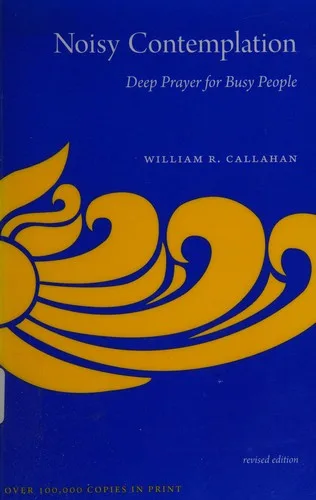
Noisy contemplation
 75
75

Noisy contemplation
William R. Callahan's "Noisy Contemplation" is a welcome disruption to the often-sanitized discourse surrounding spiritual practice. Rather than offering platitudes about finding inner peace through silence, Callahan confronts the reality of a mind that rarely, if ever, achieves it. He provocatively argues that the very 'noise' we seek to escape – the thoughts, anxieties, and external stimuli – can be the raw material for genuine contemplation. The strength of the book lies in its intellectual honesty and its refusal to oversimplify complex psychological and spiritual phenomena. A particular passage discussing the 'contemplative friction' generated by unresolved intellectual paradoxes is especially potent, framing such dissonance not as a failure of practice but as its very engine. Its limitation, however, is that the very abstractness of Callahan's arguments might leave some practitioners yearning for more concrete, actionable techniques to integrate this 'noisy' approach into daily life. The work compels a re-evaluation of what constitutes a 'spiritual' moment, suggesting it is less about the absence of sound and more about the quality of attention brought to its presence. It is a vital, if sometimes demanding, addition to the literature on consciousness.
📝 Description
75
William R. Callahan's 2008 book argues that spiritual insight arises from internal friction and external stimuli, not just silence.
Noisy Contemplation challenges the idea that spiritual growth requires absolute quiet. Callahan suggests that contemplation is an active engagement with the world, where internal conflict and sensory experience can lead to realization. He posits that the 'noise' of intellectual debate, sensory input, or inner turmoil is not an obstacle but a fertile ground for understanding. This approach moves beyond passive meditative states to embrace the dynamic, often disruptive, processes of seeking wisdom.
The book is for those who find traditional contemplative practices limiting or who question the necessity of perfect stillness for spiritual development. It speaks to seekers, philosophers, and individuals interested in self-inquiry who are open to exploring consciousness through less conventional means. Readers interested in the connections between psychology, philosophy, and esoteric thought will find Callahan's perspective particularly relevant. It addresses anyone whose inner life feels too complex or active for conventional spiritual frameworks.
Published in 2008, Noisy Contemplation emerged as Western interest in Eastern contemplative traditions was significant, though often simplified. While figures like Alan Watts offered accessible interpretations of Zen, Callahan's work interrogates contemplation itself within a Western philosophical and psychological context. It acts as a counterpoint to minimalist mindfulness movements, engaging more directly with the complexities of internal experience and external engagement as pathways to spiritual understanding.
💡 Why Read This Book?
• You will learn to reframe internal conflict and external distractions not as obstacles to spiritual growth, but as integral components of it, as explored through Callahan's concept of 'contemplative friction.' • You will gain a new perspective on the act of contemplation, understanding it as an active, dynamic engagement with the mind and world, moving beyond the traditional emphasis on enforced silence. • You will discover how the 'sacred mundane' can be accessed through heightened awareness of everyday 'noisy' experiences, challenging the separation between the spiritual and the ordinary, a core idea presented in the book's analysis.
⭐ Reader Reviews
Honest opinions from readers who have explored this book.
❓ Frequently Asked Questions
What is the core argument of William R. Callahan's 'Noisy Contemplation'?
The book argues that spiritual insight and self-awareness can arise not just from traditional silent meditation, but from actively engaging with the 'noise' of internal thoughts and external stimuli, a concept Callahan terms 'contemplative friction'.
When was 'Noisy Contemplation' first published?
The book was first published in 2008, positioning it within contemporary discussions on consciousness and spirituality.
Does the book provide practical meditation techniques?
While it offers a philosophical reorientation towards contemplation, it focuses more on the conceptual framework of engaging with mental and external 'noise' rather than providing step-by-step meditation guides.
Who is the intended audience for 'Noisy Contemplation'?
It is for individuals interested in unconventional approaches to spirituality, philosophy, and self-inquiry, particularly those who find traditional quietistic practices challenging or insufficient.
How does 'Noisy Contemplation' differ from standard mindfulness practices?
Unlike standard practices that often emphasize the quieting of the mind, Callahan's work encourages acknowledging and even utilizing the mind's natural activity and external distractions as pathways to deeper understanding.
What does Callahan mean by 'contemplative friction'?
Contemplative friction refers to the dynamic interplay of thoughts, emotions, and external events that can create a form of internal tension or pressure, which, when approached with awareness, can lead to breakthroughs in insight.
🔮 Key Themes & Symbolism
Active Contemplation
The book fundamentally redefines contemplation, moving it from a passive state of quietude to an active, dynamic process of engagement. Callahan posits that true insight isn't found in the absence of thought or external stimuli, but through a conscious interaction with them. This perspective challenges the conventional spiritual ideal of a completely tranquil mind, suggesting instead that the mind's natural activity—its questioning, its associations, its very 'noise'—can be a powerful engine for self-discovery when approached with intentional awareness.
Contemplative Friction
This central concept explores how internal dissonances, intellectual paradoxes, emotional turbulence, and even external distractions can serve as catalysts for profound realization. Instead of viewing these elements as hindrances to be overcome, Callahan frames them as 'friction' that, when understood and navigated, can generate heat and light—leading to breakthroughs in consciousness. It’s about harnessing the inherent dynamism of the human experience, rather than seeking an artificial stillness.
The Sacred Mundane
Callahan suggests that moments of spiritual significance are not confined to specially designated times or silent retreats. They can emerge from the ordinary, 'noisy' fabric of everyday life. By applying a contemplative awareness to mundane activities and sensory experiences, one can uncover layers of meaning and connection. This theme challenges the artificial separation between the sacred and the secular, advocating for a more integrated and immanent understanding of spiritual presence.
Critique of Stillness
The work offers a critical examination of the overemphasis on absolute stillness in many contemplative traditions. Callahan argues that for many individuals, particularly those accustomed to a highly stimulated modern life, seeking complete silence can be counterproductive or even alienating. He proposes an alternative approach that acknowledges and works with the inherent 'noisiness' of consciousness, making spiritual inquiry more accessible and relevant to a broader range of experiences and temperaments.
💬 Memorable Quotes
Direct passages from the work, attributed to the author.
“Silence is not the absence of noise, but the presence of attention.”
— This interpretation suggests that the value of silence in contemplation lies not in the cessation of external sounds or internal thoughts, but in the quality of focused awareness directed towards whatever arises.
“Embrace the friction; it is where insight is forged.”
— This interpretation highlights Callahan's core idea that internal conflicts, intellectual challenges, and emotional turbulence are not impediments but essential elements in the process of generating profound realizations.
“The sacred is found not in escaping the world, but in attending to it.”
— This interpretation emphasizes Callahan's theme of the 'sacred mundane,' suggesting that spiritual presence is discovered through deep, mindful engagement with everyday reality, rather than through withdrawal from it.
💡 Key Ideas
Editorial paraphrase of the work's core concepts — not direct quotes.
The mind's chatter can be a map, not just a distraction.
This paraphrased concept implies that the seemingly random or incessant stream of thoughts can, when examined closely, reveal underlying patterns, desires, and concerns that are crucial for self-understanding.
Contemplation is an active dialogue, not a passive echo.
This paraphrased concept suggests that genuine spiritual inquiry involves a dynamic exchange and critical engagement with oneself and the world, rather than merely reflecting or passively receiving external wisdom.
🌙 Esoteric Significance
Tradition
While not explicitly tied to a single lineage like Kabbalah or Theosophy, "Noisy Contemplation" draws from a broad Western esoteric and philosophical tradition that values self-knowledge and the exploration of consciousness. It aligns with Hermetic principles of "As Above, So Below" by seeking correspondences between internal states and external phenomena, and echoes Gnostic ideas of awakening through awareness of the self and the world. Its departure lies in its direct confrontation with the 'noise' as a potentially sacred element, rather than a distraction from a pure, silent state.
Symbolism
The primary 'symbol' Callahan works with is the concept of 'noise' itself—representing the mind's activity, external distractions, and internal conflicts. This 'noise' functions symbolically as the raw, unrefined material of consciousness. Another motif is 'friction,' symbolizing the dynamic tension or energetic exchange that occurs when opposing forces or ideas meet, leading to transformation. The book implicitly uses the symbol of a 'dialogue' or 'debate' within oneself as a sacred process, contrasting with the often-invoked symbol of the silent, empty void.
Modern Relevance
Callahan's work finds resonance with contemporary thinkers and practitioners exploring embodied cognition, the philosophy of mind, and critical approaches to meditation. Practices like somatic experiencing or trauma-informed therapy, which acknowledge the body's 'noise' (sensations, emotions) as vital information, echo his themes. Furthermore, artists and writers who engage with urban environments or the complexities of modern life as sources of inspiration find validation in his idea of the 'sacred mundane.' His perspective is relevant to anyone seeking to integrate their spiritual practice with the full spectrum of human experience.
👥 Who Should Read This Book
• Individuals who struggle with traditional silent meditation practices and feel alienated by the emphasis on achieving a 'blank mind,' seeking an alternative approach to inner exploration. • Philosophically inclined readers interested in the nature of consciousness, self-awareness, and the intersection of psychology and spirituality, who appreciate a nuanced, critical perspective. • Seekers of spiritual growth who are engaged with the complexities of modern life and wish to find meaning and insight within their everyday experiences, rather than solely through withdrawal.
📜 Historical Context
William R. Callahan's "Noisy Contemplation," published in 2008, arrived at a moment when Western spiritual landscapes were heavily influenced by Eastern contemplative practices, particularly mindfulness and Zen Buddhism, often presented in highly accessible, simplified forms. While figures like Thich Nhat Hanh had already made these traditions widely popular, Callahan’s work offered a distinct counter-narrative. It engaged implicitly with the philosophical currents of existentialism and phenomenology, which emphasized subjective experience and the active construction of meaning, but reoriented them towards an esoteric or spiritual inquiry. Unlike the popular trend towards de-cluttering the mind, Callahan's book implicitly challenged this by exploring the potential of intellectual and emotional 'noise.' This period also saw a continued academic and popular interest in the works of Carl Jung, whose exploration of the shadow and the unconscious mind might find resonance with Callahan's embrace of internal complexity. The reception of such works in 2008 was often within niche spiritual and philosophical circles, far from mainstream religious discourse, but contributed to a growing conversation about diverse pathways to inner awareness.
📔 Journal Prompts
The nature of 'contemplative friction' in your daily life.
Instances where external 'noise' unexpectedly led to internal clarity.
Reinterpreting a persistent internal thought pattern as a potential map.
The relationship between 'active dialogue' and passive reception in your learning.
Identifying the 'sacred mundane' within your immediate environment.
🗂️ Glossary
Contemplative Friction
The dynamic interplay of internal thoughts, emotions, and external stimuli that creates a form of energetic tension or pressure. Callahan posits this friction can be a catalyst for useful insights when actively engaged with.
Noisy Contemplation
An approach to spiritual inquiry that embraces and utilizes the mind's natural activity, internal conflicts, and external distractions as fertile ground for self-awareness and realization, rather than seeking to eliminate them.
Active Dialogue
The concept that contemplation is not a passive reception of wisdom but an engaged, often critical, internal conversation or exchange with oneself and the world.
Sacred Mundane
The idea that profound spiritual meaning and awareness can be discovered within ordinary, everyday experiences and activities, challenging the separation between the spiritual and the secular.
Presence of Attention
A redefinition of silence, suggesting its value lies not in the absence of external stimuli or thoughts, but in the quality of focused awareness directed towards whatever arises.
Contemplative Map
The notion that the mind's continuous stream of thoughts and associations, often dismissed as 'chatter,' can serve as a guide or map revealing underlying patterns crucial for self-understanding.
Internal Dissonance
The state of mental or emotional conflict arising from contradictory beliefs, values, or desires. Callahan suggests this dissonance can be a source of spiritual growth.
🔮 Readers Also Liked
Browse all →









More Free Occult Philosophy Books
View all →