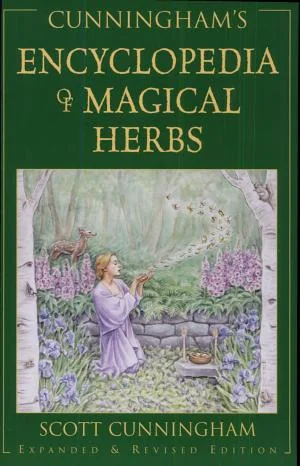
Cunningham's Encyclopedia of magical herbs
 83
83

Cunningham's Encyclopedia of magical herbs
Scott Cunningham's Encyclopedia of Magical Herbs, first appearing in 1985, presents an encyclopedic, almost botanical-garden approach to the plant kingdom's role in ritual and magic. Its sheer breadth is its most immediate strength; the meticulous cataloging of over 250 herbs, each with assigned planetary and elemental correspondences, offers a singular reference point. A notable limitation, however, is its occasionally generalized approach to complex traditions, sometimes flattening nuanced regional practices into broader categories. The section detailing the use of Mugwort (Artemisia vulgaris) for divination and dream work, for instance, is practical yet could benefit from deeper exploration of its historical variances across European folklore. Despite this, the work remains a cornerstone for modern practitioners seeking a systematic understanding of herb lore.
This encyclopedia is an indispensable, if sometimes generalized, guide to the botanical elements of magical practice.
📝 Description
83
Scott Cunningham's Encyclopedia of Magical Herbs, published in 1985, details over 250 plants for magical use.
This encyclopedia catalogs the properties, uses, and lore of more than 250 herbs pertinent to magical and spiritual work. Scott Cunningham organized this reference for those studying herbology within esoteric practices. It details each plant's energetic qualities, planetary and elemental associations, and medicinal applications.
The book stresses the intentional use of herbs in spellcraft, healing, divination, and ritual. It connects esoteric principles with concrete botanical elements, offering a unified reference point for a growing community interested in paganism and esoteric studies. The work emerged during a period of renewed interest in these subjects, presenting an accessible approach to a field often reliant on oral tradition or scattered texts.
Published in 1985, Cunningham's work arrived as interest in paganism and esoteric studies began to grow. It provided a structured, accessible guide to magical herbology, a subject often passed down through oral tradition or found in disparate texts. The encyclopedia offered a unified reference, creating a common lexicon for a diverse and expanding community. It grounds esoteric concepts in the tangible world of plants, detailing their energetic qualities and applications in ritual and healing.
💡 Why Read This Book?
• Understand the specific planetary and elemental associations for over 250 herbs, providing a structured framework for magical intent beyond generic folklore. • Learn practical applications for rituals, spellcasting, and healing as detailed in Cunningham's systematic approach, differentiating it from anecdotal herb guides. • Gain insight into the historical context of plant use in esoteric traditions, referencing the work's initial publication in 1985 amidst a revival of pagan studies.
⭐ Reader Reviews
Honest opinions from readers who have explored this book.
❓ Frequently Asked Questions
What is the primary purpose of Cunningham's Encyclopedia of Magical Herbs?
This encyclopedia serves as a comprehensive reference for over 250 herbs, detailing their magical properties, planetary and elemental correspondences, and practical uses in spellcraft, healing, and ritual.
When was Cunningham's Encyclopedia of Magical Herbs first published?
The book was first published in 1985 by Llewellyn Publications, marking a significant contribution to esoteric literature during a period of renewed interest in paganism.
Does this book include information on poisonous herbs?
Yes, the encyclopedia generally notes cautions for any herb that may be toxic or require careful handling, emphasizing safe and intentional use.
What kind of magical traditions does the book cover?
It covers a broad spectrum of Western esoteric traditions, including Wicca, witchcraft, and general folk magic, focusing on the commonalities and practical applications of herb lore.
Can this book be used for medicinal purposes?
While it mentions historical and traditional medicinal uses, it is primarily focused on magical and spiritual applications. It is not a substitute for professional medical advice or treatment.
What distinguishes this book from other herb guides?
Its focus is specifically on magical and esoteric uses, linking herbs to planetary and elemental systems, a detail less emphasized in purely botanical or medicinal guides.
🔮 Key Themes & Symbolism
Herb Correspondences
The book systematically assigns each herb to specific planets (e.g., the Sun, Moon, Mercury) and elements (Fire, Air, Water, Earth). This framework is central to its utility, allowing practitioners to select herbs that align with the energetic requirements of a spell or ritual. For example, herbs associated with Mars might be chosen for spells involving courage or conflict, while those linked to Venus could be used for love or harmony. This structured approach provides a coherent system for understanding and applying botanical energies in magical work.
Magical Applications
Beyond simple identification, the encyclopedia details the practical uses of each plant in various magical practices. This includes their application in spell sachets, incense blends, potions, anointing oils, and protective charms. Cunningham outlines specific intentions for each herb, such as using Bay Laurel for divination or Chamomile for purification and peace. The emphasis is on intentional, focused use, guiding the reader to select the appropriate herb for a desired outcome in their spiritual or ritualistic endeavors.
Botanical Lore and History
Scott Cunningham combines in the historical and folkloric significance of many herbs, connecting their magical properties to ancient traditions and cultural beliefs. This provides a deeper context for their use, illustrating how certain plants have been revered or utilized across different eras and cultures. Understanding this background enriches the practitioner's connection to the herbs and the practices associated with them, grounding the esoteric in a broader human history of plant interaction.
Personalized Practice
While providing a structured system, the book encourages personal interpretation and adaptation. Cunningham's approach is inclusive, allowing individuals to integrate the information into their existing beliefs and practices. The detailed descriptions serve as a foundation upon which readers can build their own unique relationship with magical plants, fostering an independent and intuitive approach to herb craft rather than strict adherence to dogma.
💬 Memorable Quotes
Direct passages from the work, attributed to the author.
“The energy of a plant can be used to help you.”
— This statement captures the core philosophy of the book: that plants possess inherent energies which, when understood and intentionally directed, can serve as allies in achieving magical or spiritual goals.
“A herb's name can be as powerful as its scent.”
— This highlights the importance of nomenclature and symbolic association in magical practice. The very name of a plant carries its own energetic imprint and historical significance, contributing to its overall power.
“Work with the herbs that call to you.”
— This encourages an intuitive approach to selecting and using magical herbs, suggesting that personal resonance and attraction are valid guides in choosing botanicals for spiritual work.
“Use the freshest herbs possible for the greatest power.”
— This points to the principle that the vitality and potency of a plant directly correlate with its effectiveness in magical applications, emphasizing the importance of quality and freshness.
“Each herb has its own spirit.”
— This interpretation reflects animistic beliefs often found in earth-based spiritual traditions, attributing consciousness or a distinct spiritual essence to each plant.
🌙 Esoteric Significance
Tradition
This work firmly sits within the Western Esoteric tradition, particularly drawing from Neopagan, Wiccan, and general folk magic lineages. It synthesizes elements often found in ceremonial magic (planetary and elemental correspondences) with the practical, earth-centered focus of witchcraft. It departs from more rigid Kabbalistic or Hermetic systems by prioritizing accessible, nature-based magic over complex philosophical frameworks, making it a foundational text for modern, eclectic practitioners.
Symbolism
Key symbols include planetary and elemental correspondences, which are integral to the book's system. Herbs are not merely physical objects but are imbued with the energies of celestial bodies (e.g., herbs of the Sun for vitality) and fundamental forces (e.g., Water element herbs for emotional work). The visual representation of these correspondences, often through charts or direct assignment, serves as a symbolic language connecting the terrestrial area of plants to the cosmic order.
Modern Relevance
Cunningham's Encyclopedia remains highly relevant today, influencing countless modern practitioners of witchcraft, herbalism, and general spirituality. Contemporary figures and schools, particularly those focusing on accessible earth-based magic and intuitive practice, frequently cite or draw upon its structured approach to herb correspondences and applications. It continues to serve as a primary reference for those seeking to incorporate botanical elements into their personal spiritual paths.
👥 Who Should Read This Book
• Aspiring witches and Wiccans seeking a foundational guide to understanding and utilizing the magical properties of common and uncommon plants. • Herbalists interested in the spiritual and energetic aspects of botanicals, complementing their knowledge of physical healing properties. • Students of comparative religion and folklore looking to explore the historical and cultural significance of plant use in ritual and magical traditions.
📜 Historical Context
Published in 1985, Scott Cunningham's Encyclopedia of Magical Herbs arrived during a significant resurgence of interest in paganism and esoteric practices in the West. This period saw a growing desire among individuals to connect with older traditions and find practical applications for spiritual beliefs, moving beyond established religious structures. Competing with the more academic or historically dense texts on witchcraft and herb lore that existed, Cunningham's work distinguished itself through its clear, accessible, and systematically organized approach. Unlike scholars like Margaret Murray, whose theories on the historical witch cult were influential but debated, Cunningham focused on the practical application of herb magic for contemporary practitioners. The book provided a unified and encyclopedic reference for a dispersed community, offering common correspondences and uses that facilitated shared practice and learning.
📔 Journal Prompts
The correspondences of Mugwort and its divination uses.
Your personal resonance with herbs assigned to the Moon.
How to integrate Basil's protective energies into daily life.
The elemental associations of herbs you frequently encounter.
Developing a ritual using an herb associated with Mercury.
🗂️ Glossary
Correspondences
In esoteric traditions, these are symbolic relationships between different elements, such as assigning herbs to planets, elements, or deities to understand their energetic qualities and magical applications.
Elemental Magic
A system of magic that utilizes the four classical elements (Earth, Air, Fire, Water) and sometimes Spirit (Aether) as fundamental forces, often associating them with directions, seasons, and specific energies.
Planetary Magic
A form of magic that draws upon the perceived energies and influences of celestial bodies (planets, Sun, Moon) to imbue spells, rituals, or objects with specific qualities and intentions.
Spellcraft
The practice of creating and casting spells, often involving the intentional use of tools, symbols, words, and energies to achieve a desired outcome.
Ritual
A set of actions performed in a prescribed order, typically for a religious or spiritual purpose, often used to mark significant occasions or to focus intent.
Herbology
The study of plants and their uses, encompassing medicinal, culinary, and in this context, magical and spiritual applications.
Neopaganism
A broad term for modern religious movements that draw upon pre-Christian European polytheistic traditions, often emphasizing nature worship and animism.
🔮 Readers Also Liked
Browse all →








More Free Occult Philosophy Books
View all →