《香港山脈形勢論》《如何應用日景羅經》合刊
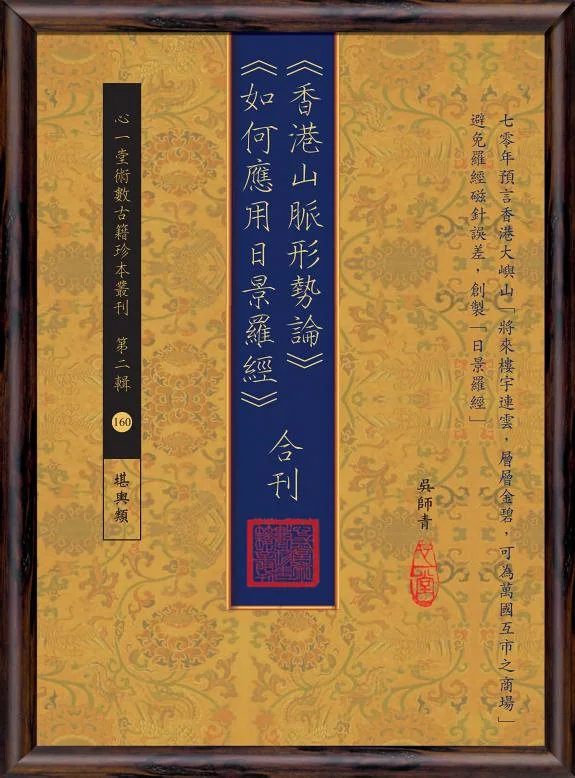
 72
72

《香港山脈形勢論》《如何應用日景羅經》合刊
Wu Shiqing's combined treatise on Hong Kong's geomantic forms and the solar compass is a fascinating, albeit dense, contribution to localized feng shui studies. The section on Hong Kong's mountains, particularly the prescient interpretation of Lantau Island as a future international trading hub, offers a compelling example of applying classical geomancy to contemporary urban prediction. Wu’s critique of standard magnetic compasses, citing their inherent inaccuracies due to magnetic declination and environmental interference, is well-articulated and provides a strong rationale for his invention of the solar compass. However, the practical application of the solar compass itself remains somewhat abstract without accompanying diagrams or detailed construction schematics, which are presumably absent in the original publication. The text assumes a considerable prior knowledge of feng shui principles, making it less accessible to the absolute novice. Nevertheless, for dedicated scholars of Chinese geomancy, this work offers valuable insights into a specific regional interpretation and a unique instrumental innovation.
📝 Description
72
Wu Shiqing's 1960s and 1970s works on Hong Kong geomancy are now combined.
This volume brings together two important texts by Wu Shiqing concerning the geomancy of Hong Kong. The first, "On the Geomantic Forms of Hong Kong's Mountains," applies classical Chinese feng shui principles to the specific topography of the region. It analyzes the mountain ranges and their energetic configurations.
The second text, "How to Apply the Solar Compass," details a unique navigational instrument developed by Wu. This device was designed to offer greater accuracy for geomantic calculations than traditional magnetic compasses. Both books were originally published in Hong Kong. This edition makes them available for contemporary study by practitioners and scholars.
The work is particularly relevant for those interested in applying traditional geomantic theories to a modern, urbanized environment like Hong Kong. It also serves as a resource for understanding the evolution of geomantic tools and methods, specifically Wu Shiqing's solar compass.
Wu Shiqing's writings are situated within the tradition of Chinese metaphysical arts, specifically geomancy or feng shui. His work draws upon classical lineages, such as that of Yang Yun-song, adapting ancient theories to the specific geographical context of Hong Kong and the Pearl River Delta. The analysis of mountain forms connects terrestrial topography to celestial divisions within Chinese cosmology, particularly the Zi Wei Yuan mansion. The invention of the solar compass highlights a practical, instrumental approach within the esoteric tradition, aiming to refine the application of geomantic principles in a contemporary setting.
💡 Why Read This Book?
• Understand the unique geomantic configurations of Hong Kong's mountains, as Wu Shiqing applies classical principles to the Pearl River Delta's topography, noting its celestial correlation with the 'Imperial Market' (天市垣). • Learn about the 'Solar Compass' (日景羅經), an innovative instrument developed by Wu Shiqing in the 1960s to overcome the limitations of magnetic compasses in precise geomantic surveying. • Discover Wu Shiqing's commentary on Hong Kong's destiny, particularly his 1964 prediction regarding Lantau Island becoming a vast international marketplace, as detailed in 《香港山脈形勢論》.
⭐ Reader Reviews
Honest opinions from readers who have explored this book.
❓ Frequently Asked Questions
When was the original publication of 《香港山脈形勢論》?
The original edition of 《香港山脈形勢論》 was first published in 1964 by Hong Kong's Zhong Tian Trading Company.
What problem does Wu Shiqing's 'Solar Compass' solve?
Wu Shiqing's 'Solar Compass' aims to resolve the significant degree errors in geomantic assessments caused by magnetic declination and environmental magnetic interference that affect traditional magnetic compasses.
What celestial body is Hong Kong's mountain formation said to correspond to?
According to Wu Shiqing, Hong Kong's mountain formations are believed to correspond to the celestial division of Tian Shi Yuan (天市垣), interpreted as a center for trade and population.
What prediction did Wu Shiqing make about Lantau Island?
In 《香港山脈形勢論》, Wu Shiqing predicted that Lantau Island would eventually feature 'buildings reaching the clouds,' becoming a grand international marketplace.
What classical feng shui text does Wu Shiqing reference for his Hong Kong geomancy?
Wu Shiqing explicitly states that he bases his work on the principles of Yang Yun-song, particularly referencing the 'Han Long Jing' (撼龍經) for his analysis of Hong Kong's mountain forms.
Are there any visual aids for the 'Solar Compass' in this combined edition?
The provided blurb indicates the original texts are restored. While the blurb mentions Wu's invention and its application in his other work, 《樓宇寶鑒》, it does not specify if construction diagrams or detailed visual aids for the 'Solar Compass' are included in this particular combined edition.
🔮 Key Themes & Symbolism
Regional Geomancy
This work anchors classical feng shui theory to the specific topography of Hong Kong. Wu Shiqing meticulously analyzes the mountain ranges and river systems, interpreting their forms through the lens of Yang Yun-song's lineage. He correlates these terrestrial features with celestial mansions, specifically identifying Hong Kong with the 'Imperial Market' (天市垣), a concept usually associated with bustling trade and population centers. This localized approach provides a unique framework for understanding the energetic undercurrents shaping the region's development and destiny.
Instrumental Innovation
A significant focus is placed on the practical challenges of accurate directional measurement in geomancy. Wu Shiqing critiques the inherent flaws of standard magnetic compasses, such as magnetic declination and environmental interference, which can lead to substantial errors in siting. To address this, he introduces the 'Solar Compass' (日景羅經), an instrument designed to provide more reliable orientation. This highlights a historical drive within geomantic practice to refine tools for greater precision in a modernizing world.
Geomantic Prediction
Wu Shiqing utilizes his analysis of Hong Kong's geomantic forms to make specific predictions about the region's future. Most notably, his interpretation of Lantau Island's topography, aligning it with the celestial 'Imperial Market,' leads him to foresee its transformation into a major international trading hub. This demonstrates the divinatory aspect of feng shui, where the study of landscape forms is believed to reveal the potential and future trajectory of a place.
Classical Lineage
The author explicitly grounds his methodology in the established tradition of Chinese geomancy, particularly citing Yang Yun-song and the 'Han Long Jing' (撼龍經). This adherence to classical texts and masters underscores the continuity of geomantic practice. Wu Shiqing's work is presented not as a radical departure, but as an authentic continuation and application of ancient wisdom to a new geographical context, ensuring its reception within the existing scholarly framework of feng shui.
💬 Memorable Quotes
Direct passages from the work, attributed to the author.
“From ancient times, geomancy scholars have rarely discussed Hong Kong. Though scholars wish to investigate, they have no way to do so.”
— This statement from Wu Shiqing highlights his motivation for writing 《香港山脈形勢論》: a perceived lack of geomantic scholarship focused on Hong Kong, prompting him to document his own observations and analysis of the local landscape.
“Lantau Island will in the future have buildings reaching the clouds, layer upon layer of gold and jade, capable of becoming a marketplace for all nations.”
— This is a direct paraphrasing of Wu Shiqing's remarkable prediction about Lantau Island, interpreted through the lens of feng shui principles and its celestial association with the 'Imperial Market,' foreseeing its destiny as a global trade center.
💡 Key Ideas
Editorial paraphrase of the work's core concepts — not direct quotes.
I have resided in Hong Kong for many years, traveled extensively through its mountains and rivers, and observed their forms, gaining insights. I commit these to writing for observers of local customs and scenery.
This paraphrase emphasizes Wu Shiqing's firsthand experience and observational approach to geomancy. It frames his work as both scholarly and appreciative of the local environment, intended for a broad audience interested in the 'spirit' of Hong Kong's geography.
Ordinary magnetic compasses, due to magnetic declination, inherent flaws in the needle, and environmental influences, can cause large degree errors when siting residences.
This paraphrased critique points to the core problem Wu Shiqing sought to solve with his 'Solar Compass.' It identifies specific technical issues with magnetic compasses, underscoring the need for a more reliable instrument in geomantic practice.
Hereby I restore the true transmission of Master Yang's heart-method and discuss the mountain forms of this region.
This paraphrase signifies Wu Shiqing's intent to honor and faithfully apply the core teachings of geomantic master Yang Yun-song. It positions his work as an authentic continuation of a respected lineage, adapting it specifically to Hong Kong's terrain.
🌙 Esoteric Significance
Tradition
Wu Shiqing's work firmly belongs to the tradition of Chinese Classical Feng Shui, specifically the 'Form School' (形勢派) lineage tracing back to masters like Yang Yun-song. It adheres to the principles of observing terrestrial Dragon veins (山脈), Water courses (水法), and integrating these with celestial correspondences (天星). His innovation with the Solar Compass, however, hints at a practical, almost proto-scientific, approach to measurement within this esoteric framework, seeking empirical accuracy for metaphysical purposes.
Symbolism
The primary symbolism revolves around the concept of 'Dragon Veins' (龍脈), representing the flow of Qi through mountain ranges, crucial for determining auspicious locations. Hong Kong's topography is interpreted in relation to the 'Imperial Market' (天市垣), a celestial symbol representing commerce and population, thus imbuing the land with cosmic significance. The 'Solar Compass' itself symbolizes the pursuit of precise orientation and truth, transcending the limitations of potentially flawed instruments, and achieving clarity in divination.
Modern Relevance
Contemporary feng shui practitioners, particularly those focusing on urban environments and practical application, draw on Wu Shiqing's localized analysis. His prescient interpretation of Lantau Island's potential as a global hub speaks to modern urban planning and real estate development. Furthermore, the critique of magnetic compass inaccuracies remains relevant for advanced practitioners, and his 'Solar Compass' concept may inspire contemporary attempts to reconcile traditional geomantic needs with modern navigational technologies.
👥 Who Should Read This Book
• Students of Chinese Geomancy seeking regional case studies: Those interested in how classical feng shui principles are applied to specific geographical locations, particularly Hong Kong's unique landscape. • Practitioners of Form School Feng Shui: Individuals who follow the lineage of Yang Yun-song and wish to study a detailed regional application of the 'Mountain Forms' (山脈形勢) theory. • Researchers of Esoteric Instrumentation: Scholars interested in the historical development of tools used in divination and metaphysical practices, specifically the innovation of the 'Solar Compass' (日景羅經).
📜 Historical Context
Wu Shiqing's combined works emerge from a specific moment in Hong Kong's history, the 1960s and 1970s, a period of intense urban development and economic growth following World War II. At this time, traditional Chinese metaphysics, including feng shui, was being re-evaluated and applied to the rapidly modernizing cityscape. Wu's writing directly addresses the 'lack of discussion' on Hong Kong's specific geomantic conditions, a notable gap given the city's burgeoning importance as an international trade center. His adherence to the lineage of Yang Yun-song places him within a long tradition of geomantic scholarship, but his innovation with the 'Solar Compass' suggests an engagement with the practical challenges posed by modern infrastructure and geographical surveying. While not a direct contemporary, scholars like J. W. Hayes documented Cantonese folk religion and customs during this era, offering a broader context for the continued relevance of such localized metaphysical studies, even if direct scholarly engagement with Wu's specific texts was limited at the time of their initial publication.
📔 Journal Prompts
The celestial correlation of Hong Kong with the 'Imperial Market' (天市垣) suggests a destiny for trade. How might this cosmic alignment manifest in contemporary urban development?
Wu Shiqing's critique of magnetic compasses highlights the importance of accurate orientation. Reflect on the symbolic significance of precise measurement in esoteric practices.
Consider Wu Shiqing's prediction for Lantau Island. What elements of its geomantic form (as described in the text) might have informed this vision?
Analyze the 'Dragon Veins' (龍脈) concept as applied to Hong Kong's specific mountain ranges. How does the terrestrial 'Qi flow' theoretically influence the human environment?
Reflect on the tension between adhering to classical masters like Yang Yun-song and innovating with tools like the 'Solar Compass' (日景羅經).
🗂️ Glossary
山脈形勢 (Shānmài Xíngshì)
Literally 'Mountain脉 Form.' Refers to the study of the shapes, contours, and energy flows of mountains and landforms in feng shui, considered crucial indicators of auspiciousness and Qi.
日景羅經 (Rì Jǐng Luójīng)
Literally 'Solar Scenery Compass.' An innovative directional instrument devised by Wu Shiqing, designed to provide accurate orientation readings independent of magnetic interference, utilizing principles related to solar observation.
天市垣 (Tiān Shì Yuán)
The 'Imperial Market' or 'Celestial Market' mansion, one of the Twenty-Eight Mansions in Chinese astronomy. Its association with a particular region is interpreted as indicative of prosperity, trade, and population.
撼龍經 (Hàn Lóng Jīng)
Literally 'Shaking the Dragon Classic.' A foundational text in feng shui attributed to the master Yang Yun-song, focusing on the principles of identifying and tracing the 'Dragon Veins' (mountain ranges) that carry Qi.
羅經 (Luójīng)
A geomantic compass, essential tool for feng shui practitioners, used to determine direction, analyze landforms, and map energetic patterns.
磁偏角 (Cí Piānjiǎo)
Magnetic declination. The angle of difference between true north and magnetic north, a factor that can cause inaccuracies when using a standard magnetic compass for precise measurements.
地學 (Dìxué)
Earth Study' or 'Geomancy.' The traditional Chinese practice of harmonizing human existence with the environment, encompassing feng shui and related disciplines.
This book appears in 1 collection
🔮 Readers Also Liked
Browse all →









From the “Geomancy” Collection
View all →






More Free Occult Philosophy Books
View all →