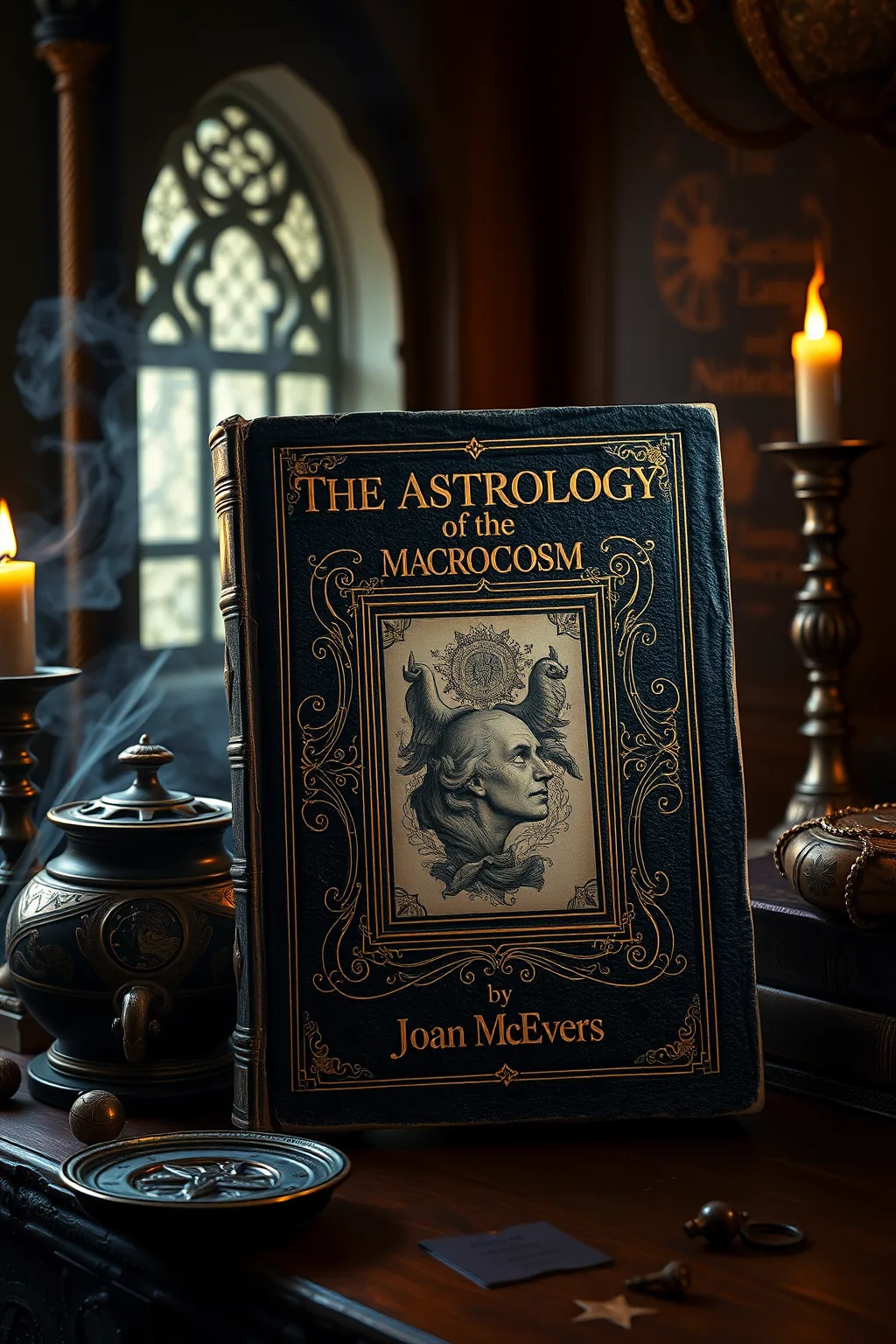
The Astrology of the macrocosm
 61
61

The Astrology of the macrocosm


Joan McEvers' 'The Astrology of the Macrocosm' stands as a monumental achievement in mundane astrology, illuminating the often-overlooked celestial influences on global affairs. McEvers possesses a rare gift for synthesizing complex astrological principles with a deep understanding of historical patterns and societal dynamics. Her insights into the symbolic language of the planets and their impact on collective human experience are particularly compelling. This is not merely a book about charts; it's a profound exploration of cosmic causality and the hidden forces that shape our world. Essential reading for seasoned astrologers and serious students of esoteric history seeking to comprehend the grander cycles of human civilization.
📝 Description
61
Joan McEvers' 'The Astrology of the Macrocosm' (1984) argues celestial patterns directly shape world events.
Joan McEvers' 1984 book, 'The Astrology of the Macrocosm,' connects celestial movements to terrestrial phenomena. McEvers posits that planetary cycles and alignments are not merely indicators of individual fate but active forces influencing historical trends, societal changes, and collective human awareness. The text aims to decode the symbolic language of the stars, presenting cosmic order as a framework for understanding the hidden dynamics that shape our world.
This work is written for dedicated astrology students, philosophers, and those seeking deeper understanding. It invites readers to view the cosmos not as a random arrangement of celestial bodies, but as a meaningful, divinely structured symbolic system. McEvers encourages an expanded astrological perspective, highlighting the connections between the smallest particles and the largest cosmic structures. The book presents astrology as a sacred science, revealing a divine plan inscribed in the heavens.
This book engages with the tradition of sidereal astrology and its broader metaphysical interpretations, which posit a correspondence between celestial events and earthly occurrences. It follows in a lineage of thought that views the cosmos as a living, symbolic entity, echoing hermetic principles of 'as above, so below.' McEvers connects astrological principles to historical cycles and collective psychology, drawing from symbolic interpretations of planetary movements that extend beyond personal horoscopes to macrohistorical and societal dynamics.
💡 Why Read This Book?
Unlock the hidden cosmic influences shaping global events and societal trends. 'The Astrology of the Macrocosm' offers a profound understanding of mundane astrology, connecting celestial patterns to historical cycles. Ideal for seekers, scholars, and practitioners who desire a deeper, more philosophical grasp of astrology's role in the grand scheme of existence.
⭐ Reader Reviews
Honest opinions from readers who have explored this book.
❓ Frequently Asked Questions
What is mundane astrology and how does this book approach it?
Mundane astrology studies the influence of celestial bodies on world events, nations, and collective human affairs. McEvers uniquely bridges this with esoteric philosophy, viewing cosmic patterns as symbolic archetypes shaping global consciousness and destiny.
Is this book suitable for beginners in astrology?
While it delves into advanced concepts, beginners with a foundational understanding of astrological basics will find it immensely rewarding. McEvers' clear prose makes complex ideas accessible.
What kind of knowledge can I expect to gain from this book?
You will gain insight into the symbolic language of the cosmos, how planetary cycles correlate with historical shifts, and a deeper appreciation for the interconnectedness of human events and celestial movements.
Does the book discuss specific astrological techniques for analyzing world events?
Yes, it explores key techniques and interpretive frameworks relevant to mundane astrology, focusing on the symbolic meaning and historical resonance of astrological configurations.
What is the philosophical significance of 'The Astrology of the Macrocosm'?
The book posits that the universe is a divinely ordered, symbolic system, and understanding its macrocosmic patterns offers profound insights into human existence, collective destiny, and the underlying order of reality.
🔮 Key Themes & Symbolism
The Cosmic Blueprint of History
This theme explores the profound concept that history is not a series of random occurrences but a divinely orchestrated unfolding, guided by immutable celestial cycles. McEvers posits that the grand movements of planets and stars act as archetypal forces, their symbolic language etched into the fabric of time. By understanding these cosmic blueprints, we can decipher the underlying patterns that drive societal evolution, cultural shifts, and the very trajectory of human civilization, offering a framework for perceiving destiny on a global scale.
Astrology as a Sacred Science
McEvers elevates astrology beyond mere prediction, presenting it as a sacred science and a vital tool for spiritual and philosophical inquiry. This theme emphasizes the esoteric dimension of celestial study, viewing the cosmos as a living, breathing entity imbued with profound symbolism. It suggests that by attuning ourselves to the subtle energies and archetypal patterns of the macrocosm, we can achieve a deeper understanding of our place within the universal order, fostering spiritual growth and a heightened awareness of the interconnectedness of all life.
The Symbolism of Planetary Archetypes
Fundamentally, this theme explores the rich, symbolic language of the planets, revealing them not just as physical bodies but as potent archetypes influencing human consciousness and collective behavior. McEvers unpacks the complex meanings of each celestial body, demonstrating how their positions and interactions in the macrocosm manifest as powerful currents that shape cultures, ideologies, and the very spirit of an age. Understanding these archetypal energies provides a profound lens through which to interpret the human experience.
💬 Memorable Quotes
Direct passages from the work, attributed to the author.
“History dances to the rhythm of the spheres.”
— This poetic assertion highlights the cyclical and patterned nature of historical progression, implying that the movements of planets dictate the tempo and direction of human events, a cosmic choreography.
“Seek the celestial architect in every earthly design.”
— This encourages the reader to look beyond superficial appearances and recognize the underlying divine intelligence and cosmic order that shapes all phenomena, from individual lives to global movements.
“The macrocosm whispers secrets to those who listen.”
— This emphasizes the subtle, often hidden, messages embedded within the cosmic patterns, urging a mindful and intuitive approach to astrological study for uncovering profound wisdom.
“Understanding the stars is understanding ourselves.”
— This profound statement underscores the interconnectedness of the individual and the cosmos, suggesting that by studying the larger universal patterns, we gain deeper self-awareness and insight into our own nature.
💡 Key Ideas
Editorial paraphrase of the work's core concepts — not direct quotes.
The heavens are a mirror to the earth, reflecting its deepest truths.
This quote captures the core tenet of mundane astrology: that celestial configurations directly correlate with and influence earthly events, suggesting a profound, reciprocal relationship between the cosmic and the terrestrial.
🌙 Esoteric Significance
Tradition
This work is deeply rooted in the Western Hermetic tradition, drawing upon principles of correspondence (as above, so below), symbolism, and the belief in an underlying divine order that governs both the celestial and terrestrial realms. It aligns with Neoplatonic thought, viewing the cosmos as a manifestation of higher spiritual principles and the planets as intermediaries carrying these influences.
Symbolism
The book masterfully deciphers the symbolic language of the macrocosm. Planets, signs, and houses are presented not just as astrological components, but as potent archetypes and forces that embody universal principles. McEvers illuminates how these symbols manifest in collective human experience, from the rise and fall of nations to the evolution of consciousness, revealing a body of meaning woven into the very fabric of the universe.
Modern Relevance
In an era grappling with global crises and rapid societal change, 'The Astrology of the Macrocosm' offers a timeless perspective. It provides a framework for understanding the deep-seated astrological currents influencing contemporary events, empowering readers to see beyond immediate chaos. Its emphasis on archetypal patterns and cosmic cycles offers a profound lens for navigating uncertainty, fostering a sense of connection to something larger than ourselves, and inspiring a more conscious engagement with the unfolding of global destiny.
👥 Who Should Read This Book
This profound work is essential for seasoned astrologers seeking to deepen their understanding of mundane astrology and its philosophical underpinnings. It is equally useful for students of history and sociology who wish to explore esoteric influences on societal development. Seekers of spiritual wisdom and philosophical insights will find a body of interconnectedness. Practitioners looking to expand their interpretive skills beyond the personal chart will discover a powerful new dimension to astrological practice, connecting the individual to the grand cosmic dance.
📜 Historical Context
Published during a period of burgeoning interest in esoteric studies and a renewed fascination with ancient wisdom traditions, Joan McEvers' 'The Astrology of the Macrocosm' emerged as a significant contribution to the field of mundane astrology. The mid-to-late 20th century saw a cultural shift where individuals increasingly sought deeper meaning beyond materialist paradigms. This era witnessed a resurgence of interest in Jungian psychology, archetypal symbolism, and holistic worldviews, all of which resonate deeply with McEvers' approach. The book tapped into a collective yearning to understand the larger forces at play in the world, offering a sophisticated astrological framework that connected the personal to the political, the psychological to the historical. It provided a much-needed bridge between ancient astrological principles and modern philosophical inquiry, solidifying its place as a foundational text for those exploring the profound interplay between the cosmos and human destiny.
📔 Journal Prompts
Reflect on a significant historical event and consider which planetary archetypes might have been powerfully activated.
How do the 'as above, so below' principles manifest in your personal life and in the wider world?
Identify a current global trend and explore its potential astrological correlations. What cosmic rhythms might be at play?
Consider the concept of 'cosmic destiny.' How does this idea resonate with your personal beliefs and experiences?
Write about a time you felt a strong connection between a celestial event and an earthly occurrence.
🗂️ Glossary
Macrocosm
The universe considered as a complex and unified whole, often seen as a reflection of the microcosm (humanity or the individual).
Mundane Astrology
The branch of astrology concerned with the study of the influence of celestial bodies on world events, nations, politics, and collective human affairs.
Archetype
In esoteric and psychological contexts, a primordial, universal pattern or image that recurs across cultures and time, often embodied by celestial bodies in astrology.
Correspondence
The Hermetic principle 'as above, so below,' suggesting that there are relationships and parallels between different levels of existence, particularly between the celestial and earthly realms.
Collective Consciousness
The shared beliefs, ideas, attitudes, and knowledge that are common to a social group or society, influenced by astrological cycles as per the book's thesis.
This book appears in 2 collections
🔮 Readers Also Liked
Browse all →







More by Joan McEvers
All books →

From the “Astrology” Collection
View all →









More Free Astrology & Cosmology Books
View all →