CS09 Mental Alchemy
 73
73

CS09 Mental Alchemy
The Brotherhood of Light Course has long been a cornerstone for students of Hermeticism, and CS09 Mental Alchemy offers a focused examination of the mind's creative power. Zain's assertion that "character is destiny" and that character is explicitly "thought-built" is the core of this volume. He meticulously outlines how complex thought-cell structures within the astral body directly influence our physical reality and environmental interactions. While the detailed explanation of these mental mechanics is commendable for its systematic approach, the dense prose can sometimes obscure the practical application for the novice. A particularly illustrative passage discusses the interaction of these thought-forms with the physical body, underscoring the psychosomatic link often explored in esoteric texts. However, the abstract nature of "thought-cell structures" might leave some readers yearning for more concrete, actionable techniques beyond general principles of mental discipline. This volume provides a foundational understanding of mental alchemy, serving as a vital link in the Brotherhood's curriculum.
📝 Description
73
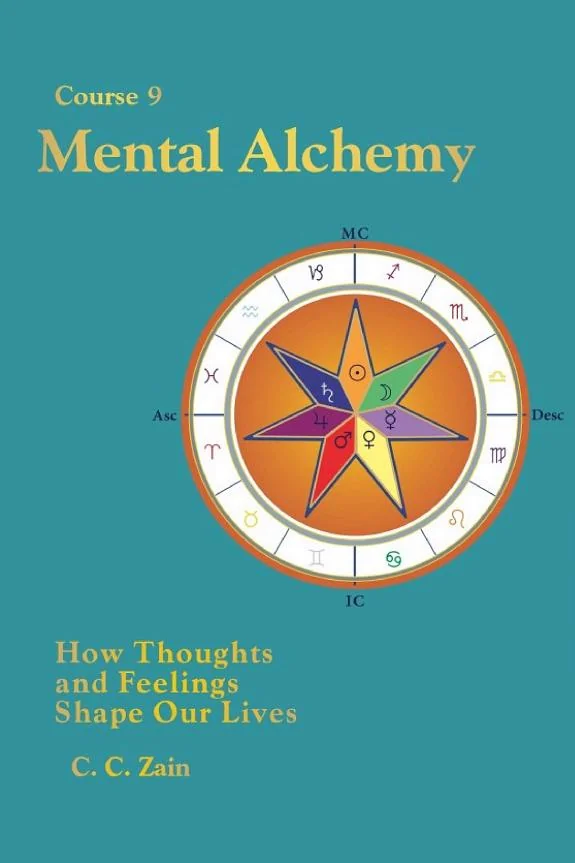
CS09 Mental Alchemy, published in 2014, details how thoughts construct reality according to Hermeticism.
This is the ninth volume in C. C. Zain's 21-book Brotherhood of Light Course. It focuses on the Hermetic principle of mentalism, explaining how our thoughts create reality and shape our lives. The book argues that character is not static but develops through conscious and unconscious thought. It describes the connection between mental patterns, the astral body, and their impact on our physical bodies, intellect, and interactions with the world.
This text is for serious students of Hermetic Sciences who want to apply mental laws practically. It appeals to those seeking to understand how to achieve personal success and develop character through focused mental effort. Readers familiar with early 20th-century esoteric writings and the Brotherhood of Light curriculum will find this volume a key part of their studies. It requires dedication to engage with its complex metaphysical ideas.
CS09 Mental Alchemy originates from Hermeticism and occult philosophy, particularly the late 19th and early 20th centuries. This period saw renewed interest in ancient wisdom, influenced by figures like Helena Blavatsky and the Theosophical Society, alongside Rosicrucian revivals. C. C. Zain's work belongs to this esoteric revival, aiming to present complex occult subjects systematically through the Brotherhood of Light Course.
💡 Why Read This Book?
• Understand the mechanism of 'thought-built' character as detailed in CS09, learning how your internal mental landscape directly shapes your external circumstances, a concept foundational to the Brotherhood of Light Course. • Gain insight into the interaction between the astral body's "thought-cell structures" and the physical form, as explained in this text, offering a unique perspective on psychosomatic influences absent in purely materialist philosophies. • Grasp the Hermetic principle of mentalism as presented in this specific volume, providing a structured, curriculum-based approach to understanding how conscious thought can be applied to alter personal destiny, a core teaching of C. C. Zain.
⭐ Reader Reviews
Honest opinions from readers who have explored this book.
❓ Frequently Asked Questions
What is the primary focus of CS09 Mental Alchemy within the Brotherhood of Light Course?
CS09 Mental Alchemy primarily focuses on the Hermetic principle of mentalism, detailing how character is constructed through thought. It explains the formation of 'thought-cell structures' in the astral body and their impact on destiny and interaction with the physical world and environment.
Who is C. C. Zain and what is the Brotherhood of Light Course?
C. C. Zain (pseudonym for Elbert Benjamine) was an American occultist who authored the 21-book Brotherhood of Light Course. This series provides a systematic curriculum on esoteric sciences, including Hermeticism, Astrology, and Kabbalah, first published in the early 20th century.
How does CS09 Mental Alchemy explain the concept of destiny?
The book explains destiny as a direct consequence of one's character, which is itself built from complex 'thought-cell structures' residing in the astral body. These mental formations, interacting with the physical and environmental factors, determine an individual's life path and fortunes.
What is the 'astral body' as described in this book?
In CS09 Mental Alchemy, the astral body is presented as the seat of the unconscious mind and the repository for 'thought-cell structures.' It is the energetic counterpart to the physical body where mental patterns are formed and stored, influencing conscious experience.
Is this book suitable for beginners in esoteric studies?
While it is part of a larger curriculum, CS09 Mental Alchemy delves into complex metaphysical concepts. It is most suitable for those already familiar with basic esoteric principles or serious students committed to a structured study of Hermetic sciences.
Where does CS09 Mental Alchemy fit within the 21-book series?
CS09 Mental Alchemy is the ninth book in the Brotherhood of Light Course. It follows foundational texts and precedes more advanced topics, focusing specifically on the practical application of mental laws and the construction of character through thought.
🔮 Key Themes & Symbolism
Thought-Built Character
The central thesis of CS09 Mental Alchemy is that character is not innate but actively constructed through the process of thinking. The book posits that persistent thought patterns coalesce into 'thought-cell structures' within the astral body, forming the blueprint of an individual's personality and destiny. This concept challenges deterministic views, empowering the reader by highlighting the causal role of mental activity in shaping life experiences, successes, and failures. It underscores the Hermetic principle that the 'All is Mind,' suggesting conscious direction of thought is the key to personal transformation.
Astral Body and Thought Forms
CS09 Mental Alchemy elaborates on the function of the astral body as the energetic substratum of the unconscious mind. It is described as the matrix where 'thought-cell structures' are formed and maintained. These structures are not merely abstract ideas but dynamic entities that interact with the physical body and the environment. The work provides an esoteric framework for understanding the subconscious, positing that its contents, built from our thoughts, exert a powerful influence on our perceptions, emotions, and ultimately, the unfolding of our destiny.
Mentalism and Destiny
This volume firmly grounds the concept of destiny in the principle of Mentalism, one of the seven Hermetic principles. It argues that one's 'fortune and success' are direct outcomes of the prevailing thought patterns and the resulting character structure. By understanding that the external world is a reflection of the internal mental state, individuals are encouraged to cultivate higher, more constructive thoughts. This active engagement with one's mental environment is presented as the alchemical process of transforming one's destiny, moving from passive victimhood to active co-creation.
Hermetic Sciences Curriculum
As the ninth book in the Brotherhood of Light Course, CS09 Mental Alchemy serves as a critical component within a larger pedagogical structure. It builds upon earlier lessons in Hermetic philosophy and Astrology, focusing specifically on the psychological and metaphysical implications of thought. The systematic approach of the course aims to provide a comprehensive education in esoteric sciences, clarifying complex subjects like alchemy and Kabbalah for dedicated students. This volume's placement emphasizes the primacy of mental discipline within the broader path of occult attainment.
💬 Memorable Quotes
Direct passages from the work, attributed to the author.
“Character is destiny and that character is thought-built.”
— This core statement expresses the book's thesis: our fate is not predetermined by external forces but is a direct consequence of the mental patterns we cultivate, which form our character.
“Thought-cell structures that reside in the astral body or unconscious mind.”
— This phrase describes the fundamental units of mental energy and formation that, according to the book, are stored in the unconscious (astral body) and dictate our psychological makeup.
“Interaction with the individual’s physical form, mental faculties and the environment.”
— This highlights the dynamic interplay the book describes, where our internal thought structures don't exist in isolation but actively influence and are influenced by our physical being and external circumstances.
“Thus an individual’s fortune and success in the world.”
— This phrase directly links the previously mentioned mental and environmental interactions to tangible outcomes in life, such as prosperity and achievement, reinforcing the idea of a direct cause-and-effect relationship.
“The ninth book in the 21 Brotherhood of Light Course series.”
— This contextualizes the work within a larger, structured curriculum on Hermetic Sciences, indicating its specific place and purpose in a progressive course of esoteric study.
🌙 Esoteric Significance
Tradition
This work is firmly rooted in the Western Esoteric Tradition, specifically within the Hermetic lineage. It draws heavily upon the principle of Mentalism, one of the seven Hermetic Principles, asserting that the All is Mind. While inspired by ancient Hermetic texts and later Rosicrucian teachings, the Brotherhood of Light Course, and CS09 Mental Alchemy within it, represents a modern, systematic interpretation. It aims to translate these ancient philosophical concepts into a practical curriculum for personal development, distinguishing it from purely historical or ritualistic approaches to Hermeticism.
Symbolism
While CS09 Mental Alchemy focuses heavily on psychological and metaphysical concepts rather than overt symbolic representation, the 'thought-cell structure' can be seen as a symbolic motif for the building blocks of consciousness. The concept of the 'astral body' itself functions symbolically as the plane of subconscious thought and emotion. The overarching theme of 'alchemy' in the title is symbolic, representing the transformative process of refining one's character and destiny through mental discipline, akin to the alchemist's transformation of base metals into gold.
Modern Relevance
The principles discussed in CS09 Mental Alchemy resonate strongly with contemporary fields such as positive psychology, the law of attraction, and cognitive behavioral therapy, albeit from an esoteric perspective. Thinkers and practitioners in New Thought movements, as well as those exploring manifestation and mind-over-matter phenomena, often engage with similar concepts of thought creation. The work's emphasis on personal responsibility for one's reality through mental cultivation continues to find adherents among those seeking self-mastery and spiritual growth outside conventional paradigms.
👥 Who Should Read This Book
• Students of Hermeticism seeking a systematic curriculum: Those studying the Brotherhood of Light Course will find this book essential for understanding the practical application of mental laws and character formation. • Aspiring occultists interested in the power of thought: Individuals looking to harness their mental faculties for personal transformation and to understand the esoteric basis of success will gain valuable insights. • Comparative religion and philosophy scholars: Researchers interested in the development of esoteric thought in the early 20th century and its unique interpretations of mind and reality will find this work informative.
📜 Historical Context
CS09 Mental Alchemy emerges from the fertile ground of late 19th and early 20th-century esoteric revivalism, a period marked by a profound interest in ancient wisdom traditions and occult philosophies. C. C. Zain, the author, operated within this milieu, seeking to systematize and present Hermetic teachings in a structured, accessible curriculum. This era saw the flourishing of movements like Theosophy, championed by Helena Blavatsky, and Rosicrucian revivals, all aiming to bridge the perceived gap between science and spirituality. Zain's Brotherhood of Light Course, first appearing in installments and later compiled, offered a comprehensive, step-by-step education in subjects ranging from astrology to Kabbalah. While many contemporaries focused on individual mystical experiences or specific magical traditions, Zain’s approach was distinctly pedagogical. The reception of such works was often polarized; embraced by dedicated students of the occult, they were frequently viewed with skepticism or outright condemnation by mainstream religious and scientific establishments, reflecting the era's intellectual tensions regarding non-traditional belief systems.
📔 Journal Prompts
The concept of 'thought-cell structures' and their formation.
Personal experience of character influencing destiny.
The interaction between mental faculties and the physical form.
Identifying the 'thought-built' nature of a current life challenge.
Cultivating positive thought patterns for desired outcomes.
🗂️ Glossary
Mental Alchemy
The process of transforming one's character and destiny through conscious control and direction of thought processes, akin to the alchemical transmutation of metals.
Thought-Built Character
The theory that an individual's personality, disposition, and inherent tendencies are not fixed but are constructed through the cumulative effect of their thoughts and mental habits.
Thought-Cell Structures
The fundamental units or patterns of mental energy that form within the astral body (unconscious mind) as a result of repeated thinking, shaping character and influencing destiny.
Astral Body
In this context, the subtle energetic body often equated with the unconscious mind, serving as the repository for thought-cell structures and influencing the physical body and external reality.
Hermetic Sciences
A broad category of esoteric disciplines based on the teachings attributed to Hermes Trismegistus, encompassing subjects like Alchemy, Astrology, Kabbalah, and the principles of Mentalism.
Mentalism
The first Hermetic Principle, stating 'The All is Mind; The Universe is Mental,' which posits that reality is fundamentally mental in nature and can be influenced by thought.
Character is Destiny
A core tenet asserting that an individual's ultimate fate and life circumstances are direct manifestations of their inherent character, which itself is shaped by mental processes.
This book appears in 1 collection
🔮 Readers Also Liked
Browse all →









From the “Mental Alchemy” Collection
View all →








More Free Alchemy & Hermeticism Books
View all →