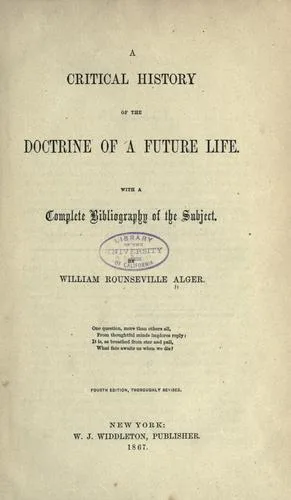
Critical history of the doctrine of a future life
 79
79

Critical history of the doctrine of a future life
Alger's "Critical History of the Doctrine of a Future Life" is a remarkable if somewhat dry, academic undertaking. Its strength lies in its sheer breadth; the meticulous cataloging of beliefs from disparate cultures is genuinely impressive for a work of 1864. For instance, the detailed examination of Zoroastrian eschatology provides a valuable, if dense, historical perspective. However, the book's limitation is its dispassionate, almost encyclopedic tone, which can make sustained engagement challenging for the general reader. The prose, while scholarly, lacks the evocative power one might hope for when discussing such ultimate subjects. Nevertheless, its value as a reference work on the historical discourse surrounding the afterlife remains significant. It serves as a foundational text for understanding the evolution of eschatological thought.
📝 Description
79
Published in 1864, William Rounseville Alger's critical history surveys beliefs about life after death.
William Rounseville Alger's "Critical History of the Doctrine of a Future Life" provides a thorough survey of ideas about existence after death. First released in 1864, this book examines a wide range of historical, religious, and philosophical traditions. Alger traces how conceptions of the afterlife have changed across different cultures and time periods. The work is not meant to argue for a particular religious belief. Instead, it functions as a detailed record and examination of how people throughout history have thought about what happens after death.
This volume is valuable for students of comparative religion, theology, and the history of ideas. It will interest academics, researchers, and anyone curious about the enduring human question of immortality. Readers interested in the philosophical roots of spiritual beliefs, from ancient Egypt and Greece to early Christianity and Eastern traditions, will find substantial information. The book suits those who appreciate detailed historical research and are prepared for a comprehensive, fact-rich study.
Alger's work appeared during the mid-19th century, a time of significant intellectual change. The rise of historical criticism and comparative mythology, alongside a growing interest in spiritualism, created an environment receptive to examining diverse beliefs about the afterlife. The book engaged with contemporary Victorian ideas about heaven and hell while also looking at older and less common perspectives, offering a counterpoint to dominant religious views.
💡 Why Read This Book?
• Gain a foundational understanding of the historical evolution of afterlife beliefs, as Alger meticulously traces concepts from ancient Egyptian cosmology to 19th-century philosophical debates. • Discover the diverse interpretations of immortality across cultures, learning how specific traditions like Zoroastrianism or Pythagoreanism conceptualized the soul's journey. • Appreciate the scholarly methodology applied to religious history, understanding how Alger synthesized vast amounts of textual evidence in 1864 to construct his comparative analysis.
⭐ Reader Reviews
Honest opinions from readers who have explored this book.
❓ Frequently Asked Questions
When was William Rounseville Alger's "Critical History of the Doctrine of a Future Life" first published?
The seminal work, "Critical History of the Doctrine of a Future Life," by William Rounseville Alger, was first published in 1864. This date places it within a significant period of religious and philosophical inquiry in the 19th century.
What historical traditions does Alger's book cover regarding the afterlife?
Alger's extensive study covers a wide array of traditions, including ancient Egyptian beliefs about the Duat, Greek conceptions of Hades and Elysium, early Christian doctrines, Zoroastrian eschatology, and various philosophical perspectives from thinkers like Plato.
Is this book a theological argument for a specific afterlife belief?
No, "Critical History of the Doctrine of a Future Life" is not a theological argument. It functions as a scholarly, historical survey and analysis of how different cultures and philosophies have conceived of life after death, rather than advocating for any single belief.
What kind of reader would benefit most from Alger's work?
Students of comparative religion, theology, philosophy of religion, and intellectual history would benefit most. It is suited for those who appreciate detailed historical research and the comparative study of human beliefs about mortality and immortality.
Does the book discuss reincarnation or only linear afterlife concepts?
The book discusses a broad spectrum of afterlife concepts, including those that imply cyclical existence or reincarnation, alongside linear concepts of heaven, hell, and spiritual realms, reflecting the diversity of human eschatological thought.
Where can I find a copy of this historical text?
"Critical History of the Doctrine of a Future Life" by William Rounseville Alger, originally published in 1864, is often available through academic libraries and online archives, as it is in the public domain.
🔮 Key Themes & Symbolism
Evolution of Eschatology
The work systematically charts the development of beliefs concerning the end times and the afterlife. Alger traces how concepts of judgment, resurrection, and spiritual realms transformed from ancient Near Eastern cosmologies, through Greek philosophical inquiries, into early Christian theology and beyond. It highlights the adaptive nature of eschatological thought, showing how societies reinterpreted or synthesized existing ideas to address new spiritual and philosophical challenges presented over centuries.
Comparative Religious Beliefs
A core part of the book is its comparative approach to diverse religious traditions. Alger meticulously examines and contrasts the afterlife doctrines of cultures as varied as ancient Egypt (with its complex Duat and judgment rituals), Persia (Zoroastrian concepts of the Chinvat Bridge), Greece (Hades, Tartarus, Elysium), and early Christianity. This broad scope allows readers to see commonalities and divergences in humanity's quest to understand post-mortem existence.
Philosophical Immortality
Beyond religious dogma, Alger engages with philosophical arguments for and against the immortality of the soul. He surveys the contributions of thinkers from Plato, who posited the soul's eternal nature, through Neoplatonism, and into the rationalist and empiricist traditions of later Western philosophy. This section critically assesses the logical and metaphysical underpinnings of various conceptions of a future life, presenting a dialogue between faith and reason.
Symbolism of the Underworld
The book frequently addresses the symbolic landscapes associated with the afterlife. Whether discussing the Egyptian underworld (Duat) with its trials and transformations, or the Greek mythological geography of the underworld, Alger deciphers the symbolic meanings embedded in these narratives. These symbols often represent not just physical locations but stages of spiritual purification, judgment, or eternal reward and punishment.
💬 Memorable Quotes
Direct passages from the work, attributed to the author.
“The human mind has always been occupied with the question of a future existence.”
— This statement expresses the book's central premise: that the contemplation of what happens after death is a fundamental and persistent aspect of human consciousness across all cultures and historical periods.
“Ancient Egypt possessed a highly developed doctrine of a future life.”
— Alger highlights the sophistication of Egyptian eschatology, emphasizing its detailed cosmology, judgment rituals, and conceptions of the soul's journey through the Duat, positioning it as a crucial early influence on later afterlife beliefs.
“Plato's philosophy offers significant arguments for the soul's immortality.”
— This refers to Alger's analysis of Platonic dialogues, such as the Phaedo, where Socrates presents philosophical reasoning for the soul's eternal nature, independent of the physical body.
“The doctrine of future retribution has varied greatly in its interpretation.”
— Alger observes that while many cultures include concepts of reward or punishment after death, the specific nature, criteria, and consequences of this retribution differ widely across traditions.
“Comparative study reveals common threads in humanity's conception of the soul's destiny.”
— This interpretation underscores Alger's finding that despite vast cultural differences, certain universal themes and archetypes emerge when examining beliefs about what happens after death.
🌙 Esoteric Significance
Tradition
While not strictly an esoteric text in the vein of Hermeticism or Kabbalah, Alger's work is foundational for understanding the historical development of beliefs that underpin many esoteric traditions. It provides a crucial scholarly framework for examining concepts like reincarnation (found in Pythagoreanism and later Theosophy), the soul's journey through spiritual planes, and the symbolic logic of afterlife realms, which are central to Western esotericism.
Symbolism
The book frequently touches upon symbolic representations of the afterlife, such as the Egyptian Duat, often depicted with perilous journeys and divine judges, signifying spiritual trials and transformation. Similarly, the Greek underworld's geography (Elysian Fields, Tartarus) serves as a symbolic map of post-mortem states. These symbolic landscapes reflect universal archetypes of descent, judgment, and eventual rebirth or spiritual culmination.
Modern Relevance
Contemporary thinkers and practitioners in fields like comparative mythology, depth psychology (particularly Jungian analysis of archetypes), and modern spiritual movements often draw upon the historical data Alger meticulously compiled. His work provides essential context for understanding how diverse cultures have grappled with the mystery of death, informing modern explorations of consciousness, spirituality, and the perennial questions of existence.
👥 Who Should Read This Book
• Students of comparative religion and theology seeking a comprehensive historical overview of afterlife beliefs across diverse cultures. • Researchers in intellectual history and philosophy interested in the evolution of concepts of immortality and eschatology from antiquity to the 19th century. • Esoteric practitioners and scholars looking for foundational historical context on doctrines of the soul's journey and post-mortem existence that inform various mystical traditions.
📜 Historical Context
Published in 1864, William Rounseville Alger's "Critical History of the Doctrine of a Future Life" emerged during a period marked by intense spiritual and intellectual curiosity. The mid-19th century saw the rise of comparative mythology and philology, notably championed by scholars like Max Müller, encouraging the cross-cultural study of religious beliefs. Simultaneously, the burgeoning Spiritualist movement in America and Europe fueled popular interest in the afterlife, often challenging traditional religious frameworks. Alger's work, therefore, occupied a unique space: it provided rigorous historical and philosophical scholarship that both engaged with and offered a more detached, analytical perspective than the fervent spiritualism of the era. It implicitly responded to prevailing Victorian Christian eschatology by presenting a vast panorama of alternative conceptions, including those from ancient Egyptian and Zoroastrian traditions, thereby contributing to a broader, more critical understanding of religious doctrines.
📔 Journal Prompts
The human mind's persistent occupation with a future existence, as noted by Alger.
Alger's detailed examination of the Egyptian Duat and its symbolic trials.
The philosophical arguments for immortality presented by Plato.
Variations in the doctrine of future retribution across cultures.
Common threads identified in humanity's conception of the soul's destiny.
🗂️ Glossary
Eschatology
The branch of theology concerned with the final events of history, or the ultimate destiny of humanity. It typically includes beliefs about death, judgment, the afterlife, and the end of the world.
Duat
In ancient Egyptian religion, the Duat is the field of the dead, the underworld. It is a symbolic landscape through which the sun god Ra and the souls of the deceased journey during the night.
Hades
In ancient Greek belief, Hades is both the god of the underworld and the name of the underworld itself, a shadowy realm where souls of the dead went after death.
Resurrection
The act of rising from the dead. In many religious traditions, it refers to the belief that the dead will be brought back to life, often as part of a divine judgment or a new spiritual existence.
Immortality
The quality or state of living forever; eternal life. Philosophically, it can refer to the soul's existence independent of the body after death.
Pythagoreanism
A philosophical and religious movement originating in the 6th century BCE with the teachings of Pythagoras. It is known for its doctrine of metempsychosis (transmigration of souls, or reincarnation).
Chinvat Bridge
In Zoroastrianism, the Chinvat Bridge is the separator between the world of the living and the world of the dead. It is a place of judgment where the soul's deeds are weighed.
🔮 Readers Also Liked
Browse all →









More by William Rounseville Alger
All books →
More Free Occult Philosophy Books
View all →