Crop Circles
 83
83

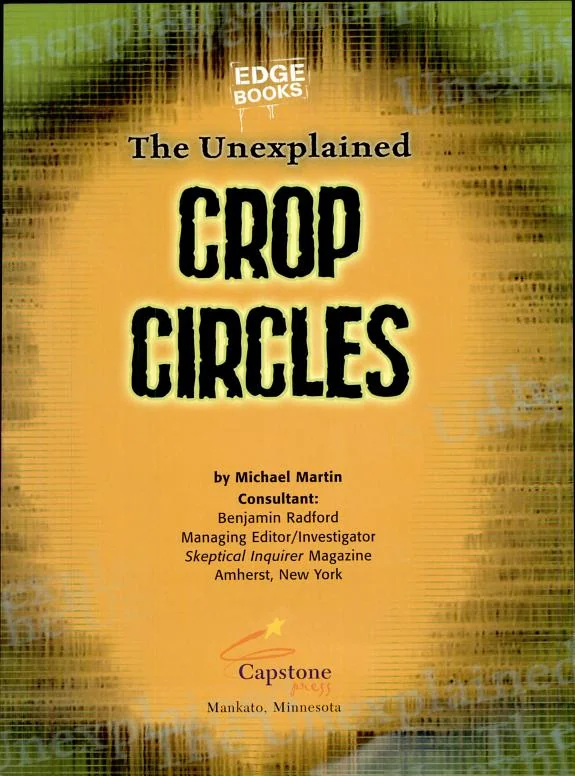
Crop Circles
Michael Martin’s "Crop Circles" offers a structured overview of a phenomenon that has captivated public imagination for decades. The author commendably moves beyond sensationalism to present a factual account of reported sightings and the varied attempts to explain their origins. A particular strength lies in the detailed descriptions of early formations, such as the simple circular depressions that preceded the more complex geometric designs. However, the book’s exploration of potential causes, while thorough in cataloging theories, sometimes feels repetitive, cycling through similar arguments without reaching a definitive conclusion. The work is most compelling when it details the historical progression of the phenomenon, especially referencing the increased complexity observed after the 1980s. Martin’s objective tone, while appropriate for a survey, might leave readers seeking a more definitive stance wanting. It serves as a solid, if sometimes cautious, introduction to the crop circle enigma.
📝 Description
83
Michael Martin's 1994 book "Crop Circles" details geometric patterns appearing in agricultural fields.
This book examines the phenomenon of crop circles, detailing their physical characteristics and the scale of their appearance. Martin discusses the visual impact and sheer physical presence of these designs, which often span hundreds of feet. He traces the documented history of crop circles, noting their emergence into public consciousness in the late 20th century and the evolution of designs from simple circles to complex patterns. Early reports and the development of investigative approaches are covered, setting the stage for understanding the ongoing debate.
Central to the book are the concepts of intelligent design versus natural occurrence, the role of perception in interpreting these events, and the potential for symbolic meaning within the formations. It also touches upon the psychological impact on witnesses and the broader cultural fascination with these enigmatic designs. The search for causes is a recurring theme.
Martin's work is intended for readers intrigued by aerial anomalies and unexplained phenomena. It appeals to researchers of unusual events, those interested in patterns in nature, and individuals seeking to understand the historical and cultural discussions surrounding these field designs. It is for those who question conventional explanations for complex geometric forms.
This book engages with traditions that seek meaning beyond conventional scientific or materialistic explanations for natural phenomena. It aligns with esoteric interests in pattern recognition, synchronicity, and the potential for non-human intelligence or consciousness to manifest in the physical world. The focus on symbolic interpretation and the questioning of established narratives places it within a broader context of exploring hidden orders or messages within the environment.
💡 Why Read This Book?
• Gain an understanding of the historical progression of crop circle formations, from simple circles to complex geometric designs, as documented from the late 20th century onwards. • Learn about the diverse range of theories proposed to explain their origins, including natural phenomena, human artistry, and more speculative causes. • Explore the cultural and psychological impact of crop circles, examining how these aerial enigmas have influenced public perception and scientific inquiry.
⭐ Reader Reviews
Honest opinions from readers who have explored this book.
❓ Frequently Asked Questions
When did crop circles start appearing frequently in public awareness?
While simple circles were reported earlier, crop circles gained significant public attention and widespread reporting from the late 1970s and particularly the 1980s onwards, evolving into more complex geometric patterns.
What are some of the primary theories about the cause of crop circles?
Theories range from natural atmospheric vortices and plasma effects to deliberate human creation, and more speculative explanations involving extraterrestrial or unknown energies.
Does the book "Crop Circles" by Michael Martin present a definitive answer?
No, the book's primary aim is to describe the phenomenon, its history, and the various hypotheses surrounding its cause, rather than to provide a single, definitive explanation.
Are there specific locations known for crop circle appearances discussed in the book?
Yes, the book often references formations appearing in agricultural regions, particularly in Southern England, which became a focal point for crop circle reports.
What is the difference between early crop circles and later ones?
Early formations were typically simple circles, while later crop circles evolved to include intricate geometric shapes, fractals, and even representations resembling binary code or astronomical alignments.
Is Michael Martin's "Crop Circles" a scientific study or a historical overview?
The book functions primarily as a historical overview and compilation of reports and theories, rather than a peer-reviewed scientific study with experimental data.
🔮 Key Themes & Symbolism
Phenomenon of Geometric Design
The book details the appearance of complex geometric patterns in agricultural fields, a phenomenon that gained prominence in the late 20th century. It explores the sheer scale and precision of these formations, often spanning acres. The focus is on documenting the visual characteristics and the regularity with which these designs manifest, prompting questions about their origin and purpose. The work presents the formations as a subject worthy of serious examination, irrespective of the proposed cause.
Historical Documentation and Evolution
Martin traces the historical arc of crop circle reports, noting the shift from simple circular depressions to elaborate designs. This historical perspective is crucial, illustrating how the phenomenon has changed over time, particularly from the 1980s onwards. The book compiles accounts and visual evidence, providing a chronological understanding of how the phenomenon became a subject of global intrigue and investigation.
Theories of Causation
A significant portion of the book is dedicated to cataloging and evaluating the multitude of theories proposed to explain crop circles. These range from mundane explanations like human hoaxes to more esoteric concepts involving atmospheric phenomena, electromagnetic energy, and even extraterrestrial intelligence. The work presents these theories without necessarily endorsing one over the others, aiming for a comprehensive survey of the ongoing debate.
Symbolism and Interpretation
Beyond the physical appearance, the book touches upon the potential symbolic or communicative aspects of crop circles. It considers whether these patterns might convey messages or hold deeper meanings, inviting readers to contemplate their significance. The intricate designs are presented as potentially more than random occurrences, opening avenues for interpretation within esoteric and philosophical frameworks.
💬 Memorable Quotes
Direct passages from the work, attributed to the author.
“The sheer scale and complexity of many formations defy simple explanations.”
— This statement captures the essence of the crop circle enigma, highlighting how the physical characteristics of the formations challenge conventional understanding and prompt deeper inquiry into their origins.
“From simple circles to intricate fractals, the evolution of designs is striking.”
— This interpretation emphasizes the observed progression in crop circle complexity over time, suggesting a potential development or learning process behind their appearance.
“The search for definitive causes continues amidst a spectrum of theories.”
— This highlights the ongoing nature of the investigation into crop circles, acknowledging the wide array of hypotheses presented without a universally accepted conclusion.
“The patterns appear with remarkable regularity in specific agricultural regions.”
— This observation underscores the non-random and geographically concentrated nature of crop circle appearances, adding another layer to the mystery of their manifestation.
💡 Key Ideas
Editorial paraphrase of the work's core concepts — not direct quotes.
Witness accounts often describe a sense of awe and mystery.
This paraphrase points to the subjective experience of encountering crop circles, suggesting they evoke powerful emotional and psychological responses beyond mere visual observation.
🌙 Esoteric Significance
Tradition
While not explicitly tied to a single esoteric lineage like Hermeticism or Kabbalah, "Crop Circles" engages with themes common in modern esoteric thought, particularly concerning patterns in nature as expressions of higher intelligence or cosmic order. It touches upon the idea of earth mysteries and sacred geometry, concepts often explored within Neo-Paganism, Theosophy, and broader New Age spiritualities that look for meaning in unexplained natural or anomalous phenomena.
Symbolism
The primary symbolism within crop circles, as explored in the book, revolves around sacred geometry. Intricate patterns often incorporate principles like the Fibonacci sequence, the Golden Ratio, and Platonic solids, suggesting a mathematical or divine blueprint. The circular motif itself can symbolize unity, wholeness, and cycles, while more complex designs might be interpreted as representations of celestial events, DNA structures, or abstract cosmological concepts.
Modern Relevance
Contemporary thinkers and practitioners in fields like geomancy, consciousness studies, and eco-spirituality continue to draw inspiration from crop circles. The concept of these formations as potential communication or energetic imprints speaks to those exploring Earth's ley lines, planetary consciousness, and intentional land art. Researchers investigating anomalous phenomena and seeking non-conventional explanations for intelligence in the universe find the historical documentation and theoretical discussions relevant.
👥 Who Should Read This Book
• Researchers of aerial phenomena and unexplained anomalies seeking a historical overview of crop circle appearances and the theories surrounding them. • Students of sacred geometry and earth mysteries interested in the mathematical precision and potential symbolic meaning of complex field designs. • Individuals curious about the cultural impact and public fascination with crop circles, exploring how these formations have been interpreted across different belief systems.
📜 Historical Context
Published in 2006, Michael Martin's "Crop Circles" emerged during a period of sustained public fascination with aerial phenomena. The late 20th century had seen crop circles evolve from simple rings, first documented in detail in the 1970s, into highly intricate geometric designs, particularly in the chalk downs of Southern England. This era was also marked by increased media attention and a proliferation of theories, ranging from the prosaic (hoaxes by artists like Doug Bower and Dave Chorley) to the speculative (extraterrestrial contact, atmospheric anomalies). The work situates itself within this ongoing discourse, cataloging the history of sightings and investigations. It appeared at a time when the internet was beginning to democratize information, allowing enthusiasts worldwide to share evidence and theories, fueling the debate. Martin's book can be seen as a comprehensive survey responding to this growing interest, offering a structured overview of a phenomenon that intrigued ufologists, skeptics, and the general public alike.
📔 Journal Prompts
The evolution of crop circle designs from simple circles to fractals.
The range of theories proposed for crop circle causation.
The potential symbolic meanings embedded within geometric formations.
Personal reflections on geometric patterns observed in nature or art.
The relationship between human perception and unexplained phenomena.
🗂️ Glossary
Sacred Geometry
The study of geometric shapes and patterns that are considered fundamental to the structure of the universe and often hold spiritual or symbolic significance.
Formation
A term used to describe a crop circle or any other geometric pattern appearing in a field.
Anomalous Phenomenon
An event or observation that deviates from what is considered normal, established, or expected, often prompting investigation.
Hoax
A deliberately deceptive act or statement, often used to describe theories that attribute crop circles to human creation.
Plasma Vortex Theory
A hypothesis suggesting that swirling electrical discharges (plasma) in the atmosphere could be responsible for creating circular patterns in crops.
Earth Mysteries
A broad term encompassing unexplained phenomena related to ancient sites, megaliths, ley lines, and other perceived energetic patterns on Earth.
Fibonacci Sequence
A sequence in mathematics where each number is the sum of the two preceding ones, often found in natural patterns and considered a component of sacred geometry.
This book appears in 1 collection
🔮 Readers Also Liked
Browse all →








From the “Crop Circles” Collection
View all →








More Free Occult Philosophy Books
View all →