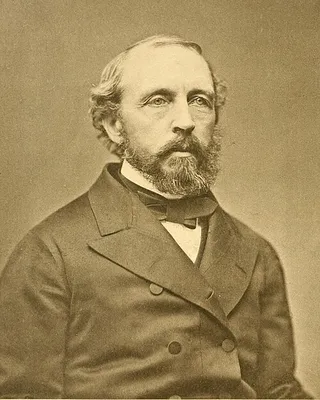
William Rounseville Alger
William Rounseville Alger was a Unitarian minister, abolitionist, and author known for his prolific writing and public speaking.
William Rounseville Alger (1822-1905) was an American Unitarian minister, poet, and author. Born in Massachusetts, he pursued theological studies at Harvard Divinity School before beginning his ministry in Roxbury. He later served churches in Boston and other locations across the country, gaining recognition for his preaching. Beyond his ministerial duties, Alger was a vocal abolitionist and a contributor to various publications, even co-editing the Christian Examiner.
His public speaking, particularly his 1857 Fourth of July address in Boston, addressed controversial issues like slavery and the Fugitive Slave Law. While initially suppressed by city authorities, his speech was later published and publicly acknowledged by the city government. Alger also held the position of Chaplain of the Massachusetts House of Representatives. His literary output included numerous books and poems, and his hymns appeared in various collections. His notebooks are preserved in university libraries, and many of his works have seen multiple editions.
Ministry and Public Life
William Rounseville Alger served as a Unitarian minister, beginning his ordained career in Roxbury, Massachusetts, in 1847. After leaving Roxbury in 1855, he preached in various prominent locations, including Boston's Bulfinch Street Church and Tremont Temple, drawing significant audiences. His ministry extended across the nation, with engagements in states like New York, Colorado, and Louisiana. Alger was also an active participant in public discourse, notably as an abolitionist. He served as Chaplain of the Massachusetts House of Representatives, where his prayers were deemed significant enough to be published. His commitment to social justice was evident in his public addresses, including a notable speech on July 4, 1857, where he strongly criticized the Fugitive Slave Law and the authorities who enforced it, a stance that initially led to the city's refusal to publish his remarks.
Literary Contributions and Legacy
Beyond his role as a minister, William Rounseville Alger was a prolific author and poet. He contributed to numerous periodicals and co-edited the Christian Examiner during the 1860s. His published works covered a range of subjects, from historical and theological topics to reflections on nature and human experience, with titles such as "History of the Cross of Christ" and "The Solitudes of Nature and of Man." His poems and hymns also found their way into various collections. Although his cousin, Horatio Alger, achieved greater fame, William was considered by some, like biographer Gary Scharnhorst, to be the more artistically gifted. Alger's literary output and archival materials, including notebooks, are held by institutions like Harvard Divinity School and the New York Public Library, indicating a lasting academic and historical interest in his contributions.
Books by William Rounseville Alger
2 free public domain books · Read online or download