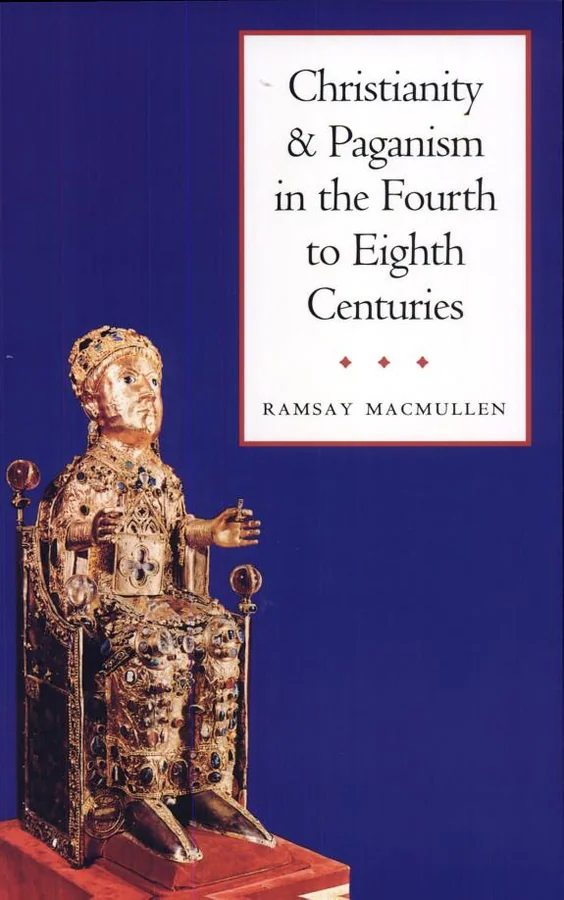
Christianity and Paganism in the Fourth to Eighth Centuries
 82
82

Christianity and Paganism in the Fourth to Eighth Centuries
MacMullen’s study offers a granular view of religious change, presenting evidence that pagan practices were not so much eradicated as absorbed and recontextualized within the expanding Christian framework. The detailed accounts of persisting rituals, like the use of bells or the continuation of sacrificial meals, are particularly compelling. However, the sheer density of historical minutiae, while its strength, can occasionally make the narrative feel somewhat fragmented. A particularly striking element is the exploration of how 'pagan' elements like processions and festivals were repurposed by the Church, blurring lines that modern scholarship often seeks to define rigidly. The book forces a re-evaluation of what 'Christianization' truly entailed for the average person in late antiquity. It stands as a solid, if dense, contribution to understanding religious syncretism.
📝 Description
82
Ramsay MacMullen's 1997 book argues that Christianization was a slow process, not a swift one.
Ramsay MacMullen's "Christianity and Paganism in the Fourth to Eighth Centuries" examines the long and often complicated integration of pagan customs and beliefs into the early Christian Church. The book shows that centuries after Christianity became the Roman Empire's official religion, many pre-Christian practices continued to appear in Christian worship and society. MacMullen uses detailed historical evidence to demonstrate a lively exchange between old and new faiths.
This work is important for scholars of late antiquity, religious historians, and anyone curious about how religious practices change over time. It suits readers who value thorough historical analysis and want to understand the material culture and daily lives of early Christians. Those who seek a deeper comprehension of how established traditions transform rather than simply vanish will find it valuable. It is especially relevant for those studying the blended nature of religious development.
The period from the 4th to the 8th centuries CE saw Christianity become the state religion of the Roman Empire with the Edict of Thessalonica in 380 CE. This marked the start of a significant religious transformation. MacMullen's study contributes to current academic discussions on the speed and character of Christianization, questioning straightforward accounts of paganism's end. He engages with the work of scholars like Peter Brown, who also studied the social history of the late Roman world.
This book fits within the broader academic study of religious history, specifically focusing on the transformation of beliefs and practices during a period of significant cultural shift. It examines how older traditions were not simply eradicated but often absorbed or adapted into a new dominant religious framework. The work contributes to understanding the complex, human process of religious change, moving beyond simplistic narratives of conquest or pure conversion. It is relevant to those interested in the historical interactions between different belief systems and the evolution of ritual and social structures within religious communities.
💡 Why Read This Book?
• Gain a nuanced understanding of religious syncretism by examining how pagan rituals, such as animal sacrifice for feasts, were integrated into Christian practices after 380 CE. • Appreciate the slow, complex process of Christianization beyond Constantine's decree, understanding that pagan customs persisted for centuries. • Analyze the material culture of early Christianity by studying specific elements like the use of bells in religious services and their pre-Christian origins.
⭐ Reader Reviews
Honest opinions from readers who have explored this book.
❓ Frequently Asked Questions
What evidence does MacMullen present for the persistence of pagan practices in Christianity?
MacMullen cites numerous examples, including the continuation of animal sacrifices for religious feasts, the use of bells in ceremonies to ward off evil, and the integration of dance into Christian services, demonstrating their endurance for centuries after official Christianization.
How does Christianity and Paganism in the Fourth to Eighth Centuries challenge traditional views of conversion?
The book argues against a simple narrative of paganism's end. It shows how conversion was a gradual, often superficial, adoption of Christian forms while older beliefs and practices continued, highlighting a complex process of assimilation rather than outright replacement.
What was the historical significance of the Edict of Thessalonica in 380 CE?
The Edict of Thessalonica, issued by Emperor Theodosius I, officially established Nicene Christianity as the state religion of the Roman Empire, marking a critical turning point in the relationship between church and state and initiating intensified efforts at religious unification.
Who was Ramsay MacMullen and what is his contribution to the study of late antiquity?
Ramsay MacMullen was a prominent historian specializing in the Roman Empire, particularly its transition from paganism to Christianity. His work is known for its detailed empirical research and its contributions to understanding the social and religious history of the period.
Does the book discuss specific pagan cults that influenced Christianity?
Yes, the work explores how elements from various pagan traditions, including sacrificial rites and festival customs, were integrated into Christian observances, illustrating a broad spectrum of influence rather than adherence to a single pagan cult.
What is the primary argument regarding the 'triumph' of Christianity presented in the book?
MacMullen reassesses the 'triumph' of Christianity by showing it was not a swift victory but a lengthy process involving significant adaptation and absorption of existing pagan cultural and religious practices, demonstrating a more complex and less absolute transformation.
🔮 Key Themes & Symbolism
Ritual Syncretism
The book meticulously details how pre-Christian rituals, such as animal sacrifice for religious feasts and the use of bells in ceremonies, were not eradicated but rather absorbed and reinterpreted within the Christian framework. This demonstrates a profound syncretism, where the outward forms of worship evolved to incorporate elements that held deep meaning for populations transitioning between faiths, illustrating the persistence of older symbolic languages within new religious structures.
The Pace of Conversion
MacMullen challenges the notion of a rapid or complete conversion following Constantine's Edict of Thessalonica in 380 CE. Instead, he presents a view of Christianization as a slow, protracted process, often characterized by superficial adherence to new doctrines while underlying pagan beliefs and practices continued. This highlights the social and cultural inertia that shaped religious change over centuries.
Material Culture of Faith
The study emphasizes the tangible aspects of religious practice, examining how physical objects and actions—like the tinkling of bells or the custom of dancing in services—carried over from paganism to Christianity. This focus on material culture provides concrete evidence of the continuity between the two religious worlds and how the sacred landscape was reshaped.
Evolving Orthodoxy
The book implicitly addresses how the definition of Christian orthodoxy itself was shaped by these interactions. As pagan elements were assimilated, the boundaries of acceptable Christian practice were constantly negotiated. Imperial decrees and theological developments played a role, but the lived experience of the populace, as depicted by MacMullen, was crucial in this ongoing formation.
💬 Memorable Quotes
Direct passages from the work, attributed to the author.
“Slaughter of animals for religious feasts persisted.”
— This highlights the continuation of ancient sacrificial practices within Christian contexts, suggesting that the symbolic meaning of these rituals was adapted rather than abandoned entirely during the transition period.
“Tinkling of bells to ward off evil during holy rites.”
— This points to the persistence of apotropaic magic within Christian worship, showing how pagan protective rituals were integrated into the Christian liturgical landscape to maintain their efficacy.
“Custom of dancing in religious services.”
— Illustrates the incorporation of ecstatic or communal movement practices from pagan traditions into Christian worship, demonstrating a blending of performative elements across religious divides.
“Christianity the one official religion of Rome.”
— This statement refers to the period after 380 CE, marking a significant shift in imperial policy that empowered Christianity but did not immediately erase all preceding religious customs.
“MacMullen investigates the transition from paganism to Christianity.”
— This expresses the core objective of the book: to analyze the complex, multi-century process by which Roman society and its religious practices transformed following Christianity's rise to prominence.
🌙 Esoteric Significance
Tradition
While not strictly an esoteric text in the vein of Hermeticism or Gnosticism, MacMullen's work is crucial for understanding the historical roots of many Western esoteric traditions. It illuminates how symbols, rituals, and belief systems from the ancient world, including pagan practices, were preserved and transmuted within the dominant Christian framework, often in suppressed or marginalized forms that later esotericists would rediscover or reinterpret.
Symbolism
The book highlights the enduring symbolism of practices like animal sacrifice, which carried ancient connotations of covenant and appeasement, and the use of bells, which in pagan contexts served apotropaic functions (warding off evil). These symbols, when carried into Christian rites, demonstrate how older layers of meaning persisted, adding a symbolic richness and continuity that resonated with the populace, even as their theological interpretation shifted.
Modern Relevance
Contemporary scholars and practitioners interested in the historical development of ritual, comparative religion, and the evolution of Western spiritual practices find MacMullen's work indispensable. It informs modern discussions on religious syncretism, the sociology of belief, and the ways in which dominant religions absorb and transform elements from preceding traditions, a process relevant to understanding contemporary spiritual movements and their often eclectic foundations.
👥 Who Should Read This Book
• Scholars of Late Antiquity and Early Christianity: Gain a detailed, evidence-based understanding of the complex process of Christianization beyond official decrees. • Researchers in Comparative Religion: Explore the mechanisms of religious syncretism and the persistence of pagan practices within a dominant monotheistic faith. • Students of Western Esotericism: Understand the historical substratum of pagan traditions that were integrated, sometimes covertly, into later Christianized societies, influencing subsequent esoteric developments.
📜 Historical Context
Ramsay MacMullen's "Christianity and Paganism in the Fourth to Eighth Centuries" emerged in a scholarly landscape deeply engaged with the social history of late antiquity. The period covered, particularly after the Edict of Thessalonica in 380 CE which declared Nicene Christianity the official religion of the Roman Empire, was a critical juncture. Scholars like Peter Brown were simultaneously exploring the lived experience of Christianity in this era. MacMullen's work directly challenged prevailing narratives that depicted a swift and total eradication of paganism. Instead, he presented meticulous evidence of the persistence and adaptation of pagan practices, arguing for a more gradual and complex process of Christianization. The book's reception was significant within academic circles, prompting further research into the syncretic nature of religious change and the material culture of early Christianity, contributing to a nuanced understanding of how established traditions transform.
📔 Journal Prompts
The persistence of animal sacrifice for religious feasts in early Christianity.
The function of bells in warding off evil during Christian rites.
Dancing as a custom within religious services during the 4th-8th centuries.
The concept of Christianization as a gradual process after 380 CE.
How the official status of Christianity influenced the continuation of pagan practices.
🗂️ Glossary
Edict of Thessalonica
An imperial decree issued in 380 CE by Roman Emperor Theodosius I, which established Nicene Christianity as the official state religion of the Roman Empire, marking a central moment in the decline of paganism.
Apotropaic
Relating to or designed to ward off evil; having protective or banishing qualities, often used in reference to charms, rituals, or symbols.
Syncretism
The amalgamation or attempted amalgamation of different religions, cultures, or schools of thought. In this context, it refers to the blending of pagan and Christian beliefs and practices.
Nicene Christianity
The form of Christianity adhering to the creed established by the First Council of Nicaea in 325 CE, which affirmed the divinity of Jesus Christ, distinguishing it from other early Christian theological interpretations.
Liturgy
A prescribed form or set of forms for public religious worship. The book examines how pagan elements influenced the development of Christian liturgy.
Late Antiquity
The historical period spanning roughly from the 3rd to the 8th century CE, characterized by significant social, cultural, and religious transformations in the Mediterranean world, including the rise of Christianity.
Imperial Patronage
The support, often financial and political, given by emperors or other rulers to religious institutions or activities, which played a significant role in the establishment and spread of Christianity.
This book appears in 1 collection
🔮 Readers Also Liked
Browse all →






From the “Paganism” Collection
View all →




More Free Witchcraft & Paganism Books
View all →







![CIA Reading Room cia-rdp75-00149r000200590003-6: PROTECTING [PRIVACY AND FREEDOM]](/img/thumb/cia-reading-room-cia-rdp75-00149r000200590003-6-protecting-privacy-and-freedom-cia-reading-room.webp)