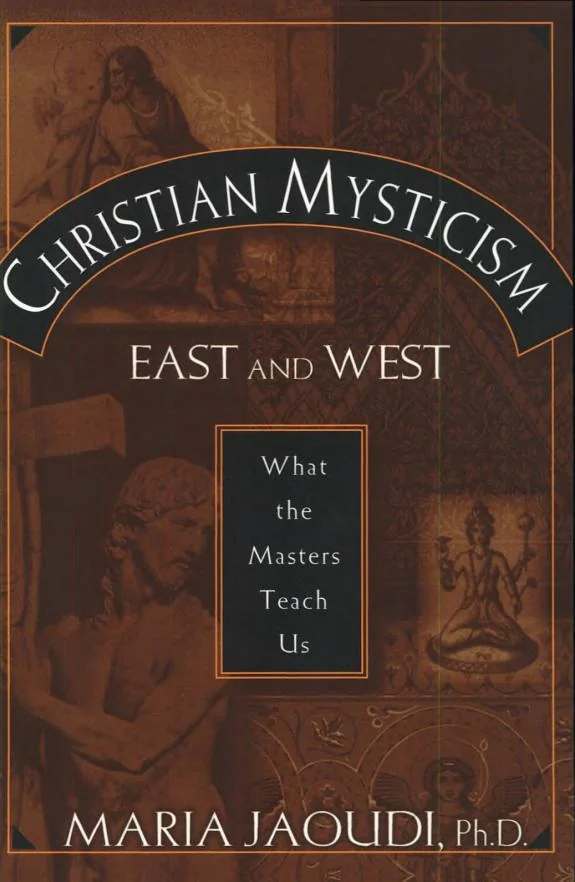
Christian Mysticism East and West
 73
73

Christian Mysticism East and West
Maria Jaoudi's Christian Mysticism East and West provides a scholarly yet accessible comparison of spiritual methodologies. Its primary strength lies in its meticulous charting of commonalities between Western Christian contemplative traditions and Eastern spiritual paths, moving beyond superficial similarities to explore shared psychological and theological underpinnings. The book excels in its detailed exploration of concepts like 'divine union' and 'inner transformation' as articulated by figures from Meister Eckhart to Shankara. A notable limitation, however, is the occasional density of academic language, which may require some readers to consult external resources. The section comparing the desert fathers' asceticism with Buddhist practices is particularly illuminating, demonstrating how shared human spiritual impulses transcend cultural boundaries. Jaoudi's work is a valuable resource for those seeking a deeper, more integrated understanding of global mysticism.
📝 Description
73
Maria Jaoudi's 1998 book compares Christian mysticism with Eastern spiritual disciplines.
Christian Mysticism East and West is a comparative study of spiritual traditions. Published in 1998, it examines the universal quest for inner transformation and divine union across various religious and philosophical systems. The book highlights how concepts of wholeness and healing appear similarly in Western contemplative practices and Eastern spiritual disciplines. Jaoudi draws parallels between Christian mystical thought and traditions like Hinduism, Taoism, Islam, and Buddhism.
This text is for students of comparative religion, esoteric philosophy, and interfaith dialogue. It will interest those seeking to understand the commonalities connecting different spiritual paths. Readers interested in the psychological and spiritual dimensions of human experience, especially as illuminated by mystical experiences, will find value here. It suits individuals engaged in personal spiritual growth who want to look beyond a single tradition.
Published in 1998, this book emerged during a time of growing interest in Eastern philosophies within Western contexts. Jaoudi's work contributes to comparative religious studies by grounding mysticism in Christian theological frameworks while engaging with non-Christian traditions. This approach offers a thoughtful perspective on spiritual traditions.
💡 Why Read This Book?
• Gain concrete insights into how the concept of 'divine union' is expressed in both Christian mysticism (e.g., via Pseudo-Dionysius) and traditions like Advaita Vedanta, offering a comparative framework for spiritual seekers. • Understand the specific practices of 'ascesis' (spiritual discipline) as detailed in the book, revealing how Christian ascetics and Eastern yogis pursued similar states of enlightenment through rigorous self-cultivation. • Learn about the historical parallels between the 1998 publication date and the burgeoning interfaith dialogue of the late 20th century, contextualizing Jaoudi's work within a specific intellectual climate.
⭐ Reader Reviews
Honest opinions from readers who have explored this book.
❓ Frequently Asked Questions
What is the primary focus of Maria Jaoudi's "Christian Mysticism East and West"?
The book primarily focuses on comparing and contrasting the mystical traditions of Western Christianity with those found in Eastern religions like Hinduism, Taoism, Islam, and Buddhism, exploring shared themes of transformation, wholeness, and healing.
When was "Christian Mysticism East and West" first published?
The book was first published in 1998, a period marked by increasing interest in comparative spirituality and interfaith dialogue.
Which Eastern traditions does the book compare with Christian mysticism?
Jaoudi’s work draws parallels with Hinduism, Taoism, Islam, and Buddhism, examining how concepts of spiritual awakening and integration manifest across these diverse belief systems.
What are the key themes explored in the book?
Key themes include spiritual transformation, the pursuit of wholeness and inner peace, and the process of healing, all viewed through the lens of both Western and Eastern mystical experiences.
Is this book suitable for beginners in comparative religion?
While scholarly, the book's comparative approach makes it accessible to serious beginners interested in understanding the common ground between global spiritual traditions.
Who is Maria Jaoudi?
Maria Jaoudi is the author of "Christian Mysticism East and West," a work that bridges theological and philosophical studies by examining mystical thought across different cultures and religions.
🔮 Key Themes & Symbolism
The Universal Path of Transformation
Jaoudi posits that the core human impulse towards spiritual evolution is universal. The book details how mystics across centuries and cultures describe a profound inner metamorphosis, often involving the dissolution of the ego and the attainment of a higher consciousness. This transformation is not merely psychological but a spiritual reorientation, a death and rebirth of the self, leading to a renewed perception of reality and one's place within it, whether viewed through the lens of Christian apophatic theology or Buddhist emptiness.
Achieving Wholeness and Integration
A central theme is the mystical pursuit of wholeness – a state of undivided being and unity with the Divine or ultimate reality. This is explored through the practices and experiences of Christian contemplatives seeking union with God and through Eastern traditions that aim for the integration of the individual self with the cosmic order. The book examines how concepts of salvation, liberation (moksha), and enlightenment all speak to this fundamental desire to overcome fragmentation and achieve a state of complete spiritual integrity.
Spiritual Healing and Restoration
The book addresses spiritual healing not as a superficial remedy but as a profound restoration of the soul to its true, unblemished state. It analyzes how mystical traditions offer pathways to healing from existential suffering, spiritual alienation, and the perceived separation from the Divine. This is presented through the example of Christian saints seeking spiritual wholeness and the therapeutic dimensions found within yogic and Buddhist practices aimed at alleviating suffering and achieving inner peace.
Asceticism as a Spiritual Tool
Jaoudi highlights the role of asceticism – disciplined spiritual practice and self-denial – as a common methodology across diverse mystical traditions. Whether it is the desert fathers' rigorous self-mortification or the yogi's disciplined meditation and fasting, the book demonstrates how these practices are employed to purify the mind and body, detach from worldly distractions, and facilitate direct experience of the sacred or ultimate truth.
💬 Memorable Quotes
Direct passages from the work, attributed to the author.
“Mystics across traditions seek a state of union.”
— This highlights the book's core argument: that despite doctrinal differences, the ultimate aim of many spiritual paths is a direct, experiential connection with the Divine or ultimate reality.
“Transformation involves the death of the old self.”
— This points to the radical nature of spiritual awakening as described by Jaoudi, suggesting that true mystical experience necessitates a profound ego-death and rebirth.
“Wholeness is the integration of the fragmented soul.”
— This expresses the concept of spiritual healing as a process of becoming complete and unified, overcoming the sense of inner division often experienced in ordinary life.
“Discipline (ascesis) prepares the vessel for divine grace.”
— This emphasizes the practical aspect of mysticism, where dedicated spiritual practices are seen as essential for creating the internal conditions necessary for profound spiritual experience.
💡 Key Ideas
Editorial paraphrase of the work's core concepts — not direct quotes.
Eastern and Western mystics share common insights.
This summarizes the book's comparative thesis, asserting that valuable spiritual wisdom can be found by examining the parallels between seemingly distinct religious and philosophical systems.
🌙 Esoteric Significance
Tradition
This work aligns with the broader esoteric tradition of comparative mysticism, seeking universal principles underlying diverse spiritual practices. While rooted in Christian contemplative theology, it departs from strict Western orthodoxy by engaging deeply with Eastern philosophical concepts, aligning it with Hermetic and Theosophical tendencies that emphasize the unity of religious experience across cultures. It fits within a lineage of scholars who sought to find the 'perennial philosophy' – a single, eternal wisdom tradition underlying all religions.
Symbolism
The book implicitly engages with symbols of 'the Way' or 'the Path,' a common motif in both Christian and Eastern spiritualities, representing the journey towards enlightenment or union with the Divine. Another key symbol explored is 'the Mirror,' often used in contemplative traditions to represent the purified soul reflecting God or ultimate reality. The concept of 'the Desert' as a place of spiritual trial and purification, central to early Christian monasticism, is also paralleled with similar ascetic landscapes in Eastern traditions.
Modern Relevance
Jaoudi's exploration remains relevant today for thinkers and practitioners interested in contemplative practices and interfaith dialogue. Contemporary figures in the 'spiritual but not religious' movement, as well as scholars of comparative religion and consciousness studies, find value in its systematic comparison. Schools of thought focusing on mindfulness, integrated spirituality, and the psychology of religion continue to draw upon such comparative analyses to understand the human quest for meaning and transcendence.
👥 Who Should Read This Book
• Students of comparative religion and theology seeking to understand the common threads in global spiritual traditions, particularly those interested in the intersection of Christian and Eastern contemplative practices. • Aspiring mystics and spiritual practitioners who wish to broaden their understanding beyond a single religious framework, learning how concepts like 'wholeness' are approached across diverse paths. • Researchers in the psychology of religion and consciousness studies looking for detailed analyses of transformative experiences and spiritual healing as documented in historical and cross-cultural mystical literature.
📜 Historical Context
Published in 1998, Christian Mysticism East and West arrived at a key moment for interfaith studies. The late 20th century witnessed a significant surge in comparative religious scholarship and a public appetite for spiritual exploration that transcended traditional boundaries. Jaoudi's work contributed to this milieu by providing a structured, academic comparison, moving beyond the more popular, often superficial, New Age syncretism that characterized some spiritual trends of the era. It engaged with the legacy of scholars like Evelyn Underhill, whose earlier work on Christian mysticism had already laid significant groundwork. While the book itself did not face notable censorship, its approach offered a nuanced perspective in a landscape where direct comparisons between Christianity and, for instance, Advaita Vedanta, were still considered by some conservative religious factions to be problematic or heretical.
📔 Journal Prompts
Reflect on the concept of 'ascesis' as presented in the book and how it might apply to modern spiritual disciplines.
Consider the parallel paths to 'wholeness' described for Christian mystics and practitioners of Hinduism.
Analyze the theme of 'transformation' through the lens of a specific Eastern tradition mentioned, such as Taoism.
Examine the idea of 'healing' as spiritual restoration, contrasting its portrayal in Western and Eastern mystical literature.
How does Jaoudi's comparison of mysticism inform your understanding of the 1998 spiritual landscape?
🗂️ Glossary
Ascesis
Spiritual discipline and rigorous self-denial practiced to purify the soul, detach from worldly desires, and achieve spiritual enlightenment or union with the Divine. Common in both Christian and Eastern mystical traditions.
Apophatic Theology
A theological approach that emphasizes what God is *not*, rather than what God *is*, often through negation and silence. Central to some Christian mystical traditions, particularly in the West.
Moksha
In Hinduism, the liberation or release from the cycle of death and rebirth (samsara). Often considered the ultimate spiritual goal, akin to salvation or enlightenment.
Taoism
An ancient Chinese philosophy and religion emphasizing living in harmony with the 'Tao' (the Way), the fundamental principle of the universe. Focuses on balance, simplicity, and naturalness.
Advaita Vedanta
A prominent school of Hindu philosophy that emphasizes the oneness of the individual soul (Atman) and the ultimate reality (Brahman), asserting that all existence is ultimately non-dual.
Ego-death
A concept in mystical and psychological literature referring to the dissolution of the sense of self or personal identity, often a precursor to profound spiritual or transformative experiences.
Pseudo-Dionysius
A 5th or 6th-century Syrian monk and theologian whose writings, particularly 'The Mystical Theology,' profoundly influenced Western Christian mysticism, introducing concepts like the divine darkness and the via negativa.
This book appears in 1 collection
🔮 Readers Also Liked
Browse all →




From the “Christian Mysticism” Collection
View all →





More Free Mysticism & Contemplation Books
View all →