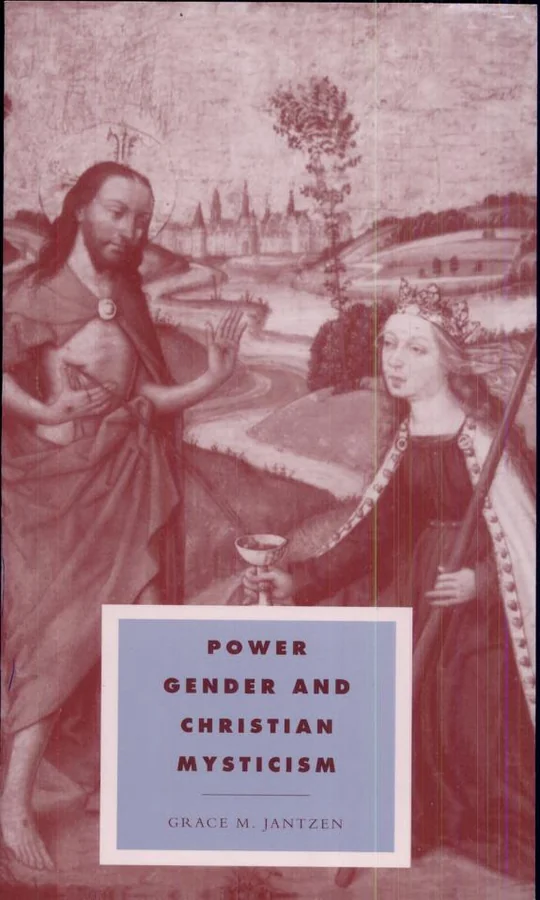
Power, Gender and Christian Mysticism
 77
77

Power, Gender and Christian Mysticism
Grace Jantzen's rigorous examination of Christian mysticism reveals a stark reality: the spiritual path, far from being universally accessible, has been a battleground for gendered power. The book's most compelling aspect is its detailed dissection of how male theologians and church authorities actively constructed and policed the boundaries of "authentic" mysticism, effectively barring women from legitimate spiritual authority. Jantzen highlights, for instance, the subtle ways in which the exclusion of women from clerical roles reinforced their marginalization within mystical discourse. While the philosophical arguments can sometimes be dense, the work's historical specificity, particularly its engagement with figures like Bernard of Clairvaux and the exclusion of women from certain monastic traditions, provides a solid foundation. The primary limitation lies in its academic tone, which may deter readers seeking a more devotional or narrative approach. Nevertheless, for its incisive critique of power within a foundational spiritual tradition, Jantzen's study remains a vital contribution.
📝 Description
77
Grace Jantzen's 1995 book examines how patriarchal structures shaped Christian mysticism's authority.
First published in 1995, Grace Jantzen's "Power, Gender and Christian Mysticism" analyzes the historical formation of Christian mystical traditions. Jantzen investigates how the definition of a mystic, typically seen as someone with direct divine access, was influenced by patriarchal systems. The book details how these power dynamics resulted in women's exclusion from recognized mystical authority, even when their spiritual contributions were significant.
This work is relevant for students and scholars of gender studies, medieval history, and religious studies. It provides a critical framework for understanding the social and political forces that mold religious authority. Individuals interested in feminist theology, the history of Christian spirituality, and the philosophical bases of religious experience will find its arguments pertinent. The book emerged in the mid-1990s, a time when feminist and post-structuralist theories prompted critical re-examinations of historical accounts.
Jantzen's study engages with the history of Christian contemplative traditions, which often positioned individuals with perceived direct experience of the divine at the center of spiritual life. By examining how gender influenced who was recognized as an authoritative mystic, she situates discussions of spiritual attainment within broader social and political frameworks. The book considers how concepts like apophatic theology, which speaks of God through negation, could be used in ways that both reinforced and potentially challenged existing hierarchies of spiritual knowledge and authority.
💡 Why Read This Book?
• Understand the historical mechanisms of exclusion: Learn how patriarchal structures in medieval Christianity, specifically through the lens of clerical authority, systematically marginalized women from recognized mystical discourse, a concept Jantzen explores through the 1995 publication. • Gain insight into the social construction of religious authority: Grasp how concepts of spiritual access and divine connection were not purely theological but were shaped by socio-political forces, as demonstrated by the book's analysis of the period surrounding its initial publication. • Analyze the philosophical implications of gender in spirituality: Discover how feminist and post-structuralist critiques, applied to Christian mysticism, reveal the power dynamics embedded in theological language and practice, offering a unique perspective on the intersection of gender and metaphysics.
⭐ Reader Reviews
Honest opinions from readers who have explored this book.
❓ Frequently Asked Questions
What is the central argument of "Power, Gender and Christian Mysticism"?
The book argues that the historical construction of Christian mysticism was significantly shaped by patriarchal power structures, leading to the exclusion of women from recognized spiritual authority and direct access to the divine.
Who was Grace Jantzen and when was this book first published?
Grace Jantzen was a scholar of religious studies and feminist theology. "Power, Gender and Christian Mysticism" was first published on November 16, 1995.
What historical period does the book primarily focus on?
While its analysis has broader implications, the book primarily examines the medieval and early modern periods of Western Christian history, detailing the exclusion of women from mystical traditions and institutions.
How does Jantzen connect gender and mystical authority?
Jantzen demonstrates how male-dominated institutions and theological interpretations defined who could be considered a mystic, thereby controlling access to spiritual authority and power, often to the detriment of women.
What academic fields would find this book most useful?
The book is highly relevant to gender studies, medieval history, feminist theology, religious studies, and the philosophy of religion due to its interdisciplinary approach.
Does the book offer a new interpretation of specific mystics?
Yes, it re-examines the historical narratives surrounding many figures, including the exclusion of women from certain monastic orders and the interpretation of their spiritual experiences within patriarchal frameworks.
🔮 Key Themes & Symbolism
Patriarchal Control of Spiritual Authority
This theme examines how male-dominated religious institutions and theological discourse actively constructed definitions of 'mysticism' that inherently favored men. Jantzen details the mechanisms by which women's spiritual experiences were either ignored, reinterpreted to fit male paradigms, or actively suppressed, thereby maintaining a hierarchy where spiritual authority was synonymous with male ecclesiastical power. The work highlights how doctrines and practices were shaped to reinforce this control.
The Social Construction of the Mystic
Jantzen argues that the very concept of the 'mystic' – one possessing direct divine knowledge – is not a universal spiritual category but a historically and socially constructed role. The book illustrates how, in the Western Christian tradition, this role was defined and policed by those in power, ensuring that only certain individuals, predominantly men, could attain recognized status and the associated authority that came with it.
Exclusionary Theological Frameworks
The work scrutinizes how specific theological interpretations and doctrines, particularly concerning gender roles and the nature of divine access, served to exclude women from the formal discourse and practice of Christian mysticism. Jantzen analyzes how concepts like obedience, silence, and the perceived spiritual inferiority of women were woven into theological arguments that justified their marginalization within spiritual movements.
Feminist Critique of Religious History
This theme positions Jantzen's book as a foundational text in the feminist re-evaluation of religious history. It demonstrates the necessity of applying critical gender analysis to understand how dominant historical narratives have been shaped by power imbalances. The book provides a methodology for uncovering the silenced voices and overlooked contributions of women in spiritual traditions, challenging established orthodoxies.
💬 Memorable Quotes
Direct passages from the work, attributed to the author.
“In the Western Christian tradition, the mystic was seen as having direct access to God, and therefore great authority.”
— This foundational statement sets up Jantzen's core argument: the perceived divine access granted to mystics was historically conflated with, and used to legitimize, earthly power structures.
“Men of power defined and controlled who should count as a mystic, and thus who would have power.”
— This highlights the central thesis that the recognition and definition of mystical experience were not objective spiritual phenomena but deliberate acts of social and political control by dominant male figures.
“Women were pointedly excluded.”
— A direct and stark assertion that captures the book's focus on the gendered nature of exclusion within the historical development of Christian mysticism and its associated authority.
“Because the mystical has gone through many social constructions, the modern ph...”
— This fragment suggests a broader philosophical point: the very idea of 'mystical' is not static but has been continually redefined by societal forces, impacting contemporary understandings of spirituality.
“Its main argument, however, is philosophical.”
— This indicates that while the book uses historical evidence, its ultimate aim is to engage with philosophical questions about knowledge, power, and the nature of religious experience itself.
🌙 Esoteric Significance
Tradition
While rooted in Christian theology and history, Jantzen's work engages with broader metaphysical questions about access to knowledge and the nature of spiritual authority. It departs from purely devotional or dogmatic interpretations by applying secular critical theory, particularly feminist and social constructionist perspectives, to understand the mechanisms of esoteric power within a religious framework. It challenges the notion of inherent spiritual truth, instead focusing on how 'truth' itself is historically mediated.
Symbolism
The book doesn't focus on overt esoteric symbols in the Hermetic or Kabbalistic sense. Instead, its symbolism lies in the structures of power themselves: the monastery as an institution, the clerical hierarchy, and the very language used to describe divine encounter. The 'symbol' of the excluded woman represents the systemic suppression of alternative spiritual epistemologies and the limitations imposed by patriarchal interpretations of divine union.
Modern Relevance
Jantzen's work remains highly relevant for contemporary discussions in feminist theology, queer theology, and critical studies of religion. Thinkers exploring the intersection of power, identity, and spirituality draw on her analysis to deconstruct contemporary religious institutions and spiritual movements. Her insights are foundational for understanding critiques of guru-figures and spiritual leaders who wield unchecked authority, particularly when gender dynamics are involved.
👥 Who Should Read This Book
• Academic researchers in gender studies and medieval history: Gain a critical framework for analyzing how power structures shaped historical narratives and institutional development within religious contexts, particularly concerning women's roles. • Students of feminist theology and spirituality: Understand the historical roots of gender inequality in religious traditions and learn how to critically deconstruct patriarchal interpretations of mystical experience and divine authority. • Philosophers of religion and social theorists: Explore the concept of the social construction of religious authority and how concepts of 'truth' and 'access' are politically mediated within spiritual traditions.
📜 Historical Context
Published in 1995, Grace Jantzen's "Power, Gender and Christian Mysticism" emerged during a critical period for feminist scholarship and the re-examination of religious history. The late 20th century saw a surge in post-structuralist and gender-based critiques applied to traditional disciplines, challenging established canons. Jantzen's work directly confronted the historiography of Christian mysticism, which had often presented a male-centric view, influenced by scholars like Bernard McGinn who focused heavily on male figures. Competing with the more traditional, hagiographical accounts of saints and mystics prevalent in earlier scholarship, Jantzen's book introduced a rigorous, deconstructive approach. Its arguments about the social construction of religious authority found echoes in broader intellectual currents questioning established power structures and seeking to recover marginalized voices. While not a widely cited contemporary in terms of direct engagement, its impact lies in its contribution to the growing body of feminist theological and historical analysis.
📔 Journal Prompts
The construction of the 'mystic' as a role defined by male power.
How theological frameworks historically excluded women from spiritual authority.
The philosophical implications of "social constructions" on religious experience.
Analyzing patriarchal control within a specific religious historical period.
Re-evaluating historical narratives of Christian mysticism through a gendered lens.
🗂️ Glossary
Mysticism
In the context of this book, mysticism refers to the direct experience of or communion with the divine, often characterized by altered states of consciousness, profound spiritual insight, and a sense of unity with God.
Patriarchy
A social system where men hold primary power and predominate in roles of political leadership, moral authority, social privilege, and control of property. In this book, it's analyzed as the force shaping religious institutions and definitions of spiritual authority.
Social Construction
The idea that concepts, understandings, and identities are developed through social interaction and historical context, rather than being inherent or natural. Jantzen applies this to the concept of 'mysticism'.
Apophatic Theology
Also known as negative theology, it describes God by denying what God is not, emphasizing the ineffability and transcendence of the divine, which can be a site for both spiritual connection and conceptual exclusion.
Spiritual Authority
The recognized right or power to guide, influence, or command others in matters of faith, doctrine, and spiritual practice, often derived from perceived direct access to divine knowledge or a sanctioned religious role.
Gender Studies
An interdisciplinary field that explores the social, cultural, and political constructions of gender, examining how these influence identity, social relations, and power structures.
Historiography
The study of the writing of history, including the analysis of historical methods, interpretations, and the biases that shape historical narratives.
This book appears in 1 collection
🔮 Readers Also Liked
Browse all →





From the “Christian Mysticism” Collection
View all →








More Free Mysticism & Contemplation Books
View all →