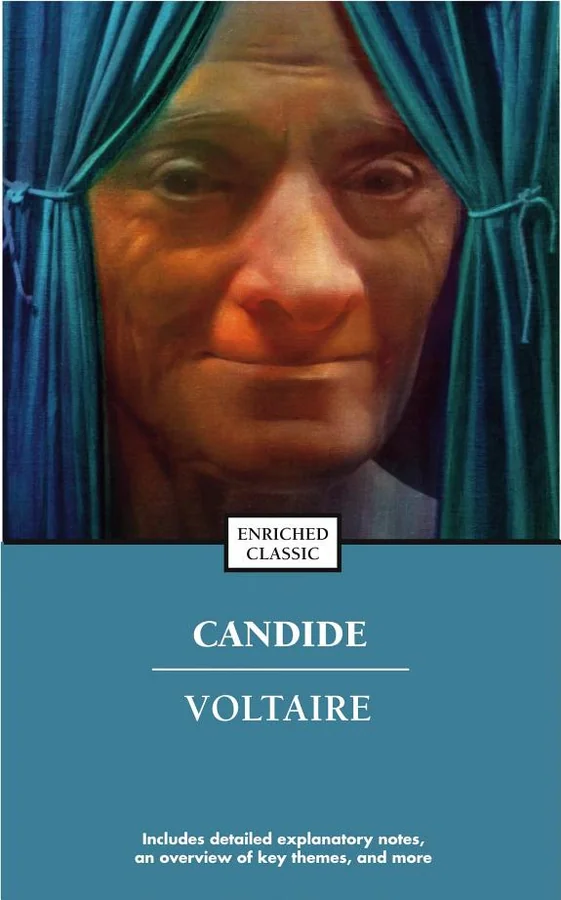
Candide
 81
81

Candide
Voltaire's 'Candide' remains a potent, if dark, amusement. Its relentless parade of calamities, designed to dismantle Pangloss's optimistic philosophy, functions with brutal efficiency. The work’s strength lies in its sharp, often cynical, wit, which skewers societal follies from religious hypocrisy to the pointless brutality of war. A particularly effective sequence details Candide’s experiences in the Spanish Inquisition, highlighting the arbitrary cruelty of established power. However, the sheer velocity of misfortune can sometimes feel less like sustained satire and more like a frantic checklist of horrors, occasionally blunting the emotional impact. Despite this, the novella's enduring power lies in its stark contrast between naive belief and brutal reality. It is a necessary, if uncomfortable, examination of human folly.
📝 Description
81
Voltaire's 1759 novella 'Candide' satirizes the philosophical idea that this world is the best possible.
First published in 1759, Voltaire's 'Candide, or Optimism' uses a seemingly simple adventure story to critique prevailing philosophical optimism. The tale follows Candide, a young man raised with the belief that everything is for the best, who is then subjected to a continuous stream of disasters. These misfortunes include banishment, war, natural catastrophes like the Lisbon earthquake, and personal betrayals. Through Candide's relentlessly negative experiences, Voltaire targets the notion that the existence of evil and suffering can be reconciled with a benevolent divine plan.
The novella's narrative structure, detailing Candide's harsh experiences across various settings, serves to dismantle the arguments for optimistic philosophy. Voltaire employs sharp wit and absurdity to question the prevailing intellectual currents of the Enlightenment. The book was controversial upon release, facing censorship due to its perceived impiety and its direct challenge to established institutions and theological explanations for suffering.
While often read as a straightforward Enlightenment satire, 'Candide' engages with deeper philosophical and theological debates that touch upon esoteric traditions. The book's direct confrontation with Leibnizian optimism and the problem of evil resonated with a desire to understand suffering's place in a divinely ordered universe. Esoteric thought often seeks explanations beyond conventional religious or philosophical dogma, and Voltaire's relentless questioning of 'all is for the best' aligns with a tradition that probes the hidden mechanics of existence and the nature of reality, even if his method was through rational critique rather than mystical revelation.
💡 Why Read This Book?
• Understand the philosophical underpinnings of Enlightenment optimism and its critique, specifically how Voltaire uses Candide's 1759 journey to challenge Leibnizian ideas. • Gain insight into the historical context of the 1755 Lisbon earthquake and its influence on Voltaire's views regarding divine providence and human suffering. • Explore the concept of 'cultivating our garden' as a practical philosophical response to existential despair, as presented in the novella's conclusion.
⭐ Reader Reviews
Honest opinions from readers who have explored this book.
❓ Frequently Asked Questions
What is the historical significance of Candide's publication year, 1759?
Published in 1759, 'Candide' was a product of the Enlightenment, a period marked by reason and skepticism. It directly challenged prevailing philosophical optimism, notably Leibniz's ideas, and faced immediate censorship due to its critiques of religion and society.
Who was Pangloss and what did he represent in Candide?
Pangloss is Candide's tutor and a caricature of philosophical optimists, particularly Gottfried Wilhelm Leibniz. He relentlessly maintains that 'all is for the best in this best of all possible worlds,' even in the face of overwhelming evidence to the contrary.
How did the 1755 Lisbon earthquake influence Voltaire's writing?
The devastating 1755 Lisbon earthquake, which killed tens of thousands, profoundly shook Voltaire's faith in optimistic philosophies that posited a benevolent, all-powerful creator. It fueled his skepticism and his critique of the idea that suffering is divinely ordained for a greater good.
What does the phrase 'cultivate our garden' mean in Candide?
Near the end of the novella, 'cultivate our garden' is interpreted as a call to practical work, community, and finding meaning in tangible efforts rather than abstract philosophical speculation. It suggests focusing on what one can control and improve directly.
Was Candide banned or censored upon its release?
Yes, 'Candide' faced significant censorship and was condemned by religious and political authorities across Europe shortly after its anonymous publication in 1759. Its satirical attacks on established institutions made it highly controversial.
What is the primary philosophical target of Voltaire's satire in Candide?
Voltaire primarily satirizes the doctrine of philosophical optimism, most notably as articulated by Gottfried Wilhelm Leibniz. He uses Candide's relentless misfortunes to expose the perceived absurdity of claiming this is the 'best of all possible worlds.'
🔮 Key Themes & Symbolism
Critique of Philosophical Optimism
The novella functions as a direct assault on the Leibnizian concept that this world, despite its apparent evils, is the absolute best possible creation of a benevolent deity. Voltaire systematically dismantles this notion through Candide's unending series of horrific experiences, from El Dorado's loss to the horrors of war and the Inquisition. Pangloss's unwavering adherence to this philosophy, even when faced with personal mutilation or the Lisbon earthquake, highlights its detachment from reality and its inadequacy as a response to suffering.
The Problem of Evil and Suffering
Candide's narrative is a relentless exploration of the problem of evil. Voltaire presents suffering not as a necessary consequence of free will or a test of faith, but as an often arbitrary and senseless affliction. The book catalogues natural disasters (earthquakes), human cruelty (war, torture, slavery), and personal betrayals, forcing the reader, alongside Candide, to confront the vastness of human and natural suffering without easy philosophical comfort.
Satire of Institutions and Dogma
Voltaire employs sharp satire to critique various societal and religious institutions. The military is depicted as barbaric, the Church as hypocritical and persecutory (especially the Spanish Inquisition), and aristocracy as often corrupt or foolish. Even seemingly utopian societies like El Dorado are ultimately found wanting or are abandoned due to Candide's inherent, albeit naive, desire for connection and his entanglement with Cunégonde.
The Turn to Practicality
The novella concludes not with a grand philosophical resolution, but with a pragmatic imperative: 'Il faut cultiver notre jardin' ('We must cultivate our garden'). This famous line suggests that the antidote to abstract philosophical despair and overwhelming suffering lies in focused, practical work and community engagement. It represents a shift from metaphysical speculation to tangible action as a means of finding meaning and coping with existence.
💬 Memorable Quotes
Direct passages from the work, attributed to the author.
“‘What is optimism?’ said Candide. ‘Alas!’ said Martin, ‘it is the mania of maintaining that all is well when it is not.’”
— This exchange between Candide and the pessimistic Martin provides a concise definition and critique of optimism. Martin’s cynical perspective offers a counterpoint to Pangloss’s unwavering belief, framing optimism as a delusion or a stubborn refusal to acknowledge harsh realities.
“‘We must cultivate our garden.’”
— The concluding statement of the novella, this is often interpreted as a call to practical labor, self-sufficiency, and finding meaning in tangible work rather than abstract philosophical debates. It suggests focusing on one's immediate sphere of influence to combat despair.
“Candide witnessed twenty-two kings of that country being shot for having tried to kill the king.”
— This absurd yet grim statement illustrates Voltaire’s satirical portrayal of political instability and the arbitrary nature of power and violence. It highlights the senselessness of conflict and the brutal consequences of political ambition.
💡 Key Ideas
Editorial paraphrase of the work's core concepts — not direct quotes.
‘It is demonstrable,’ said Pangloss, ‘that things cannot be otherwise: for, since everything is made for a purpose, everything must necessarily be for the best purpose.’
This quote captures the core tenet of philosophical optimism that Voltaire relentlessly satirizes. Pangloss's assertion, delivered even in dire circumstances, highlights the rigid, teleological reasoning he employs to justify the existence of evil within a supposedly perfect creation.
‘Is it possible that the apes of the Old World are put to death because they have the misfortune to be good to eat?’
This line, spoken by Candide, reflects his naive bewilderment at the arbitrary cruelties and injustices of the world. It uses a seemingly simple observation to question the logic behind suffering and exploitation.
🌙 Esoteric Significance
Tradition
While not explicitly aligned with a single esoteric tradition, 'Candide' engages with themes relevant to Gnosticism and Hermeticism through its critique of a flawed creation and its exploration of suffering. The Gnostic idea of a lesser creator (Demiurge) responsible for the material world's imperfections finds a parallel in Voltaire's depiction of a world rife with evil, challenging the notion of a perfectly benevolent God. The Hermetic principle of 'As Above, So Below' is implicitly questioned by the disconnect between Pangloss's lofty pronouncements and the base realities Candide faces.
Symbolism
The 'best of all possible worlds' concept serves as a primary symbolic target, representing flawed theological or philosophical systems that ignore empirical suffering. Candide himself symbolizes naive innocence and the journey of disillusionment. The recurring motif of earthquakes and natural disasters symbolizes the chaotic, indifferent forces of nature that defy rationalization. The 'garden' at the end symbolizes a turn towards practical, terrestrial concerns and personal responsibility as a means of finding meaning.
Modern Relevance
Contemporary thinkers grappling with existentialism, absurdism, and the problem of evil continue to find resonance in Voltaire's work. His critique of blind faith and unexamined optimism is pertinent in discussions surrounding technological utopianism, political ideologies, and the search for meaning in a seemingly chaotic world. Schools of thought emphasizing pragmatism and secular ethics often cite the 'cultivate our garden' conclusion as a precursor to their own focus on actionable solutions and personal agency.
👥 Who Should Read This Book
• Students of Enlightenment philosophy: To understand a key critique of Leibnizian optimism and the philosophical debates surrounding the problem of evil in the 18th century. • Readers interested in social satire: To appreciate Voltaire's masterful use of wit, irony, and exaggeration to expose the follies and hypocrisies of societal institutions and human behavior. • Individuals questioning deterministic worldviews: To engage with a narrative that challenges facile explanations for suffering and advocates for practical action over abstract speculation.
📜 Historical Context
Voltaire's 'Candide, or Optimism,' published anonymously in 1759, arrived amidst the intellectual ferment of the French Enlightenment. This era championed reason, empirical observation, and skepticism toward established religious and political authorities. The novella directly confronted the prevailing philosophical optimism, particularly the ideas of Gottfried Wilhelm Leibniz, who argued that this is the best of all possible worlds. Voltaire was deeply affected by the devastating 1755 Lisbon earthquake, an event that seemed to mock any notion of a benevolent, all-powerful creator governing a world free of gratuitous suffering. Contemporaries like Jean-Jacques Rousseau, though often critical of Voltaire, were also grappling with questions of natural law and human corruption. 'Candide' was met with immediate condemnation and censorship across Europe, solidifying its status as a radical critique of both philosophical complacency and institutionalized power.
📔 Journal Prompts
The persistent assertion by Pangloss that 'all is for the best' despite overwhelming evidence of suffering.
Candide's repeated experiences of violence and misfortune following his expulsion from the castle.
The contrast between the philosophical pronouncements of Pangloss and the pragmatic conclusion to 'cultivate our garden.'
The role of the Lisbon earthquake of 1755 as a catalyst for questioning optimistic philosophies.
The depiction of various societal institutions, such as the military and the Inquisition, as targets of satire.
🗂️ Glossary
Philosophical Optimism
A philosophical doctrine, most famously articulated by Gottfried Wilhelm Leibniz, which posits that the existing world is the best possible world that could have been created by a benevolent and omnipotent God.
Pangloss
The tutor of Candide and a caricature of a philosophical optimist. He maintains the belief that 'all is for the best' regardless of the horrific circumstances he and Candide encounter.
Theodicy
An attempt to reconcile the existence of evil and suffering in the world with the belief in an omnipotent, omniscient, and benevolent God. Voltaire's 'Candide' is a satirical critique of common theodicies.
El Dorado
A mythical land of immense wealth and happiness where everything is ordered and peaceful. Candide and Cacambo briefly visit El Dorado but ultimately leave, finding its perfection ultimately isolating.
The Lisbon Earthquake (1755)
A catastrophic earthquake, tsunami, and subsequent fires that devastated Lisbon, Portugal, killing tens of thousands. This event significantly impacted Voltaire's views on divine providence and optimism.
Satire
The use of humor, irony, exaggeration, or ridicule to expose and criticize people's stupidity or vices, particularly in the context of contemporary politics and other topical issues. Voltaire employs it heavily in 'Candide.'
Cultivate our garden
The concluding imperative of 'Candide,' suggesting a turn towards practical work, personal responsibility, and focusing on one's immediate environment as a means to find meaning and cope with existence.
This book appears in 1 collection
🔮 Readers Also Liked
Browse all →








From the “Enlightenment” Collection
View all →


More Free Occult Philosophy Books
View all →