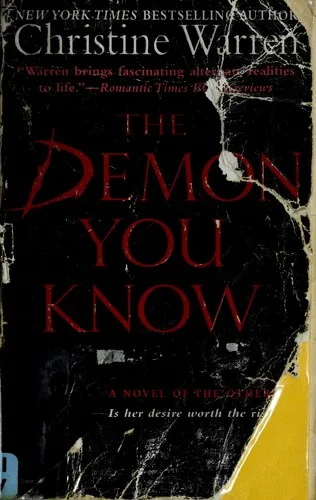
The Demon You Know
 72
72

The Demon You Know
Christine Warren's The Demon You Know approaches the subject of demonic entities with an analytical lens that is both refreshing and, at times, somewhat restrained. The strength of the work lies in its consistent effort to psychologize demonic figures, framing them as potent symbols of internal conflict rather than purely external threats. The discussion of 'threshold entities' offers a particularly intriguing perspective, moving beyond simplistic good-versus-evil dichotomies. However, the book occasionally falters in providing truly novel insights, sometimes circling back to established psychological archetypes without offering significant new interpretations. The 2007 publication date means it engages with ideas that have since become more mainstream in certain esoteric circles, making some points feel less groundbreaking now than they might have then. Warren's prose is clear and accessible, but it lacks a certain evocative power that could have amplified the book's more potent concepts. It's a solid, if not entirely revolutionary, contribution to the literature on confronting one's inner and outer shadows.
📝 Description
72
Christine Warren's 2007 book examines demonic entities not as external evils, but as reflections of the self.
Published in 2007, The Demon You Know addresses the nature of demonic entities and their connection to human experience. Christine Warren suggests that these figures are not solely external malevolent forces. Instead, she proposes they can represent inner psychological turmoil and the shadow aspects of the self. This perspective moves away from traditional fear-based narratives, aiming for a more analytical understanding of entities often misunderstood.
The book is suitable for those interested in comparative demonology, occult studies, and esoteric psychology. It will appeal to readers who wish to understand the symbolic role of demons across different mythologies and spiritual traditions. It is especially relevant for individuals exploring the shadow self, personal growth through confronting internal struggles, and the historical development of demonological ideas. Those who read esoteric subjects with a critical eye will find the depth of this inquiry rewarding.
The Demon You Know emerged in 2007 amidst growing interest in the occult and paranormal. It connects with contemporary discussions in Jungian psychology, particularly the concept of the shadow, and with modern witchcraft and neo-paganism's reinterpretation of traditional figures. While published before extensive academic study of demonology's sociology, the book contributes to ongoing cultural dialogue about evil and the human psyche.
💡 Why Read This Book?
• Gain a structured understanding of how demonic figures can be interpreted as psychological archetypes, moving beyond simple fear-based narratives. This offers a unique lens for self-exploration not found in purely theological texts. • Learn about the concept of 'threshold entities' and 'sympathetic resonance,' providing specific esoteric frameworks to analyze personal experiences and the nature of energetic interactions. • Discover practical approaches to 'willful engagement' with perceived negative forces, empowering readers with tools for conscious interaction rather than passive avoidance, as detailed in its analytical chapters.
⭐ Reader Reviews
Honest opinions from readers who have explored this book.
❓ Frequently Asked Questions
What is the main argument of The Demon You Know regarding demonic entities?
The book argues that demonic entities can be understood not just as external malevolent forces but also as symbolic representations of internal psychological struggles and shadow aspects of the human psyche.
When was The Demon You Know first published?
The Demon You Know was first published in 2007 by Christine Warren.
Does the book offer practical advice for dealing with perceived negative spiritual influences?
Yes, it explores concepts like 'willful engagement,' suggesting conscious interaction and understanding as more effective methods than passive fear when confronting perceived negative influences.
What does Christine Warren mean by 'threshold entities'?
Threshold entities, as explored in the book, are beings that exist on the boundaries between different dimensions or states of consciousness, representing liminal and transitional forces.
Is The Demon You Know suitable for beginners in occult studies?
The book is suitable for beginners who possess an analytical mindset and are interested in the psychological and symbolic interpretations of occult concepts, rather than purely practical spellcraft.
How does this book relate to Jungian psychology?
The work aligns with Jungian concepts by framing demonic figures as powerful symbols of the 'shadow self' and exploring how confronting these internal aspects can lead to personal transformation.
🔮 Key Themes & Symbolism
Psychological Shadow Archetypes
Warren posits that figures traditionally labeled 'demonic' often serve as potent symbolic representations of the human psyche's darker, unacknowledged aspects. The work encourages readers to view these entities not as external invaders but as manifestations of internal conflict, fear, and suppressed desires. This perspective draws parallels with Jungian concepts of the shadow self, suggesting that confronting these internal 'demons' is crucial for psychological integration and spiritual growth. The book explores how our own fears and unresolved issues can create a 'sympathetic resonance' that amplifies these perceived external forces.
Energetic Imprints and Resonance
A core theme involves the concept of energetic imprints and sympathetic resonance. The book suggests that places or individuals can carry residual energies from intense emotional events or prolonged exposure to certain influences, creating an 'imprint.' Furthermore, it explores how a person's internal state—their fears, beliefs, and emotional vibrations—can create a 'sympathetic resonance' that attracts or amplifies specific types of energetic phenomena, including those traditionally associated with demonic influence. Understanding this resonance is presented as key to managing one's energetic environment.
Thresholds and Liminal Entities
The work introduces the idea of 'threshold entities,' beings that occupy liminal spaces between different states of consciousness or dimensions. These entities are not necessarily inherently evil but represent transitional forces or energies that operate at the edges of our perceived reality. Their nature is often fluid and dependent on the observer's state of awareness. The book examines how these liminal forces can be encountered and the importance of maintaining psychological and spiritual equilibrium when interacting with such potent, boundary-crossing energies.
Conscious Engagement vs. Passive Fear
Warren advocates for 'willful engagement' as a more effective strategy for dealing with perceived demonic or negative influences than passive fear. The book argues that succumbing to fear often empowers these forces, whereas a conscious, analytical, and intentional approach—even if challenging—allows for understanding, containment, or transformation of the encountered energies. This theme emphasizes personal agency and the power of focused consciousness in reading through the esoteric landscape, moving away from victimhood towards empowered interaction.
💬 Memorable Quotes
Direct passages from the work, attributed to the author.
“Demons are not always external; often they are projections of our own deepest fears.”
— This interpretation highlights the book's central thesis that demonic figures can serve as powerful metaphors for internal psychological struggles, encouraging self-reflection rather than external blame.
“The imprint left by intense emotion can act as a beacon for certain energies.”
— This suggests that residual psychic energy, or 'imprints,' created by significant events can attract specific types of spiritual or energetic phenomena, influencing the atmosphere of a place or person.
“Understanding the nature of sympathetic resonance is key to managing one's energetic field.”
— This points to the idea that a person's internal state creates a vibrational match, or resonance, that can draw certain influences towards them, emphasizing the importance of inner balance.
“To face the threshold is to confront the boundaries of your own reality.”
— This captures the essence of encountering 'threshold entities,' framing such experiences as profound challenges to one's perception of self and the nature of existence.
“Fear feeds what it cannot comprehend; knowledge offers a path to mastery.”
— This captures the book's pragmatic approach, advocating for informed engagement and understanding as the most potent tools for dealing with perceived malevolent forces.
🌙 Esoteric Significance
Tradition
While not strictly adhering to a single esoteric lineage, The Demon You Know draws heavily from psychological esotericism, particularly Jungian archetypal psychology, and contemporary neo-pagan and witchcraft traditions that re-interpret traditional demonology. It departs from strict grimoire traditions by focusing on the symbolic and psychological dimensions of demonic figures rather than their invocation or banishment in a ritualistic sense. It aligns with modern esoteric thought that seeks to integrate shadow aspects of the psyche, viewing them as essential for wholeness.
Symbolism
Key symbols include the 'demon' itself, representing the shadow self or unacknowledged psychological forces. 'Thresholds' symbolize liminal states of consciousness or transitions between realities, where encounters with potent, often ambiguous, energies occur. 'Imprints' function as symbolic residues of intense experiences, acting as energetic anchors or beacons within esoteric frameworks, influencing the ambient spiritual atmosphere.
Modern Relevance
Contemporary practitioners of shadow work, depth psychology enthusiasts, and modern witches often find resonance with Warren's approach. Thinkers exploring the intersection of psychology and spirituality, particularly those who re-examine traditional religious figures through a symbolic lens, draw upon these concepts. The work remains relevant for those seeking to understand the psychological underpinnings of fear and occult phenomena in a post-traditional spiritual landscape.
👥 Who Should Read This Book
['• Students of esoteric psychology and comparative mythology: Gain a framework for understanding the symbolic and psychological roles of demonic figures across cultures.', "• Individuals interested in shadow work and personal integration: Discover how to reframe internal struggles and confront psychological 'demons' constructively.", '• Seekers exploring alternative interpretations of occult phenomena: Learn about concepts like sympathetic resonance and threshold entities beyond traditional demonological texts.']
📜 Historical Context
Published in 2007, Christine Warren's The Demon You Know arrived during a resurgence of interest in the occult and esoteric studies, partly fueled by the internet's capacity to connect like-minded individuals. While not directly engaging with specific historical occult movements like Aleister Crowley's Thelema or the Golden Dawn, the book reflects a broader contemporary trend of re-evaluating traditional mythologies and spiritual figures through psychological and symbolic lenses. This period saw a rise in comparative demonology and a growing acceptance of diverse spiritual paths. Warren's work can be seen as part of a lineage that seeks to explain figures often relegated to folklore or religious condemnation, aligning with the more analytical and psychological approaches to esoteric subjects that gained traction in the early 21st century. It engaged with popular culture's fascination with the supernatural while offering a more introspective framework, distinct from the sensationalist occultism prevalent in some circles.
📔 Journal Prompts
The concept of 'sympathetic resonance' and your personal energetic landscape.
Reflecting on personal 'thresholds' and the entities that inhabit them.
Identifying the 'imprint' of significant past experiences on your present self.
Analyzing a personal fear through the lens of a 'demon' archetype.
Practicing 'willful engagement' with a minor internal resistance.
🗂️ Glossary
Sympathetic Resonance
The principle that similar energetic frequencies attract or amplify each other, suggesting that one's internal state can resonate with and attract external influences.
Imprint
A residual energetic signature left behind by intense events, emotions, or entities in a specific location or on a person.
Threshold Entities
Beings or energies that exist on the boundaries between different states of consciousness, dimensions, or realities.
Willful Engagement
A conscious, intentional, and analytical approach to interacting with perceived spiritual or psychological forces, as opposed to passive fear or avoidance.
Shadow Self
In Jungian psychology, the unconscious aspects of the personality that the conscious ego does not identify in itself; often seen as the source of 'demonic' projections.
Esoteric Psychology
The study of the mind and consciousness from an esoteric or spiritual perspective, often integrating psychological theories with metaphysical concepts.
Liminal
Relating to a transitional or initial stage of a process, or occupying a position at, or on both sides of, a boundary or threshold.
🔮 Readers Also Liked
Browse all →









More by Christine Warren
All books →

More Free Occult Philosophy Books
View all →