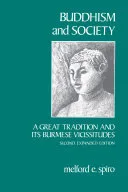
Buddhism and Society
 73
73

Buddhism and Society
Melford E. Spiro’s "Buddhism and Society" is a rigorous anthropological dissection that eschews spiritual uplift for academic inquiry. Its strength lies in its unflinching application of social science frameworks to understand Buddhist communities. Spiro’s analysis of the Theravada monk’s role, for instance, as presented in Chapter 7, highlights the tension between monastic ideals and worldly engagement, a crucial point often overlooked in popular accounts. However, the book’s dense academic prose can be a barrier for readers without a background in social theory. While it offers invaluable insights into the social construction of religious practice, its focus remains decidedly on the 'society' aspect, leaving the 'Buddhism' as an object of study rather than a source of spiritual guidance. It’s a critical examination, not an invitation to faith.
📝 Description
73
Melford E. Spiro's 1982 work, Buddhism and Society, analyzes Buddhist practices through Western social science.
Published in 1982, Melford E. Spiro's Buddhism and Society is not a guide for beginners or a devotional text. Instead, it offers an academic analysis of Buddhist beliefs and practices, viewed through the lens of Western anthropological and sociological theories. Spiro, an anthropologist himself, does not treat Buddhism as a single spiritual path. He examines it instead as a collection of diverse social phenomena.
This book is for scholars, students, and serious researchers in anthropology, sociology, and religious studies. It will appeal to those interested in cross-cultural religious analysis and who seek a critical, analytical perspective on Buddhist traditions. Spiro moves beyond popular interpretations to understand the societal roles and functions Buddhism has played in various communities. His work engaged with anthropological debates about the nature of religion and its social embedding.
While not strictly an esoteric text itself, Buddhism and Society engages with the study of Buddhism at a time when Western interest in Eastern religions was growing. Spiro's anthropological approach offered a scholarly counterpoint to the often romanticized and simplified views of Buddhism found in popularizing books of the late 20th century. His work situated Buddhist traditions within their specific social and cultural contexts, challenging universalist claims and encouraging a more critical understanding of the religion beyond its spiritual aspects.
💡 Why Read This Book?
• Gain a scholarly understanding of Buddhist practices as social phenomena, by examining Spiro's anthropological fieldwork and theoretical frameworks, moving beyond simplistic devotional views. • Understand the critical distinction between doctrine and lived religion through Spiro's analysis of how Buddhist ethics are enacted in diverse social settings, as explored in his comparative ethnographies. • Appreciate the historical context of Western scholarship on Buddhism by reading a key text from 1982 that directly addressed the popularization of Eastern religions.
⭐ Reader Reviews
Honest opinions from readers who have explored this book.
❓ Frequently Asked Questions
Is "Buddhism and Society" by Melford E. Spiro a religious text?
No, "Buddhism and Society" is an academic work of anthropology and sociology. First published in 1982, it analyzes Buddhist practices and beliefs through social science theories, rather than promoting religious doctrine.
What anthropological theories does Melford E. Spiro use in "Buddhism and Society"?
Spiro employs theories from cultural anthropology and sociology to examine Buddhist societies, focusing on concepts like social structure, ritual, and the relationship between religion and culture.
When was "Buddhism and Society" first published?
The book "Buddhism and Society" by Melford E. Spiro was first published on May 27, 1982.
Does "Buddhism and Society" discuss different schools of Buddhism?
Yes, Spiro's work comparatively examines Buddhist traditions, notably focusing on Theravada Buddhism and its social manifestations in specific cultural contexts, as detailed in his ethnographic accounts.
What is the main argument of "Buddhism and Society"?
Spiro argues that Buddhist practices and beliefs should be understood as social phenomena embedded within particular cultural and historical contexts, rather than as universal, unchanging doctrines.
Who is Melford E. Spiro?
Melford E. Spiro (1924-2011) was a prominent American cultural anthropologist known for his extensive fieldwork in Southeast Asia, particularly Burma (Myanmar), and his theoretical contributions to the study of religion.
🔮 Key Themes & Symbolism
Religion as Social Practice
Spiro's central thesis posits that religious traditions, including Buddhism, are fundamentally social constructs. He analyzes how doctrines are interpreted and practiced within specific cultural matrices, demonstrating that "Buddhism" is not a singular entity but a constellation of socially embedded traditions. This perspective challenges essentialist views and emphasizes the performative and communal aspects of religious life, exploring how rituals and monastic institutions serve societal functions.
Theravada Monasticism
A significant portion of the book scrutinizes Theravada Buddhist monasticism, particularly in its Burmese context. Spiro examines the complex relationship between the monk's pursuit of nirvana and their engagement with the lay community, which supports them materially. He examines the social roles monks fulfill beyond purely spiritual ones, questioning the degree to which monastic life aligns with or diverges from core Buddhist teachings when viewed through a sociological lens.
Doctrine vs. Lived Experience
The work meticulously dissects the gap between canonical Buddhist doctrine and the lived religious experience of practitioners. Spiro illustrates how popular beliefs and practices often diverge from or reinterpret formal teachings, influenced by local customs, psychological needs, and social pressures. This theme highlights the dynamic and often contradictory nature of religious adherence across different strata of society.
The "Western" Gaze on Buddhism
Published in 1982, "Buddhism and Society" implicitly critiques the prevalent Western tendency to romanticize or oversimplify Eastern religions. Spiro's academic rigor serves as a corrective to popularizing accounts, advocating for an analytical approach that respects the complexity and diversity of Buddhist traditions without succumbing to uncritical admiration or esoteric projection.
💬 Memorable Quotes
Direct passages from the work, attributed to the author.
“Buddhism is not a religion in the Western sense of the word.”
— This statement suggests that applying Western categories of 'religion' to Buddhist traditions may be inadequate. Spiro implies that Buddhism's emphasis on philosophy, ethics, and psychological discipline, alongside ritual, distinguishes it from Western models, particularly concerning the concept of a creator God.
“The monk is a Buddhist, but he is also a Burmese.”
— This interpretation highlights the intersection of religious identity and national/cultural identity. Spiro points out that monastic practitioners are shaped by their specific cultural context (e.g., Burmese society), influencing their behavior and the way Buddhist principles are enacted in daily life.
“The wisdom of the West has failed.”
— This phrase, used to contrast with the book's approach, reflects a sentiment prevalent in the era of its publication. It acknowledges a perceived crisis in Western thought that drove interest in Eastern religions, but Spiro intends his work to be a scholarly analysis, not part of that popular trend.
“This book is not an example of that genre [popularizing Eastern religions].”
— Spiro explicitly distances his work from the wave of books aiming to present Eastern religions to a Western audience in a simplified, often spiritualized manner. He emphasizes his commitment to scholarly rigor and critical analysis over popular appeal.
💡 Key Ideas
Editorial paraphrase of the work's core concepts — not direct quotes.
The aim of the book is to interpret Buddhism in the light of some current theories about religion.
This quote clearly states Spiro's methodological approach: using contemporary social science theories to analyze Buddhist phenomena. It signals that the book is an academic study, not a spiritual guide or historical narrative focused solely on doctrine.
🌙 Esoteric Significance
Tradition
While "Buddhism and Society" is primarily an anthropological study, its rigorous analysis of religious systems touches upon themes relevant to comparative esotericism. It departs from traditional esoteric lineages by applying secular social science frameworks rather than mystical or occult methodologies. However, by deconstructing popular understandings and examining the social realities of Buddhist practice, it offers a critical lens that can inform esoteric scholars seeking to understand the historical and cultural contexts of traditions they study.
Symbolism
Spiro's work focuses less on overt esoteric symbolism and more on the social functions of symbols within Buddhist communities. For instance, the monastic robes, while simple, signify a distinct social status and commitment, separating the monk from lay society. Similarly, the stupa or temple serves not just as a place of worship but as a community focal point, its architecture often embedding cultural values and historical narratives rather than purely esoteric meanings.
Modern Relevance
Contemporary scholars in religious studies and anthropology continue to draw on Spiro's methodological rigor in analyzing religious phenomena. His insistence on context-specific interpretation remains vital for understanding the diverse manifestations of Buddhism globally. Thinkers interested in the secularization of religion, the sociology of belief, and the anthropology of ritual find his work a foundational text for understanding how religious traditions adapt and persist within societal structures.
👥 Who Should Read This Book
• Anthropologists and Sociologists of Religion: Researchers seeking to understand the application of social science theories to religious traditions will find Spiro's analytical framework invaluable. • Students of Comparative Religion: Those studying Buddhism academically will benefit from a critical perspective that distinguishes between doctrine and social practice, as presented in his 1982 work. • Readers Dissatisfied with Popular Buddhism: Individuals seeking a more analytical and less romanticized understanding of Buddhist cultures and societies, moving beyond introductory spiritual texts.
📜 Historical Context
Published in 1982, Melford E. Spiro's "Buddhism and Society" emerged during a period of intense Western fascination with Eastern philosophies and religions, fueled partly by figures like Alan Watts and the broader counterculture movement. This era saw numerous books aiming to make Buddhist concepts accessible, often with a spiritual or therapeutic bent. Spiro’s work, however, deliberately positioned itself outside this popularizing trend, functioning as a serious academic contribution to anthropology and the sociology of religion. It engaged with prevailing theoretical debates within these fields concerning the nature of religious belief and practice. Unlike contemporaries who might focus on the philosophical underpinnings or spiritual practices, Spiro's anthropological approach emphasized the social and cultural functions of Buddhism. His critical reception highlighted its value as a rigorous, theory-driven analysis, contrasting sharply with the more devotional or introductory texts common at the time.
📔 Journal Prompts
The Theravada monk's dual identity as a religious figure and a member of society.
Spiro's distinction between Buddhist doctrine and lived religious experience.
The role of ritual in Buddhist communities as examined by Spiro.
Critiquing Western interpretations of Eastern religions as presented in the book.
The social function of monastic institutions within Buddhist societies.
🗂️ Glossary
Soteriology
The study of religious doctrines of salvation. In the context of "Buddhism and Society," it refers to how Buddhist traditions understand liberation or enlightenment and the paths leading to it.
Theravada Buddhism
A major branch of Buddhism prevalent in Southeast Asia (e.g., Sri Lanka, Thailand, Cambodia, Laos, Burma). It emphasizes the original teachings of the Buddha as preserved in the Pali Canon.
Monasticism
A religious way of life in which individuals renounce worldly pursuits to dedicate themselves to spiritual discipline, often living in communities (monasteries) under vows.
Ethnography
The systematic study of people and cultures. Ethnographic research involves immersing oneself in a particular society or community to observe and record their customs, beliefs, and social behaviors.
Canonical Doctrine
The set of beliefs, principles, and teachings that are officially accepted as authoritative within a religious tradition, typically derived from sacred texts.
Lay Practitioner
An individual who follows a religion but is not ordained as a member of the clergy or religious elite (e.g., a monk or nun). They typically engage with religious life while participating in secular society.
Nirvana
In Buddhism, the ultimate goal of spiritual practice; a state of liberation from suffering, desire, and the cycle of rebirth.