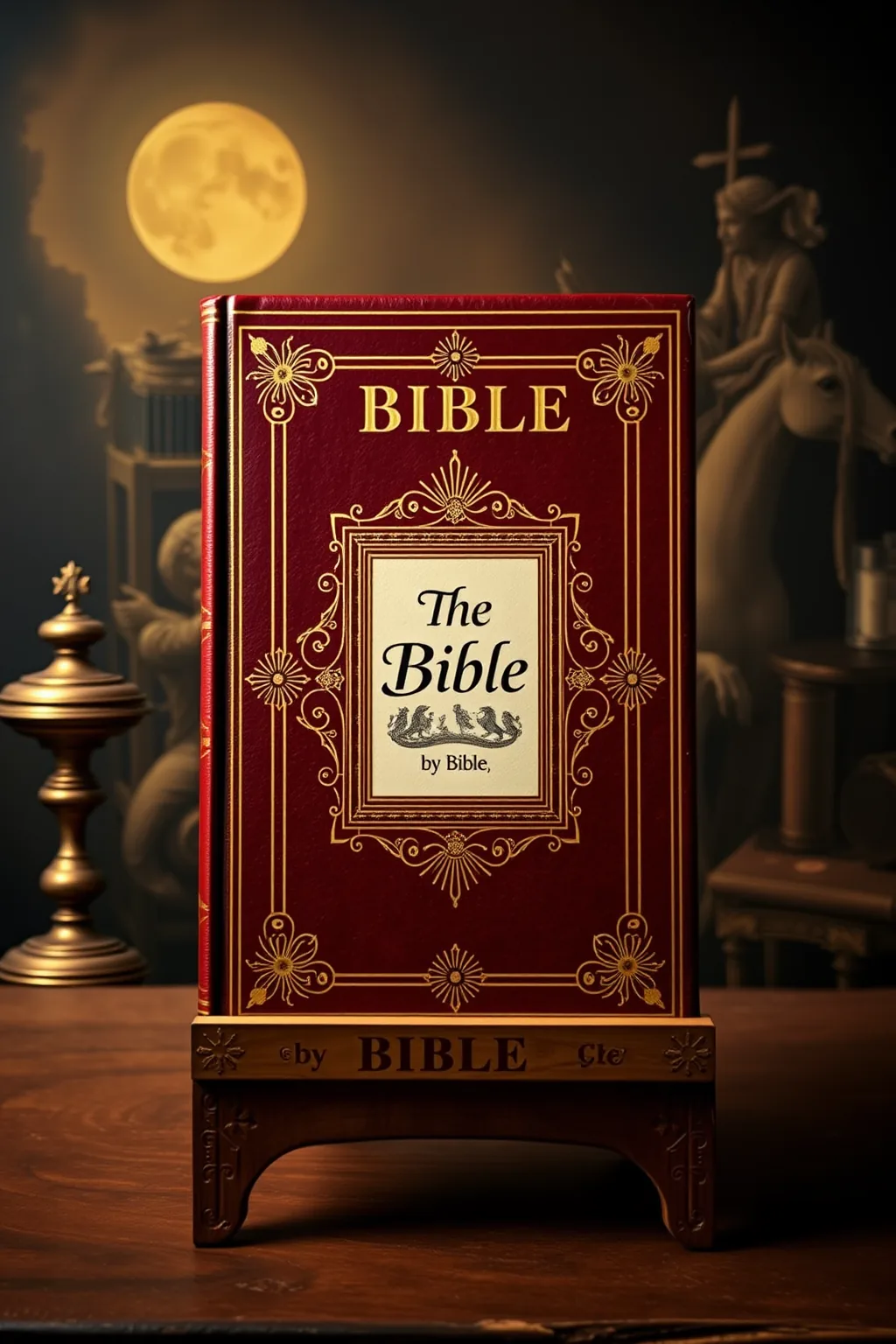
Bible
 71
71

Bible
Approaching the Bible as a text for esoteric study presents unique challenges. Its sheer volume and diverse authorship, spanning centuries of ancient Near Eastern history, defy easy categorization. While it contains passages rich with allegorical potential and symbolic depth, particularly in prophetic books and the Song of Solomon, its primary function has historically been theological and ethical instruction. The King James Version, first published in 1611, offers a specific linguistic and stylistic flavor, its Jacobean English contributing to its distinct aura. A limitation for the modern esoteric reader is the need to sift through extensive historical, legal, and genealogical material to find the more mystical strands. However, passages like the creation accounts in Genesis, or the visions of Ezekiel, offer potent imagery that has fueled esoteric interpretation for centuries. The Bible's enduring influence on Western consciousness, for better or worse, makes it a necessary, albeit complex, text for understanding esoteric traditions that arose from or reacted to its narrative.
📝 Description
71
The Bible is a collection of sacred texts compiled over centuries by various authors within ancient Israel.
This collection is divided into two main sections: the Old Testament and the New Testament. The Old Testament recounts the history, laws, and prophecies of the Israelites, focusing on their covenant with God. It includes narratives, poetry, and wisdom literature. The New Testament concentrates on the life, teachings, death, and resurrection of Jesus Christ, alongside the early Christian church. Its writings cover theological arguments, letters, and apocalyptic visions.
The compilation process spanned approximately 1,500 years, with earliest components dating to the second millennium BCE. The Old Testament canon was largely established by the 2nd century CE. The New Testament writings appeared in the 1st and 2nd centuries CE, during the Roman period and early Christian diaspora. Key figures like Paul the Apostle were instrumental in spreading Christian teachings. The translation into vernacular languages, such as the King James Version in 1611, significantly influenced religious practice and literacy.
While often viewed through its mainstream theological lens, the Bible contains elements that have been interpreted within esoteric traditions. Gnostic interpretations, for instance, often engage with the Bible's narratives and symbolism to uncover hidden spiritual meanings or alternative cosmologies. These readings may focus on specific figures, parables, or prophetic passages, seeking a deeper, allegorical understanding beyond literal or historical accounts. The concept of a divine covenant, the nature of the divine, and the path to spiritual enlightenment are themes that resonate with broader esoteric inquiries into humanity's relationship with the sacred.
💡 Why Read This Book?
• Learn about the concept of the Covenant, a foundational agreement between God and humanity central to the Old Testament, influencing later theological and philosophical discussions on divine-human relationships. • Explore the symbolism of the Exodus narrative, a pivotal event in the Old Testament that serves as a powerful metaphor for liberation and spiritual transformation in many esoteric traditions. • Understand the early theological interpretations of Jesus's life and teachings as presented in the Gospels, which have formed the basis for diverse Christian mystical paths and their understanding of divine immanence.
⭐ Reader Reviews
Honest opinions from readers who have explored this book.
❓ Frequently Asked Questions
When was the Bible first published in English?
The King James Version of the Bible, a significant English translation, was first published in 1611. This version is notable for its linguistic style and its impact on the English language.
What are the main divisions of the Bible?
The Bible is primarily divided into two major sections: the Old Testament (or Hebrew Bible) and the New Testament. The Old Testament contains texts predating Jesus Christ, while the New Testament focuses on his life and the early Christian church.
Who are considered the main authors of the Bible?
The Bible is a compilation of works by many authors across different eras. Key figures in the Old Testament include Moses, David, and various prophets. For the New Testament, prominent authors are the Apostles, such as Paul, Matthew, Mark, Luke, and John.
What is the historical significance of the Book of Genesis?
Genesis, the first book of the Bible, is significant for its creation narratives, accounts of early human history, and the establishment of patriarchal lineage. It lays the groundwork for many theological concepts and the concept of divine covenant.
How has the Bible influenced Western culture?
The Bible's influence is profound, shaping law, ethics, art, literature, and philosophy in Western civilization. Its narratives and moral teachings have provided a framework for societal values and individual spiritual exploration for centuries.
Is the Bible considered a single book or a collection?
The Bible is considered a collection of sacred scriptures, rather than a single book. It comprises 66 books in the Protestant canon, divided into the Old and New Testaments, written by various authors over approximately 1,500 years.
🔮 Key Themes & Symbolism
Divine Covenant
The Bible extensively details the concept of a covenant, a sacred agreement between God and humanity. This theme is most prominent in the Old Testament, beginning with covenants made with Noah, Abraham, and Moses. These agreements establish a framework for divine-human interaction, outlining divine promises and human responsibilities, often involving specific laws and rituals. For esoteric study, the covenant can be interpreted as an initiation into divine mysteries or a blueprint for spiritual evolution, guiding practitioners toward alignment with cosmic order.
Revelation and Prophecy
A core theme is divine revelation – God communicating His will, plans, and warnings to humanity through chosen individuals, known as prophets. Books like Isaiah, Jeremiah, and Ezekiel in the Old Testament, and prophetic passages in the New Testament, serve as conduits for this divine message. Esoterically, prophetic texts are often viewed as encoded spiritual knowledge, offering insights into cosmic cycles, future events, and the underlying spiritual reality. Interpreting these visions and pronouncements requires a symbolic and allegorical approach, seeking hidden meanings beyond literal readings.
Symbolism of Creation and Fall
The opening chapters of Genesis present foundational narratives of creation and humanity's subsequent 'fall' from a state of primal innocence. The Garden of Eden, the Tree of Knowledge, and the serpent are potent symbols frequently explored in esoteric traditions. The creation account can be seen as a cosmic emanation process, while the fall represents a descent into material consciousness or a separation from the divine source. This narrative arc provides a framework for understanding spiritual journeys of reintegration and the quest for lost paradisiacal states.
Spiritual Law and Transformation
The Bible contains extensive legal codes, most notably the Ten Commandments and Levitical laws, which can be interpreted as expressions of universal spiritual principles. Beyond the literal, these laws offer a structured path toward purification and ethical development. The New Testament shifts focus to inner transformation through grace and faith. Esoterically, these laws and teachings are seen as tools for spiritual discipline, guiding the practitioner toward a higher state of consciousness and alignment with divine will, fostering personal metamorphosis.
💬 Memorable Quotes
Direct passages from the work, attributed to the author.
“In the beginning God created the heavens and the earth.”
— This opening statement from Genesis establishes a foundational cosmological principle: the universe originates from a singular divine source. It sets the stage for understanding existence as divinely willed and ordered, a concept central to many creation myths and esoteric cosmologies.
“You shall not take the name of the Lord your God in vain.”
— This commandment from Exodus emphasizes the sacredness of divine names and the power of words. Esoterically, it points to the importance of focused intention and reverence when invoking divine principles or energies, highlighting the potential for misuse through careless or disrespectful application.
“The Lord is my shepherd; I shall not want.”
— From Psalm 23, this verse expresses profound trust and reliance on a divine guiding force. It conveys a sense of spiritual provision and protection, portraying God as a benevolent overseer who ensures the well-being of the faithful, a comforting image for those seeking spiritual solace.
“For where two or three are gathered in my name, there am I among them.”
— Attributed to Jesus in Matthew, this statement highlights the power of collective intention and spiritual community. It suggests that focused spiritual gatherings create a sacred space where divine presence is amplified, a principle fundamental to ritual and group meditation practices.
“For the letter kills, but the Spirit gives life.”
— From 2 Corinthians, this aphorism distinguishes between superficial, literal understanding and profound, spiritual insight. It advocates for seeking the living essence and transformative power behind sacred texts and doctrines, a key tenet in esoteric interpretation.
🌙 Esoteric Significance
Tradition
The Bible sits at the confluence of Abrahamic traditions, particularly Judaism and Christianity, which form the bedrock of Western esotericism. While not a direct adherent to Hermeticism or Kabbalah in its primary form, its narratives and theological concepts have been extensively reinterpreted and integrated into these lineages. Jewish mystical traditions, like Kabbalah, often employ biblical exegesis to uncover hidden divine emanations and cosmic structures, particularly through gematria and textual analysis. Christian esotericists have drawn upon the New Testament, especially the Gospels and Pauline epistles, for insights into Christ consciousness and the path of spiritual union.
Symbolism
Key symbols abound. The Tree of Life and the Tree of Knowledge in Eden, for instance, are interpreted in Kabbalistic traditions as representing divine order and the dualistic nature of manifest reality, respectively. Water is a pervasive symbol, signifying purification, the unconscious, and divine presence, as seen in the Red Sea crossing or Jesus's baptism. Light is consistently used to represent divine wisdom, enlightenment, and the presence of God, contrasting with darkness as ignorance or spiritual void. The serpent, while often depicted negatively, can also symbolize primordial wisdom or transformative energy in certain esoteric readings.
Modern Relevance
Contemporary esoteric practitioners across various disciplines continue to engage with the Bible. Modern Kabbalists draw upon its texts for deeper understanding of the Sephirot. Christian mystics and contemplative orders find enduring practices rooted in the Gospels and Psalms. Many New Age and self-help movements extract allegorical meanings related to personal empowerment, spiritual awakening, and manifestation from biblical stories. Thinkers in comparative mythology and depth psychology also analyze its archetypal narratives for universal human themes. The Bible remains a potent source for those seeking spiritual frameworks, ethical guidance, and symbolic language for the ineffable.
👥 Who Should Read This Book
• Students of Western Esotericism: Those seeking to understand the foundational texts that have influenced Kabbalah, Christian mysticism, and Hermeticism, providing context for later esoteric developments. • Comparative Religion Scholars: Researchers interested in the origins of Abrahamic faiths, examining the historical and theological evolution of monotheism and its sacred literature. • Aspiring Mystics and Contemplatives: Individuals drawn to the spiritual depths and allegorical potential within the Bible, seeking practices and insights for personal transformation and union with the divine.
📜 Historical Context
The Bible's formation occurred over a vast span of antiquity, originating within the cultural and religious milieu of the ancient Near East. Its earliest texts reflect a developing polytheistic environment before coalescing around monotheistic principles by the time of the Babylonian exile (circa 586-538 BCE). The compilation of the Old Testament canon was a complex process, influenced by scribal traditions and theological debates that continued into the early centuries CE. The New Testament emerged from the Hellenistic world of the 1st and 2nd centuries CE, a period marked by diverse philosophical schools like Stoicism and Neoplatonism, and various mystery cults. The Apostle Paul's extensive epistles, written in the mid-1st century CE, were instrumental in shaping early Christian theology and its dissemination. The reception of these texts was not uniform; various councils debated which books to include, and later, the Church of Rome often controlled access and interpretation, leading to periods of censure and the marginalization of certain Gnostic interpretations that engaged differently with biblical narratives.
📔 Journal Prompts
The concept of the Covenant as a divine promise: how does this framework inform your understanding of spiritual commitment?
Ezekiel's vision of the dry bones: what dormant aspects of your spiritual life might be reanimated by divine breath?
The Serpent in Eden: explore its symbolic representation beyond mere temptation.
The significance of the Exodus narrative for personal liberation.
Interpreting the 'letter' versus the 'Spirit' in sacred texts.
🗂️ Glossary
Covenant
A solemn agreement or pact, particularly between God and humanity in the Bible. These covenants establish divine promises and set forth obligations for the parties involved, forming a central to the Abrahamic faiths.
Monotheism
The belief in the existence of only one God. This concept is central to the Old Testament and distinguishes ancient Israelite religion from the polytheistic practices of surrounding cultures.
Prophet
An individual believed to be a messenger of God, conveying divine will, warnings, or prophecies to a community. Prophets played a central role in ancient Israelite society.
Eschatology
The theological study of the end times or final events in history, often involving divine judgment, the coming of a messiah, and the establishment of a new cosmic order. Found in both Old and New Testaments.
Gospel
Literally meaning 'good news,' this term refers to the accounts of Jesus Christ's life, teachings, death, and resurrection, primarily found in the four New Testament books attributed to Matthew, Mark, Luke, and John.
Apostle
One of the twelve disciples chosen by Jesus Christ to spread his teachings, or a significant early Christian missionary like Paul. Apostles were central to the foundation of the Christian Church.
Exodus
The second book of the Old Testament, detailing the Israelites' liberation from slavery in Egypt under Moses. It is a foundational narrative of divine intervention and national identity.
🔮 Readers Also Liked
Browse all →





More by Bible
All books →
More Free Freemasonry & Secret Societies Books
View all →