Being nobody, going nowhere
 77
77

Being nobody, going nowhere
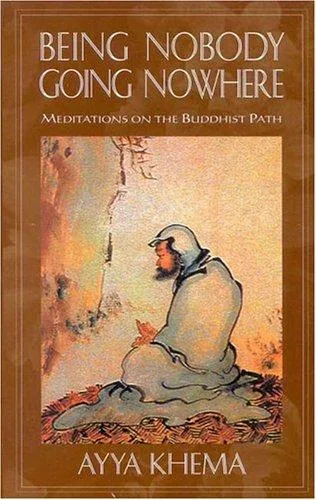
Ayya Khema’s Being Nobody, Going Nowhere cuts through the usual spiritual verbiage with the sharp clarity of a practiced hand. Her directness, particularly in the sections detailing the dissolution of self-identification, is striking. She avoids the pitfalls of spiritual bypassing, insisting on the rigorous, often uncomfortable, work of facing one’s own mind. The book's strength lies in this unflinching practicality; it’s a manual for the serious practitioner, not a casual read. However, its very directness might feel stark to newcomers, lacking the gentler scaffolding some may expect. A passage discussing the cessation of 'I' thoughts, while potent, could benefit from more varied examples to illustrate its application beyond formal sitting. Ultimately, this is an indispensable text for those ready to confront the foundations of their perceived reality.
📝 Description
77
Ayya Khema published 'Being Nobody, Going Nowhere' in 2001, offering a direct path to Buddhist meditation.
This book provides practical instruction in Buddhist meditation, focusing on cultivating stillness and insight. Ayya Khema, a Buddhist nun and teacher, draws on her extensive experience to guide readers. The text centers on the principles of mindfulness and the dissolution of the self, aiming to make these ideas accessible to Western practitioners. It is suitable for individuals who want to start or deepen their meditation practice, especially those interested in Buddhist teachings who may find extensive scholarly study daunting. The book is for sincere individuals ready to engage directly with their minds, regardless of their previous Buddhist background. It is also valuable for those seeking to use mindfulness for greater mental clarity and emotional balance.
The central idea concerns the illusory nature of the self and how liberation comes through non-attachment. Khema describes mindfulness (sati) as a practice for dismantling habitual thought patterns that cause suffering. Concepts such as impermanence (anicca), suffering (dukkha), and non-self (anatta) are presented as realities to be observed directly through sustained meditation, rather than as abstract doctrines.
Published in 2001, 'Being Nobody, Going Nowhere' arrived as Western interest in Eastern contemplative traditions grew. Ayya Khema's work offered experiential guidance rooted in Theravada and Mahayana Buddhism. Her approach provided a straightforward alternative to more academic or syncretic interpretations, appealing to those seeking authentic teachings. The book's focus on direct meditation practice aligns with a broader movement towards applying these traditions for personal development.
💡 Why Read This Book?
• Learn the core practice of Vipassanā meditation as taught by Ayya Khema, focusing on the direct observation of impermanence (anicca) and non-self (anatta) to dismantle egoic structures. • Understand the concept of 'no-self' (anatta) not as a philosophical idea but as a directly verifiable experience through sustained mindfulness, as explained in the book's practical guidance. • Gain practical techniques for cultivating equanimity amidst challenging mental states, directly applying Khema's instructions on observing thoughts without identification, a key takeaway from her teaching style.
⭐ Reader Reviews
Honest opinions from readers who have explored this book.
❓ Frequently Asked Questions
What is the primary teaching method in Ayya Khema's 'Being Nobody, Going Nowhere'?
The book primarily focuses on practical meditation instruction, emphasizing mindfulness (sati) and insight (vipassanā) as taught within the Buddhist tradition. Ayya Khema guides readers through the process of observing the mind and reality directly, aiming for experiential understanding rather than purely intellectual comprehension.
When was 'Being Nobody, Going Nowhere' first published?
The book 'Being Nobody, Going Nowhere' by Ayya Khema was first published in 2001. This places its release within a period of significant growth in Western interest in Buddhist meditation practices.
What is the significance of the title 'Being Nobody, Going Nowhere'?
The title reflects the Buddhist concept of 'anatta' (non-self) and the ultimate aim of spiritual practice, which is liberation from the cycle of rebirth and suffering. 'Nobody' signifies the dissolution of a fixed, independent self, while 'Nowhere' points to transcending conditioned existence and attachment to outcomes.
Is this book suitable for absolute beginners in meditation?
Yes, while direct and practical, the book is designed to guide sincere beginners. Ayya Khema provides clear instructions and explanations of core Buddhist meditation concepts, making it accessible for those new to the practice, though it demands commitment.
What is Vipassanā meditation as presented by Ayya Khema?
Vipassanā, or insight meditation, as presented by Ayya Khema, involves the systematic observation of one's own experience—thoughts, feelings, bodily sensations—to gain direct insight into impermanence, suffering, and non-self. It is the central practice detailed in the book.
Does the book discuss specific Buddhist deities or complex rituals?
No, 'Being Nobody, Going Nowhere' focuses almost exclusively on the core meditative practices and direct experience of the mind. It prioritizes the fundamental teachings on mindfulness and the nature of reality, largely sidestepping elaborate rituals or devotional practices.
🔮 Key Themes & Symbolism
The Illusion of Self
The book rigorously deconstructs the conventional notion of a permanent, independent 'self.' Ayya Khema argues that our sense of 'I' is a constructed phenomenon, a product of habitual thought patterns and clinging. Through practices like mindfulness of the breath and body, readers are encouraged to directly observe the impermanent nature of all mental and physical phenomena, thereby undermining the foundation of ego-centric identification. This theme is central to understanding suffering and the path to liberation, presented not as an abstract philosophical debate but as an experiential investigation.
Mindfulness as Direct Insight
Khema emphasizes that mindfulness (sati) is not mere passive observation but an active, penetrating awareness that leads to insight (vipassanā). It's the tool by which the practitioner sees through the veils of delusion and habit. The book details how to apply this sharp attention to every aspect of experience—sensations, emotions, thoughts—revealing their transient nature. This constant, clear seeing is presented as the antidote to automatic, unexamined reactions and the basis for developing wisdom and compassion.
Non-Attachment and Liberation
Central to the book's teachings is the concept of non-attachment, which arises naturally from the direct realization of impermanence and non-self. By understanding that phenomena are fleeting and that there is no fixed 'owner' of experiences, the urge to cling, crave, or push away diminishes. This process leads toward liberation (nirvana), not as a distant goal, but as a state of being free from the torment of conditioned existence and the cycle of suffering, achieved through diligent practice.
The Practice of Stillness
The book advocates for cultivating profound inner stillness as a prerequisite for clear insights. This is not a forced suppression of activity but a natural quieting that arises from understanding the mind's workings. Through sustained meditation, the reader learns to let go of mental agitation and distraction, creating a stable platform from which to observe reality as it is. This stillness is crucial for dismantling the frantic energy of the ego and realizing the peace that lies beyond conceptualization.
💬 Memorable Quotes
Direct passages from the work, attributed to the author.
“The 'I' is a thought, and when the thought ceases, the 'I' ceases.”
— This concise statement expresses the book's core message about the illusory nature of the self. It suggests that our sense of identity is not a solid entity but a mental construct, and that liberation is possible through the cessation of this identifying thought process.
“When you see things as they are, you are free.”
— This highlights the liberating power of direct, unadulterated perception. Freedom, in this context, comes not from changing external circumstances but from seeing reality clearly, free from the distortions of personal bias, desire, and aversion.
“Meditation is not a way to escape from reality, but a way to enter into it.”
— This clarifies the purpose of meditation as presented by Ayya Khema. It's not about avoiding life's difficulties, but about developing the clarity and presence to engage with reality authentically and deeply.
“There is no fixed self to protect or aggrandize.”
— This directly addresses the ego's constant drive for self-preservation and enhancement. By pointing to the absence of a permanent self, Khema encourages practitioners to let go of this futile and exhausting endeavor.
“The goal is to see clearly what is impermanent.”
— This emphasizes the central role of recognizing impermanence (anicca) in the Buddhist path. It suggests that understanding the transient nature of all things is key to reducing attachment and suffering.
🌙 Esoteric Significance
Tradition
While rooted firmly in the Buddhist tradition, specifically drawing from Theravada and Mahayana streams, Ayya Khema's presentation in *Being Nobody, Going Nowhere* possesses an esoteric quality through its direct focus on experiential realization and the dissolution of conventional reality constructs. It bypasses elaborate philosophical systems to engage directly with the mind's nature, a characteristic often found in esoteric paths that prioritize inner transformation over external dogma. The emphasis on seeing through illusion aligns with Gnostic or certain mystical traditions that seek direct knowledge of ultimate reality.
Symbolism
The book uses minimal overt symbolism, favoring direct experiential instruction. However, the title itself functions symbolically: 'Nobody' represents the absence of a fixed, independent self (anatta), a core Buddhist concept often explored esoterically. 'Nowhere' signifies transcending conditioned existence, the cycle of rebirth (samsara), and attachment to specific states or outcomes, pointing towards an unconditioned reality. The practice of observing the breath, a fundamental meditative technique, can be seen as a symbol of life-force and the constant flux of existence.
Modern Relevance
Ayya Khema's work remains highly relevant today, particularly for contemporary mindfulness practitioners and those exploring Buddhist philosophy outside of traditional religious structures. Her clear, no-nonsense approach speaks to secular mindfulness movements and individuals seeking practical, non-dogmatic methods for mental clarity and emotional regulation. Thinkers and practitioners focused on non-duality, the nature of consciousness, and the deconstruction of identity continue to find value in her direct teachings, which offer a potent antidote to the pervasive sense of self in modern culture.
👥 Who Should Read This Book
• Individuals seeking a direct, practical introduction to Buddhist meditation, particularly Vipassanā, who appreciate clear, unembellished instruction. • Practitioners disillusioned with overly academic or therapeutically diluted approaches to mindfulness, looking for authentic teachings rooted in monastic tradition. • Serious students of the Dharma interested in directly investigating the concepts of impermanence (anicca) and non-self (anatta) through sustained meditation practice.
📜 Historical Context
Published in 2001, Ayya Khema's *Being Nobody, Going Nowhere* arrived as Western Buddhism was maturing beyond initial popularization. The late 20th and early 21st centuries saw a surge in interest in mindfulness and meditation, often detached from specific cultural or religious contexts. Khema's work, however, offered a clear lineage to Theravada and Mahayana traditions, providing rigorous, unadorned instruction. This contrasted with more syncretic or therapeutically focused approaches gaining traction, such as those championed by figures like Jon Kabat-Zinn with MBSR (Mindfulness-Based Stress Reduction). Her direct, authoritative style, honed through decades of monastic practice in Asia and teaching globally, appealed to those seeking authentic, experiential teachings, positioning her book as a significant contribution to the serious study and practice of Buddhist meditation in the West.
📔 Journal Prompts
The cessation of the 'I' thought: Explore moments where the sense of self momentarily dissolves.
The nature of impermanence: Observe three fleeting sensations or thoughts and their passing.
Direct insight into reality: Document an experience where seeing 'things as they are' brought clarity.
The practice of stillness: Reflect on the challenges and benefits of cultivating mental quietude.
Non-attachment to outcomes: Analyze a situation where letting go of a desired result proved difficult.
🗂️ Glossary
Anatta
A core Buddhist concept meaning 'non-self' or 'no-self.' It refers to the doctrine that there is no permanent, unchanging, independent self or soul underlying existence. Understanding anatta is crucial for liberation from suffering.
Anicca
The Pali word for impermanence. It denotes the fundamental characteristic of all conditioned phenomena—that they are in a constant state of flux and change. Recognizing anicca is a key insight in Buddhist meditation.
Often translated as 'suffering,' 'dissatisfaction,' or 'stress.' It is one of the Three Marks of Existence in Buddhism, referring to the inherent unsatisfactoriness of conditioned existence due to impermanence and the illusion of self.
Sati
Pali word for mindfulness or awareness. It involves paying attention in a particular way: on purpose, in the present moment, and non-judgmentally. It is the foundation of Buddhist meditation practice.
Vipassanā
Meaning 'insight' meditation. It is a practice of developing insight into the true nature of reality, particularly the characteristics of impermanence, suffering, and non-self, through careful observation of one's own experience.
Ego
In this context, refers to the conditioned sense of self, the 'I' that arises from clinging, identification, and habitual thought patterns. The book aims to deconstruct this ego-construct.
Clinging
The mental act of grasping onto pleasant experiences, avoiding unpleasant ones, and holding onto the idea of a self. It is identified as a primary cause of suffering in Buddhist teachings.
🔮 Readers Also Liked
Browse all →








More by Ayya Khema
All books →
More Free Spiritual Development Books
View all →