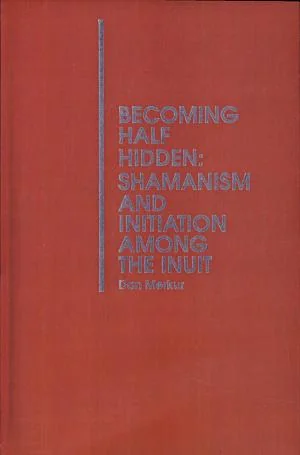
Becoming half hidden
 76
76

Becoming half hidden
Daniel Merkur’s 'Becoming Half Hidden' offers a rigorously argued exploration of consciousness and self-perception, distinguishing itself through its intellectual depth. Merkur avoids the pitfalls of New Age platitudes, instead presenting a well-researched analysis that challenges conventional notions of identity. A particular strength lies in his detailed examination of how symbolic language shapes our inner landscape, as seen in his discussion of archetypal imagery. However, the book’s academic tone, while a strength for some, might prove dense for readers seeking a more immediately experiential approach. One particularly striking passage discusses the 'shadow self' not as a mere Freudian concept but as a fundamental aspect of being that, when integrated, can lead to a more complete self-awareness. Overall, 'Becoming Half Hidden' is a significant contribution for serious students of the psyche and esoteric philosophy.
📝 Description
76
Daniel Merkur's 2016 book examines the relationship between inner worlds and outward reality.
Published in 2016, 'Becoming Half Hidden' by Daniel Merkur analyzes how internal experience and external events connect. Merkur does not offer simple instructions but instead investigates the psychological and spiritual forces that shape how we understand the world and our position in it. His writing is academic but remains accessible, drawing on a broad base of historical and philosophical ideas to build his arguments. The book addresses how individuals create their own realities, frequently with an incomplete grasp of the forces at play. Merkur suggests that genuine insight often demands accepting contradiction and uncertainty. He discusses the nature of self, the way symbols organize perception, and how altered states of awareness might uncover hidden truths.
Emerging in the early 21st century, a period of renewed interest in consciousness studies and esoteric traditions, Merkur's work contributes to ongoing discussions about the mind and spirit. It aligns with traditions that explore the structures of consciousness and the symbolic language of experience, drawing implicit connections to figures like Carl Jung and his work on archetypes. The book engages with the history of thought concerning mysticism and psychological phenomena, aiming for a perspective that avoids oversimplification.
💡 Why Read This Book?
• Gain a nuanced understanding of how symbolic systems, particularly archetypal imagery, shape your perception of reality, a concept Merkur meticulously details. • Explore the philosophical implications of consciousness studies and esoteric traditions, moving beyond surface-level explanations of inner experience. • Discover how the concept of the 'shadow self' can be integrated for greater self-awareness, as presented in Merkur's specific analytical framework.
⭐ Reader Reviews
Honest opinions from readers who have explored this book.
❓ Frequently Asked Questions
What is the central argument of Daniel Merkur's 'Becoming Half Hidden'?
The central argument explores the complex relationship between internal psychological states and external reality, proposing that our perception is profoundly shaped by symbolic structures and often operates with an incomplete awareness of underlying forces.
When was 'Becoming Half Hidden' first published?
'Becoming Half Hidden' by Daniel Merkur was first published in 2016, reflecting contemporary scholarship in consciousness and esoteric studies.
Does the book offer practical exercises for self-transformation?
While the book is analytical rather than prescriptive, its exploration of concepts like the shadow self and symbolic language provides a foundational understanding for personal development.
What academic fields does Merkur draw upon in this work?
Merkur draws upon psychology, philosophy, comparative religion, and the history of esoteric traditions, building a multidisciplinary approach to understanding consciousness.
Is 'Becoming Half Hidden' suitable for beginners in esoteric studies?
It is best suited for readers with some background or serious interest in esoteric philosophy and psychology, as it delves into complex theoretical concepts.
How does Merkur's work relate to Carl Jung's ideas?
Merkur's work shares Jung's interest in archetypes and the unconscious but offers its own distinct analytical framework for understanding their role in self-perception and reality construction.
🔮 Key Themes & Symbolism
Symbolic Structuring of Reality
Merkur investigates how symbols are not merely representations but active agents that shape our perception of the world and ourselves. He examines how archetypal patterns, ingrained in the collective unconscious, influence individual consciousness, creating frameworks through which experiences are filtered and understood. This theme underscores the idea that our reality is, in part, a construct built upon these symbolic foundations, influencing everything from personal identity to societal norms.
The Nature of Selfhood
The book probes the complex nature of the self, challenging monolithic views of identity. Merkur explores the 'half hidden' aspect of our being, suggesting that much of our psyche remains obscured, influencing our actions and beliefs without our full awareness. He discusses the integration of various psychic components, including the shadow, as crucial for a more complete and authentic self-understanding.
Consciousness and Perception
A core focus is the exploration of consciousness as a dynamic and often fluid state. Merkur analyzes how different states of awareness, including those influenced by symbolic immersion or psychological introspection, can alter our perception of reality. The work considers how the boundaries of the self can become permeable, allowing for a deeper connection with underlying psychological and spiritual currents.
Integration of the Shadow
Merkur addresses the concept of the 'shadow self,' not merely as a Freudian construct but as an integral, often disowned, part of the psyche. The book argues that acknowledging and integrating these hidden aspects are essential steps toward wholeness and a more honest engagement with oneself and the world. This process is presented as vital for moving beyond a fragmented sense of identity.
💬 Memorable Quotes
Direct passages from the work, attributed to the author.
“The self is not a fixed entity but a fluid process.”
— This interpretation suggests that Merkur views identity not as something static, but as an ongoing development shaped by internal and external factors, constantly evolving.
“Symbols act as bridges between the visible and the invisible.”
— This highlights Merkur's view on the power of symbolism, positing that symbolic language and imagery serve as essential mediators, connecting our conscious awareness to deeper, often unconscious, realities.
“The shadow, when acknowledged, ceases to exert unconscious control.”
— This interpretation emphasizes Merkur's perspective on the shadow self; by bringing it into conscious awareness, its power to dictate behavior from the background is diminished, fostering greater agency.
“Our perceived reality is deeply influenced by the symbolic lexicon we employ.”
— This suggests that the way we understand and interact with the world is fundamentally shaped by the symbolic language and frameworks we unconsciously adopt and utilize.
💡 Key Ideas
Editorial paraphrase of the work's core concepts — not direct quotes.
To be 'half hidden' is to live with a partial awareness of one's own being.
This paraphrased concept points to Merkur's central idea that individuals often operate with an incomplete understanding of their own psyche, a state of being partially obscured from oneself.
🌙 Esoteric Significance
Tradition
Merkur’s work can be situated within the broader lineage of Western esotericism, particularly its psychological and philosophical branches. While not overtly aligned with specific schools like Hermeticism or Kabbalah, it shares an interest in the hidden structures of reality and consciousness that these traditions explore. His approach draws heavily on analytical psychology, a key development in 20th-century esoteric thought, and his exploration of the self and symbol appeals to Gnostic concerns about hidden knowledge and fragmented being.
Symbolism
Key symbols in 'Becoming Half Hidden' include the 'shadow,' representing the disowned or unconscious aspects of the self, and the 'hidden,' signifying obscured knowledge or potentials. Merkur treats these not just as abstract concepts but as active forces shaping perception. The 'bridge' is another motif, symbolizing the connection between conscious and unconscious realms, and the means by which insights from the hidden aspects of being can be integrated into everyday awareness.
Modern Relevance
Contemporary thinkers and practitioners in fields like depth psychology, comparative mythology, and integral spirituality find resonance in Merkur's work. His analytical rigor provides a valuable counterpoint to more purely experiential or dogmatic approaches. Modern researchers into consciousness, self-awareness, and the impact of symbolic frameworks on cognition can draw upon his insights for a more integrated understanding of the human psyche.
👥 Who Should Read This Book
• Students of analytical psychology and comparative mythology seeking to understand the interplay of archetypes and personal identity. • Philosophically inclined readers interested in the construction of reality and the nature of consciousness, who appreciate rigorous theoretical exploration. • Esoteric practitioners and scholars looking for a sophisticated, non-dogmatic analysis of selfhood, symbolism, and the hidden dimensions of the psyche.
📜 Historical Context
Daniel Merkur's 'Becoming Half Hidden', published in 2016, emerged during a period of continued academic and popular engagement with consciousness studies, Jungian psychology, and the history of esoteric thought. This era saw a resurgence of interest in how ancient wisdom traditions intersect with modern psychological theories. Merkur's work contributes to this ongoing discourse, offering a sophisticated analysis that parallels the efforts of scholars like Richard Rudgley, who explored the anthropological and historical dimensions of altered states and shamanism. Unlike more purely mystical or devotional texts, Merkur’s approach is grounded in critical analysis, engaging with philosophical concepts and psychological frameworks. The intellectual currents he navigates include those influenced by Carl Jung's pioneering work on archetypes and the collective unconscious, a concept Merkur implicitly engages with throughout the book.
📔 Journal Prompts
The 'half hidden' nature of the self: What aspects of your own being feel most obscured?
Reflect on a personal symbol: How does this symbol structure your understanding of a particular experience?
The shadow as an integrated force: How might acknowledging a disowned trait lead to greater wholeness?
The function of archetypal imagery: Identify a recurring pattern in your life that mirrors a universal theme.
The relationship between inner states and outer reality: How does your internal landscape color your perception of external events?
🗂️ Glossary
Shadow Self
In Merkur's context, this refers to the disowned, unconscious, or repressed aspects of the personality that, when unacknowledged, can exert an unconscious influence on behavior and perception.
Symbolic Lexicon
The collection of symbols, images, and conceptual frameworks through which an individual or culture interprets and understands reality. Merkur emphasizes its active role in shaping perception.
Archetypal Imagery
Universal patterns or motifs that emerge from the collective unconscious, representing fundamental human experiences and psychological structures, as theorized by figures like Carl Jung.
Consciousness
The state of being aware of and responsive to one's surroundings; Merkur explores its fluid nature and its deep connection to symbolic processes and self-perception.
Perceived Reality
The subjective experience of the external world, which Merkur argues is significantly constructed and influenced by internal psychological states and symbolic frameworks.
Integration
The process of incorporating various aspects of the psyche, including the shadow, into a cohesive and conscious sense of self, leading to greater wholeness.
Half Hidden
A state of being where significant portions of one's own psyche, motivations, or the underlying structures of reality remain unknown or unacknowledged to the individual.
🔮 Readers Also Liked
Browse all →









More by Daniel Merkur
All books →


More Free Occult Philosophy Books
View all →