Johann Joseph von Görres was a German writer and philosopher who explored Christian mysticism and defended church authority.
Johann Joseph von Görres (1776–1848) was a multifaceted German figure, known as a writer, philosopher, theologian, historian, and journalist. Initially drawn to the French Revolution, his views shifted after witnessing French administration in the Rhineland. He became a prominent voice in German intellectual circles, particularly associated with the Heidelberg Romantic movement. Görres engaged in political journalism, founding the influential newspaper Der rheinische Merkur, which advocated for German unity under imperial rule. His writings also delved deeply into theological and philosophical subjects, culminating in extensive work on Christian mysticism and a strong defense of papal authority.
Early Life and Political Evolution
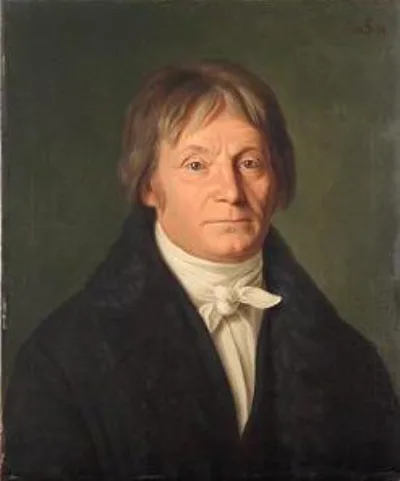
Born in Koblenz, Görres received a Jesuit education. His early sympathies lay with the French Revolution, but his experiences and observations, particularly his diplomatic mission to Paris in 1799, led him to abandon his republican ideals. He became critical of French governance in the Rhineland and later advocated for a united Germany under an emperor. During Napoleon's rule, he lived a quieter life, focusing on scholarship and teaching. He was married and had a career as a secondary school teacher in Koblenz and lectured at Heidelberg University. His appearance was noted for its striking intensity by contemporaries like Henry Crabb Robinson and Clemens Brentano.
Journalism and Political Activism
Görres became a prominent journalist, founding Der rheinische Merkur in 1814. This publication strongly opposed Napoleon and championed the idea of a unified Germany. Its outspokenness earned it Napoleon's attention, who reportedly called it "a fifth power." The newspaper also called for a representative government and a Prussian constitution. Despite warnings from censorship authorities, Görres persisted, leading to the suppression of the Merkur in 1816 and his dismissal from his teaching position. He continued his political writing, publishing tracts that analyzed revolutions and advocated for public opinion, which led to further suppression and arrest orders, forcing him to flee.
Exploration of Mysticism and Ultramontanism
Following his political struggles, Görres shifted his focus more intensely towards theological and mystical studies. He developed a profound interest in Christian mysticism, examining medieval mystics and contemporary ecstatic phenomena. This research culminated in his four-volume work, Christliche Mystik. Later in life, he became a staunch defender of the Catholic Church's authority, embracing Ultramontanism. His polemical work, Athanasius, defended church power against state interference, sparking significant controversy. He continued to write on these themes in the Historisch-politische Blätter with his son, Guido.
Key Ideas
- Critique of the French Revolution's impact on governance and society.
- Advocacy for German national unity under an imperial system.
- Exploration and exposition of Christian mysticism.
- Defense of the Catholic Church's authority and power (Ultramontanism).
Notable Quotes
“Görres has the wildest physiognomy – looks like an overgrown old student. A faun-like nose and lips, fierce eyes, and locks as wild as Caliban’s. Strong sense, with a sort of sulky indifference toward others, are the characteristics of his manner.”
“The public morals, corrupted as they were from the high to the lower classes of society, abjured the aid of the clergy: in the dissolution of all the principles of justice and morality, nought remained unconsumed, save the consuming power itself — wit, which now not as a creative, but as a destroying spirit, brooded over the abyss. The literati, who had formerly gone to court, now, after having there finished their schooling, turned to the people and preached to them another doctrine — of the God who resided in matter, of the Heaven to be found in the senses, of morality that consisted in cunning, and of the felicity that voluptuous indulgence afforded; and that all beside was the vain deception and jugglery of priests, whether at court or in the Church. That warm genial view of the Middle Age, which, in the same way as antiquity gave life to mountains, springs, and trees, looked on the state in all its members and parts as a thing endued with vitality, and procured for them, as so many essential personalities, love and attachment; that warm ennobling view had long since passed away. In room of this, the doctrine of political materialism had descended from the high to the lower regions of society, and for warm life had substituted cold abstractions, cyphers, and rigid geometrical forms, which cut sharply into private life; and for such dead abstractions it was impossible to feel affection. The portion of the nobility that sank into degeneracy at court, incurred the contempt of the people. The better part, who residing on their estates, still cultivated many ancient virtues, were, as holding extensive landed possessions in the face of grinding poverty, objects of hatred; and their consideration was undermined by the arrogance and ever increasing wealth of the monied class. Thus all bonds were relaxed, in proportion as the inward expansion of all relations increased. Authority sometimes, with a good-natured imprudence, assisted in the destruction; sometimes terrified, struggled against it in impotent opposition, by means of her police and bastilles, and then again sent her armies over the Atlantic, in order to visit in America the school of freedom. Thus all was prepared for the stroke; and when the same want of money, which through the indulgencies had led to the Reformation, necessitated the convocation of the three estates, the Revolution broke out.”
Books by
4 free public domain books · Read online or download